
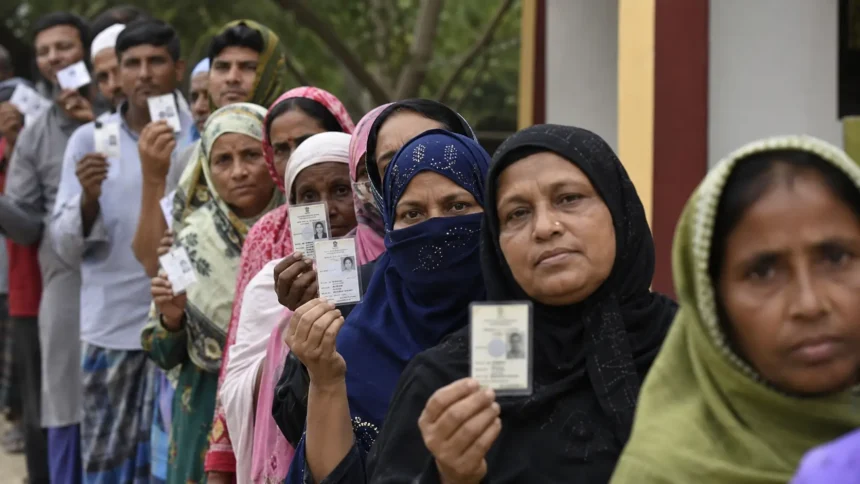
In fact, for the last decade or so, West Bengal’s political landscape had appeared very stable and quite predictable to political commentators. The party in power, the All India Trinamool Congress (TMC), had been able to keep near total control of the state for the most part, their main backing coming from a solid and steady minority vote. But the recent election outcomes have left the locals surprised and brought to light a significant shift in voting behavior. The Bharatiya Janata Party (BJP), has managed to break through the areas that people thought it was impossible to do so, by exploiting a divided minority vote which has changed the political map of the state significantly.
The Statistical Reality of a Changing Tide
The most glaring evidence of this political metamorphosis lies in the shifting seat tallies across three crucial minority-dominated districts: (Murshidabad, Malda and Uttar Dinajpur). Traditionally, these places were almost like the stronghold of TMC. However, the political scenario in the 43 assembly constituencies in these districts changed completely.
BJP pulled off a great move displaying a major jump as it increased its strength from only eight seats in 2021 to a powerful nineteen. In contrast, TMC’s stronghold weakened as their number of seats went down from 35 to 22. The CPI(M), the Indian National Congress and within local ones like the Aam Janata Unnayan Party (AJUP) took over the remaining constituencies. This change in the division of the seats was not only a winning step for the saffron party continue; it also showed a serious loss of the TMC’s most reliable support base.
The Murshidabad Metamorphosis
To understand the mechanics of this shift, one must look at Murshidabad. Boasting a Muslim population of over 66%, the district was the ultimate TMC fortress. In the 2021 elections, the ruling party captured an overwhelming 20 out of 22 seats. Fast forward to the most recent contest, and the TMC’s haul was slashed to just nine. Astoundingly, the BJP matched this number, leaping from two seats to nine.
This drastic equalization was largely driven by a splintered electorate. In battlegrounds like Rejinagar, Nowda, Raninagar, and Domkal, the minority vote was no longer cast as a unified bloc. Instead, it was scattered across multiple candidates from the Congress, Left, and AJUP.
Adding fuel to the political fire was the Special Intensive Revision (SIR) of electoral rolls, which resulted in the deletion of approximately 7.8 lakh names in Murshidabad. While the TMC leadership vocally blamed these purges for their diminished margins, political analysts argue a different reality. The data suggests that even with the deletions, it was the diffusion of the remaining minority votes among various opposition players that truly kneecapped the TMC.
The Dual Strategy: Fragmentation Meets Consolidation
Elections are rarely decided by a single variable. While the TMC suffered from a splintered minority base, the BJP benefited immensely from a reverse phenomenon: the aggressive consolidation of Hindu votes. The BJP managed to use this united demographic in places like Nabagram and Kandi to win the seats that, if only two parties had been contesting, would have been simply impossible for them to win mathematically. In fact, this double movement – breaking the TMC’s voters and at the same time creating a loyal base for the BJP – was exactly the recipe that changed the entire equation.
Ripple Effects Across the State
This issue was far from Murshidabad alone. In Malda, a splintered opposition gave a chance for BJP to raise their presence from four seats to six, whereas Congress took just enough votes away from TMC to kill its chances. Likewise, in Uttar Dinajpur, the BJP quadrupled its foothold from two seats to four, at the same time, the TMC dropped from seven seats to five. In numerous segments here, the total vote share of the Left-Congress combination was bigger than the margin by which TMC lost, TMC division equals defeat perfectly illustrated by this. Besides, distant murmurs of this phenomenon were also heard in Birbhum and South 24 Parganas, indicating this to be a whole state’s mentality change rather than a small area’s anomaly.
The Machinery of Politics: BJP vs. The Opposition
Leaving aside local demographics, these findings clearly point toward the poor condition of Indian political parties. Gradual but sure changes have led BJP to develop a flexible and well-organized political machinery after the 2024 General Elections. This is exactly why the BJP conducts thorough post-election analyses of their failures, changes the political message, and very carefully implements the plans made by top leaders, as the recent activities of BJP in West Bengal and Assam prove.
On the very opposite side is the INDIA bloc. No matter how well they have performed recently, the opposition coalition is still unable to function properly due to continuous disagreements, individual rivalries and absence of a strong connection with the common people. Besides, they have been disintegrated and even presenting a patchy appearance rather than a properly working, well-integrated alternative to the voters. It is this sluggishness of the opposition that helped the BJP to take control of the narrative and gradually win more and more seats.
A New Era of Fluidity
West Bengal has officially stepped into a different political era. The 2021 elections were mostly spoken about in terms of people’s fear coming from the NRC and CAA, and this fear caused the minority voters to unite in a single protective bloc behind the TMC. Now, that fear has gone down quite a bit, and voters are making use of their democratic right to consider other options, whether it is Left, Congress, or even regional parties. For the ruling TMC, the era when they could just depend on sheer loyalty and fixed vote banks without any doubt is definitely over. They need to work towards gaining the people’s trust once again. As for the opposition, this election result should be a stern reminder to them that lack of unity can be a fatal mistake.
At last, the political map of Bengal cannot be written in a permanent way anymore, it is get- ting continuously changed by a highly aware electorate that demands real strategy, strong organization, and trustworthy governance.