
The Matua community, representing only 17 percent of West Bengal’s population, is a powerful electoral force as they influence approximately 50 Assembly seats in the state. However, for many years, these Dalit Hindus, who were victims of religious persecution in Bangladesh and had to flee, remained invisible to the Indian political system – their citizenship was uncertain and their dignity was not recognized. Now, their invisibility has unexpectedly turned into their most valuable political asset and Prime Minister Narendra Modi is well aware of the ways to utilize it.
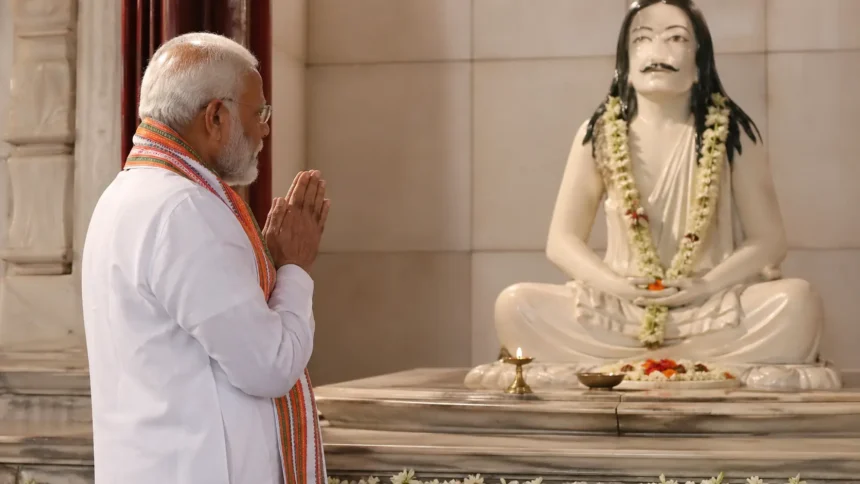
On April 26 2026 a few days before the second phase of the West Bengal Assembly elections, Modi went to the Thakurbari Temple in Thakurnagar and prayed at the main altar of the Matua community. The event was well planned. At a Bongaon rally, he publicly assured the Matua-Namasudra community that the citizenship issue would be resolved through the Citizenship Amendment Act. This is a commitment that has been repeatedly made – and broken.
Who Are the Matuas?
Around the 19th century, the Matua sect was started by Harichand Thakur in East Bengal (now Bangladesh), with his main ideas being to help raise the status and conditions of the most socially and economically downtrodden communities. This religion is a mixture of Hinduism and social reform, it does not recognize the caste system and idol worship, and it advocates for equality among all people. Following the Partition and the Bangladesh Liberation War, several Matuas fled to West Bengal and mainly settled in North 24 Parganas and Nadia districts. They came with little but their faith and for generations, successive governments gave them little more in return.
Under communist rule in West Bengal, the ‘politics of class’ became more pronounced and pervasive, and oppressed-caste identity was lumped into oppressed-class identity. Barring class, all other identities became inconsequential. The Matuas were absorbed into the Left’s votebank machinery but never truly championed. When the TMC came to power, the story did not fundamentally change, though development boards were eventually set up.
The BJP’s Calculated Courtship
The Citizenship Amendment Act, passed in 2019, became central to the BJP’s appeal — promising a pathway to Indian citizenship for non-Muslim refugees from Bangladesh who entered India before December 31, 2014. For Matua families who had lived as de facto stateless persons for generations, this was electric. Since the 2019 Lok Sabha polls, a substantial section of Matua voters shifted to the BJP in every election, and the saffron party rode that wave to unprecedented gains in Bengal.
But the promise has begun to curdle. The Special Intensive Revision of voter rolls led to roughly 3.25 lakh names being deleted from North 24 Parganas alone, with deletion rates in Matua-dominated constituencies such as Gaighata and Bagda reaching as high as 67 to 80 percent for flagged voters. The TMC has argued bitterly that the BJP first lured the Matuas with citizenship promises, then allowed them to be stripped from the very voter rolls that give them political power.
A Pattern Larger Than One Community
The Matua story is not unique, it is West Bengal’s recurring tragedy. Along with Namasudra and Rajbanshi, other communities like Bagdi Bauri Chamar, Dom etc. are still deprived economically and socially decades after independence. The discrimination in caste forced them to lowly occupations continuously and disallowing the means of education and opening up of jobs in government resulting in their being left far behind to this day.
A number of districts Puruliya Maldah Uttar Dinajpur and Coochbehar not only have poor healthcare facilities and access but are also the ones with the highest number of people deprived of these facilities, estimated to be around 18 million. These tribal belts are inhabited by the Santhal, Munda, and Oraon communities that apart from being a source of electorates, hardly have a presence of roads, hospitals, and schools in their localities. Even the TMC’s announcement of new cultural and development boards for the Munda Kora Dom, and Kumbhakar communities came just a few months ahead of the 2026 Assembly elections, hinting that efforts to reach the marginalized communities were more a matter of electoral arithmetic than genuine governance across party lines.
The Deeper Question
The journey of the Matua community’s politics from being totally ignored to becoming absolutely necessary, from being wooed to possibly being removed from voter lists perfectly captures the cynical circle that India’s marginalised communities go through. They are the ones who are thought of at election time, getting the spotlight in temple photo-ops, being promised citizenship and dignity, and finally, after all that, are left to keeping their fingers crossed.
Modi’s temple visit to Thakurnagar is a powerful image. But images fade. What the Matuas, and the Rajbanshis, Namasudras, Santhals, and dozens of other forgotten communities of West Bengal, need is not a Prime Minister in prayer. They need the promises kept.