
Grand Announcements, Hollow Ground
When Narendra Modi updated the Look East Policy to the “Act East Policy” in 2014, he referred to Northeast India as “Suvarnabhumi” which translates to “the golden land”. Almost 10 years onward, the ‘gold’ is still hidden in the Northeast. The region is still suffering from the contradiction of a government that largely emphasizes the importance of ‘connectivity’ while the Northeast continues to surge with a lack of basic infrastructure like, a good road system, reliable railway services, and economically productive corridors that actually generate jobs.
The fancy numbers the government produces, are the best flippers of the stats game. Be it the National Highways Development Program or the National Master Plan for Transportation, they have numbers built like walls. Between 2014 to now, according to government data, ₹1.07 trillion have gone to building 10,000 km of national highway in the Northeast, with 5,000 km still being constructed. But idiots over at the state-run media think the statistics built for fancy news captures the real life of the people, like a Manipuri farmer, whose village road washes away during the months of rain, or an Arunachali student, who spends his day making the long trek to an internet cafe, where the connection doesn’t drop every 20 minutes.
The Execution Gap: Projects Without Completion
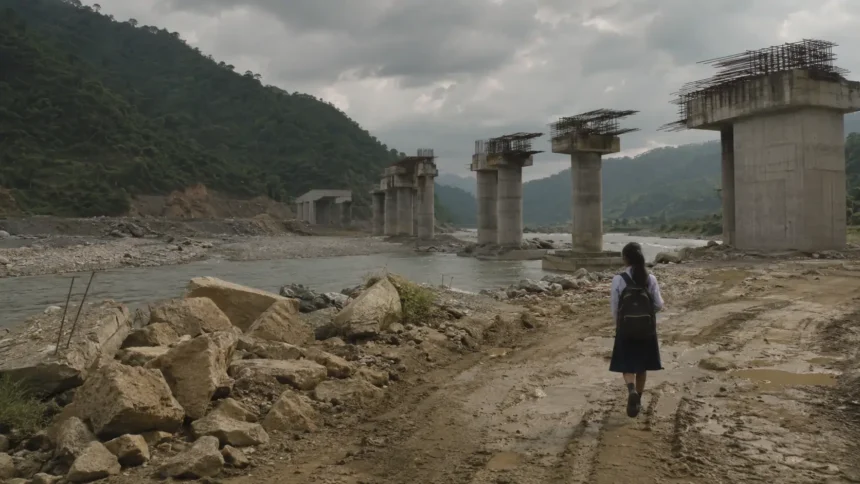
The Modi government has shown interest in improving infrastructure in the Northeast states, but has not translates policy into programs in time or budget. grow at 14% per year. As of December 2024,190 highway projects spanning 3,848 km were still active across the eight northeastern states, The price tag for the projects was reported at ₹82,452 crores. “Active” means funded, not completed. Projects are stalled for a variety of reasons, such as, land acquisition, challenging construction environment, and lack of enforcement of delivery. Over the period 2021 and 2025, 90 projects, for a total of ₹3,417.68, were planned, and funded, under the Northeast Special Infrastructure Development Scheme. At the end of 2024, only 30 of the projects were completed. The completion rate is 33%. In the other regions of the India, the underdelivering is problematic and is a potential trigger politically.
Politically, for the state of Modi, the policy of construction in the regions of the heartland , and almost none in the Northeast, is the status quo. Modi framed the constructure of expressways linking the four cities of India as strategic construction much like governs Mumbai, Nagpur, and Nasik. The Northeast states border 5 other nations and are slow in progress. In defense of his government, he used the word in economic statements to describe the budget allocations.
The Political Arithmetic of Neglect
What causes the ongoing uneven development in infrastructure? This can be explained by political logic. The eight northeastern states collectively account for only 25 seats in the Lok Sabha, or only about 4.5% of the total. For a government skilled at building electoral infrastructure by literally constructing roads where the most voters live, the Northeast has high costs and low payoff when it comes to investing resources for votes. Uttar Pradesh, with 80 Lok Sabha seats, gets expressways. Manipur, with only two seats, gets nothing but empty promises.
Independent economists and critics note point out, the last decade of Modi’s government has seen the greatest growth in inequality as growth has become even more concentrated in the politically and economically powerful areas, urban centers with high populations and dense investments. The Northeast falls into none of those categories And, whenever the government decides to release it, its own data reinforces that.
Infrastructure Without Livelihood Is Theatre
Despite roads and airports, a lack of investment leaves them pretty much ignored. The Act East Policy said the Northeast would be a bridge to Southeast Asia, but there is no industrial policy, manufacturing, or a trade route to economically involve the Northeast people. While analyzing India’s Act East Policy , researchers noted the Northeast’s real change will come only when it’s no longer both a geopolitical asset and a peripheral, neglected area. No ceremonies will ever change this contradiction.
The Northeast’s unbalanced infrastructure is intentional. It shows a government that is happy about announced road length and ignores social change. Never will the Northeast be more than a buffer or afterthought, and never will the gold in Suvarnabhumi, be found as long as the Northeast is considered a buffer and a gold mine in the Suvarnabhumi.
.