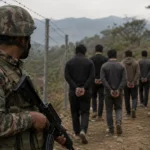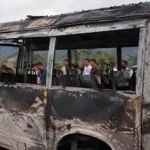

Starting on May 2023, the state of Manipur of the Northeast part of India has witnessed one of the most intense acts of ethnic violence in recent South Asia. The violence has still found ways to re-occur in cyclical waves despite the massive government intervention namely the deployment of tens of thousands of security people, curfews, internet shutdowns and even times of direct federal control. The dispute, mainly between the Meitei people (majority in the Imphal Valley) and the Kuki-Zo tribal communities (inhabiting the hilly areas), has claimed the lives of more than 250260 people and displaced more than 60, 70,000 people.
This chronic instability begs a critical analysis question: why has state intervention not been able to create lasting peace? This article contends that the reoccurrence of violence in Manipur is not only a law-and-order problem, but rather has been caused by structural level drivers of historical grievances, ethnic polarisation, deficiencies in governance, militarisation of the society and unresolved political-economic competition, all which contribute to failure of state-led interventions.
Historical Background and Weaknesses.
The instability of Manipar cannot be explained without putting it in the context of a long history of ethnic rivalry. There have been several periods of conflict in the state, such as the NagaKuki conflicts of the 1990s that left approximately 750 people dead.Manipur has also experienced insurgencies and ethnic claims as a result of gaining independence as a state in 1972.
The ongoing dispute was precipitated in May 2023 after a judicial order to look into giving Scheduled Tribe (ST) status to the Meitei people. Kuki groups saw this move as a threat to their constitutionally guaranteed rights to land and to affirmative action policies.The demonstrations that followed were swiftly transformed into violent fights and this showed the instability of inter-community relationships.
Accordingly, the repetition of violence is grounded in some historical grievances that have remained unresolved as opposed to isolated occurrences of violence today. The national responses to these structural tensions which are narrow-minded in terms of security do not address the long-standing security crises.
Ethnic Polarisation and Spatial Segregation.
The intensification of ethnic polarisation between the communities has been found to be one of the most determinant factors explaining the persistence of violence. The war has actually partitioned Manipur along the lines of Meitei and Kuki areas in the valley and the hill respectively. Whole communities have been moved in an ethnicist fashion, and some observers refer to this phenomenon as de facto partition.
There has been evidence that violence has caused communities to shift outright resulting in almost total separation of Meiteis and Kukis in some areas.. This segregation limits the chances of inter-community interaction and heightens mistrust, complicating the reconciliation.
Furthermore, the victimhood and fear narratives have strengthened the ethnic polarisation. Every group feels that it is existentially threatened and this perpetuates cycles of revenge. Interventions by the government, which usually lack trust-building and reconciliation mechanisms, are thus not enough to undo this systemic division.
Measure of Violence and Humanitarian Crisis.
The sheer scale of the crisis itself is a factor which makes it persistent. By 2024-2025, the conflict had resulted in:
- Over 250–260 deaths
- 60-70,000 internally displaced person (IDP
- Over 4,700 homes were burned down and hundreds of places of worship were ransacked
- Over 1,000 injuries and dozens missing
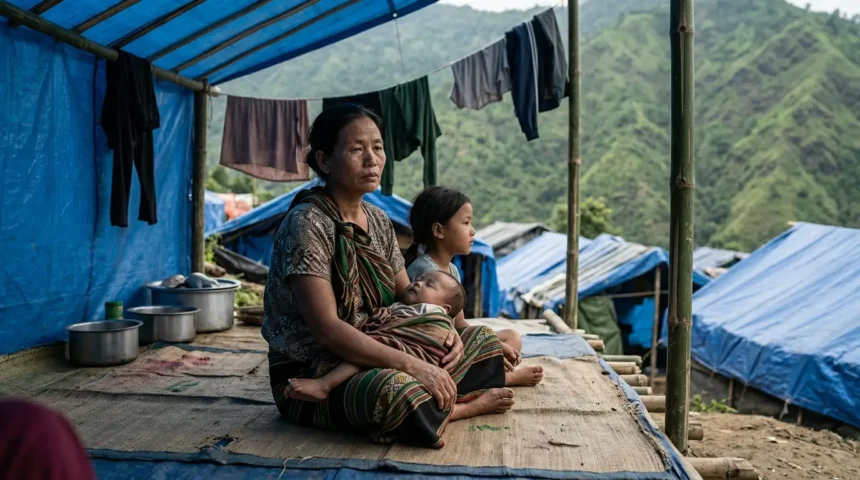
Mass displacement has resulted in a long-term humanitarian crisis with thousands of people residing and working in overcrowded relief camps without sufficient healthcare and sanitation.