
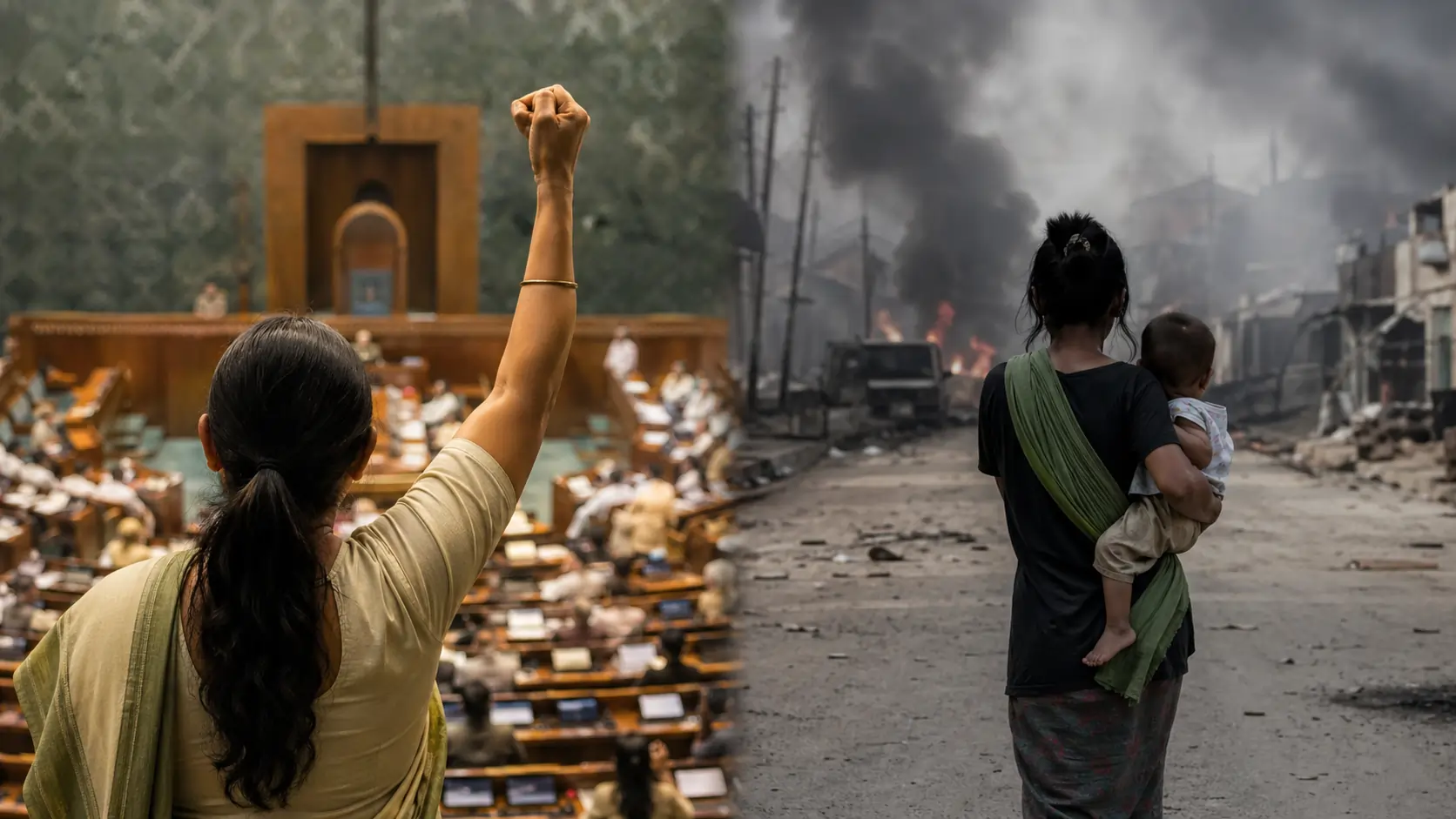
On 17th April 2026 the Constitution (131st Amendment) Bill, the means to implement 33% reservation for women in the Parliament was not passed in the Lok Sabha. The government got 298 votes in favor which was less than the required 352 votes. It was short by 54 votes. Speaker Om Birla revealed the fact that had been quietly kept as a secret: the bill could not be revived. The Lok Sabha was adjourned sine die and along with it, the BJP’s loudest promise to the women of India fell on the same floor of Parliament which it had so theatrically celebrated in 2023.
Women’s Rights as a Trojan Horse
However, a mere counting of votes would be an inadequate measure of this monumental blunder. The dramatis personae of the act was not women alone. Opposing the Bill, Rahul Gandhi, Mallikarjun Kharge, and an united INDIA Bloc led the charge calling the Bill a “Trojan horse”. Their point was not the reservation of women but the sudden exposing of a massive reorganization of constituencies, based on the 2011 census data, which would increase the seats of the House of the People from 543 to 815 and, in the process, re-orient the country’s political map quite clearly in BJP’s favor for the 2029 general elections. The Women’s Reservation Bill was just a delicious taste. The delimitation was the pill.
A Trick Played Twice
That wasn’t the first time BJP played that trick. The Nari Shakti Vandan Act was passed in 2023 with grand celebrations but implementation was cleverly linked to a census and delimitation that had no fixed date – which in effect meant that no woman would be in a reserved seat at least before 2034. The 2026 bill was meant to be a “bridge” that sped up the timeline to 2029. However, political commentators were blunt that it was a ploy to consolidate electoral gains before the demographic changes of a new census could fully be reflected. When it failed, the BJP did not table the accompanying Delimitation Bill or the Union Territories Laws Amendment Bill for voting. They simply withdrew them and went home. If this had truly been about women, those bills would have been separated from the outset.
Now Look East, Look at Manipur
Ethnic violence in the northeastern state between the majority Hindu Meitei community and the majority Christian Kuki-Zo tribal communities has been the main issue there since May 3, 2023. Government data reveals that 258 people have died 60 000 have been forced to flee their homes 4 800 houses have been destroyed by fire, and 386 places of worship have either been desecrated or demolished. Women were the main victims of this nightmare. Multiple Kuki-Zo women reported rape and sexual assault. Vigilante groups like Arambai Tenggol, with over 60,000 cadres armed with weapons looted from state police armories, were named in FIRs for sexual violence. No prosecution was carried out against any of their members. For instance, a 31-year-old Kuki woman was tragically burned alive in November 2024. The bodies of women and children were retrieved from rivers. During all this time, Prime Minister Modi did not make a single visit to Manipur.
A Government That Enabled the Violence
The state government under Chief Minister N. Biren Singh, a BJP leader, was not merely ineffective. Audio recordings submitted to the Supreme Court, verified by a forensic laboratory with 93% certainty, allegedly captured Singh’s own voice describing how he instigated violence and shielded attackers. The Supreme Court has called Manipur a situation where “law and order have completely broken down.” Amnesty International alleged that both the state and central governments had “utterly failed.”
The UN expressed concern about sexual violence, hate speech, and the targeting of a specific ethnic and religious minority. Singh finally stepped down in February 2025 when BJP’s own ally, National People’s Party, decided to withdraw the support. President’s Rule was imposed. Then, as recently as February 2026, once again, a new BJP government was sworn in. Till now, more than 60,000 people, primarily Kuki-Zo, are still displaced. Neither a senior official nor a militia leader has been prosecuted. The first peace meeting between the two communities in three years happened only in March 2026.
Two Faces of the Same Betrayal
This is the context in which the Women’s Reservation Bill was debated and defeated. On one side, a government dressing up an electoral power grab as gender justice. On the other, a government presiding over the longest-running episode of targeted violence against women in recent Indian history, and facing zero accountability for it.
It was their government that was going on and on blaming the opposition for “denying women their rights” in Parliament, while at the same time they were running the very state where women were being stripped in public, gang-raped, set on fire and killed, as well as being made to keep quiet. The very Home Minister, who was singling out the opposition for deserting women, was the one governing a state where armories were looted, militias were armed, and victims were asked to withdraw their complaints. The Women India Forgot to Include
The women of Manipur are Indian women. Their bodies are not a regional footnote to be omitted from the national conversation on gender justice. When we talk about who sits in Parliament, we must also talk about who is safe enough to live in their own home. The Nari Shakti Vandan Adhiniyam was a bill about representation. What happened, and continues to happen, in Manipur is a crisis of survival. Both demand to be named together, because both flow from the same political culture: one that invokes women when it is useful, and abandons them when they need protection most.