
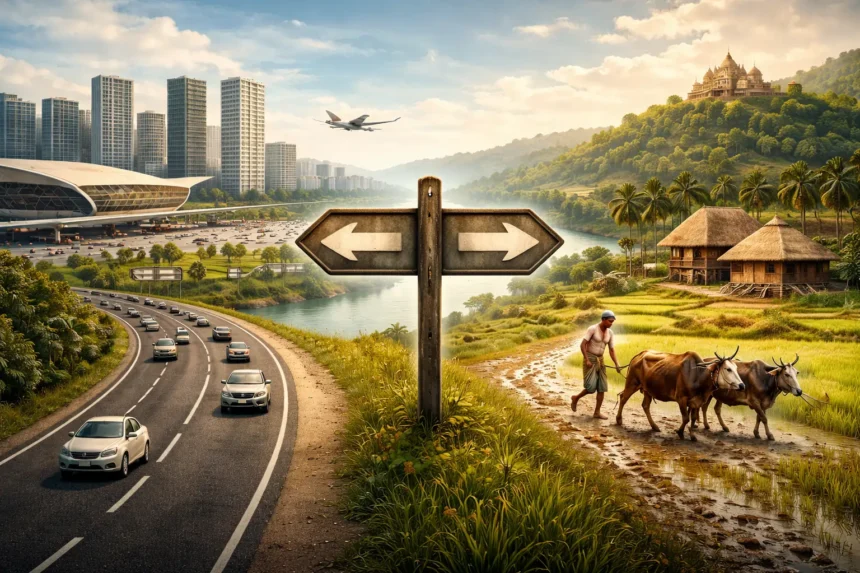
Assam will be at a crossroad in its history in 2026. Assam with a population of about 3.66 crore has a population increase rate of above 17 per cent since 2011 and it has approximately equal population of men (1.86 crore) and women (1.80 crore). The success of this demographic population is indicative of opportunity and anxiety young vitality and political unrest, financial ambitions and cultural identity arguments.
The political discussion of the state is dominated by two strong trends: development and identity. On the one hand, the development of the economy, investment of infrastructure, and modernization bring hope to millions of people. Conversely, the apprehension of cultural dilution, migration and belonging drives discussions even on the other, in homes, tea gardens, as well as student hostels. Politics in Assam is not the remote theory but practice.
Economic Growth: A New Narrative of Progress
Assam is one of the rapidly developing regional economies in India in the recent years. In 2025-26, the Gross State Domestic Product (GSDP) of this state is estimated to be approximately [?]7.41 lakh crore (US $87 billion), which increases at 12.5 per cent. per year over the last ten years. The estimated growth of the state is 15 percent in 2025-26, which is a strong momentum. Sectors such as services (approximately 45 per cent of the economy), industry (30 per cent) and agriculture (25 per cent) have led to this increased growth, as well as the thriving tourism and logistics. Connectivity is also characterized by large investments.
The recently stretched terminal at the Lokapriya Gopinath Bordoloi International Airport has increased its capacity of 13.1 million passengers annually, making the Assam an even closer proximity to South and Southeast Asia. To a large number of young professionals in Guwahati, this development is hopeful to remain in the state as opposed to the cities that were far away. Ritu is a software developer and she says she used to see her friends going off to work in Delhi and Bengaluru. Here now things are different-this I can make a future here.
However, the prosperity is not always accompanied by the economic opportunity. Unemployment, particularly among the educated young people has been an issue of concern despite the increased production. According to labour polls, millions of young Assam residents continue to seek effective employment- a disconnect between the development and experience.
The Politics of Identity: Language, Belonging, and Beliefs
As economic indicators are shining, the debate on identity and belonging is heating up. The cultural environment of Assam is highly varied: there are Assamese, Bodo, Bengali, and other languages which form the linguistic fabric of Assam. The 72.2 percent literacy rate depicts an educated traditional society. In the case of older generations, identity politics are connected with both memory and history.
The 1980s and 1990s were marked by political movements that aimed at retaining land rights and the indigenous culture, leaving a strong effect on the politics of Assam. The modern arguments on identity are the result of those past considerations, influenced by the fear of cultural assimilation, division of resources, and demographic changes.
A single point of conflict is the Citizenship Amendment Act (CAA) which, since March 2024, has provided an avenue to expedited citizenship to some non-Muslim migrants of post-neighbouring countries. By late 2025, Assam has only received 12 applications and only three people have been given citizenship under the Act- nowhere near the levels of fear that were being projected in previous years.
Although the uptake of CAA is minimal, the emotional effect is embedded. To most communities, the proposal of shifting citizenship policies in a multicultural society poses concerns of cultural security and political representation particularly with the imminent election period
Elections in 2026: A Political Thermometer
Politics in particular is being extremely heated up in 2026 due to the fact that Assam is bound to have a state assembly election by March-April 2026. The assembly session of 126 seats will be fought as the incumbent Bharatiya Janata Party (BJP) and allies will be fighting to retain power against a resurgent opposition, where Congress are the challengers.
The elections are becoming more than a matter of party politics- they will see how well the leaders walk the fine line of promising growth and issues of identity. Problems such as unemployment, resilience against disasters, education, and provision of infrastructure will be of great concern to the ground level voters.
Floods, Erosion, and the Politics of Nature
Assam has not been immune to natural vulnerability in development. Geography of the state predisposes it to floods; almost half the land area of the state is prone to floods, which is approximately 10 percent in the whole country. The swelling of the Brahmaputra every year affects families, livelihoods and cleanses farmlands. In 2025, more than 6.5 lakh people were impacted by floods which claimed losses of up to 5,000 crore and damaged homes and cropland in several districts.
To a farmer in Dhubri, whose rice fields are wiped away every monsoon, government growth statistics get chilled blood. Airports and GDP growth, says Abdul, a displaced farmer. But when the river takes our land, who is responsible of us? His question is representative of a larger political fact: without the development policies being framed to incorporate climate resilience and social protection, economic growth may seem remote and even intangible.
Youth and the Future: Between Aspiration and Anxiety
The future of Assam will be judged by the young population of the state. Youth aspirations stand with political discussions and expectation of society with about 60 percent of its population being below the age of 35. Dignity and agency is an entry-point to many young Assamese, through education and employment. But numerous people also complain of the slowness in the local creation of high-skill jobs. T
he area of social media has been a lively political arena among the youths. Students express their expectations of a state that will provide them not only with cultural respect but also with a career opportunity, but they insist on holding the state accountable regarding such issues as climate change, the quality of education, and transparency in governance as well. To the youth of this generation the answer is simple: Does Assam have a chance to become more economic without losing the soul of their people? Not abstraction this is what directs them to vote, to select professions and to fantasize about their motherland.
Conclusion:
The 2026 of the journey of Assam is regarding balance. The economic development of the state, which is characterized by the increase of GSDP, the large-scale construction of infrastructure, and diversification of the economy, gives real prospects. Such a promise, however, can be fulfilled only in the event that political leadership attends to the daily concerns of its citizens: concerns relating to culture, belonging, climate vulnerability and opportunity.
Politics in Assam is a human narrative: it is the tea garden worker who wants to hear the price stay stable, it is the youth which wants to get a job without leaving home, it is the farmer which is trying to restore his home after floods and it is the family which is discussing about their future language and traditions. The key to success is to find a path that will involve not only inclusive development but also strong respect to the identity such that development will not lead to the decline of the same culture that makes Assam what it is.