
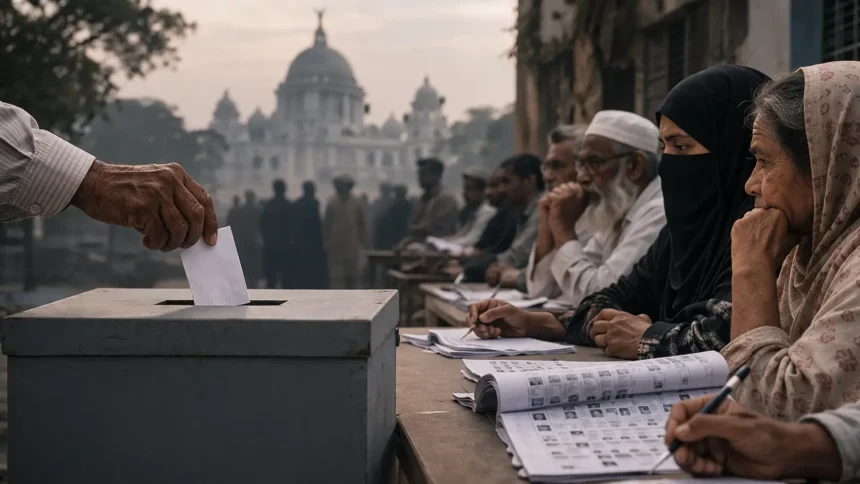
The ballot is the most basic tool that a citizen uses to express their power in a democratic country. However, in West Bengal, the use of this tool seems to have been dulled deliberately over time. The SIR of electoral rollsinitiated by the Election Commission of Indiahas led to nearly 90-91 lakh voters being removed from the list. This number represents close to 12% of the total electorate of the state. (The Times of India) Such a move is not merely a matter of administrative fine-tuning. It is a political act of such enormity that it has brought to the surface the most serious questions about the very essence of democracy, the impartiality of institutions, and the use of electoral mechanisms as instruments of power.
The Scale of Deletion: A Democratic Shock
Before the update, West Bengal had about 7.6 crore registered voters. After the implementation of SIR, the number of voters decreased by almost a one-eighth. (The Times of India)Even during the adjudication process, the figures remain frightening. Out of approximately 60 lakh cases that were examined, over 33 lakh individuals are still excluded despite thorough checks. (The Economic Times)
These are not minor errors – they are millions of people losing their constitutional right to vote. In any democratic system, such a large-scale purge would lead to self-examination by the institutions. However, in India, it has been turned into something normal via official languages like ‘cleaning’ and ‘verification.’
Selective Deletions: Patterns That Raise Red Flags
The most unsettling part of the SIR exercise is not only the extent but also the pattern. The data shows that Muslim-majority constituencies such as Murshidabad experienced the most deletions, along with areas of Matuas and other marginalized groups. In Kolkata, in some constituencies, the deletion percentages in the adjudicated cases reached from 70 to 87%, mainly affecting migrants and the poor. (The Times of India) This is the point where the story changes from mere administrative correction to political mistrust. When deletions are mainly targeted to certain groupsespecially minoritiesthe main valid question is raised: is this for the sake of electoral accuracy or electoral engineering?
The BJP Narrative vs Ground Reality
The Bharatiya Janata Party (BJP) has presented the operation as a war against ‘infiltrators, ‘ arguing that only non-citizens were removed. However, this explanation doesn’t stand up to the light of the facts. If the measure was really addressing illegal entrants, how is it that even long-term residents, senior citizens, and whole families are being removed from the lists on the basis of very minor discrepancies?
Besides, the heavy burden of proof has practically been inverted. The citizens are the ones who need to demonstrate their eligibility, which in many cases means producing documents they simply may not have and on top of that, within very short time frames. This situation really harms the poor, migrants, and minorities, who generally have the least amount of documentation. This is not neutral governance. This is structural exclusion masquerading as administrative reform.
Algorithmic Democracy or Algorithmic Disenfranchisement?
There have also been worries about the use of automated or algorithm-based criteria for detecting “inconsistencies”. The critics say that the unqualified parameters such as “logical consistency” have simply been a pretext for deleting people. If the hidden technical procedures are combined with lack of accountability, the operations become a black box – the people inside do not completely comprehend, can not challenge or change their exclusion. This is very much the opposite of democratic transparency. The purpose of voting is to include as many people as possible, not to subject them to algorithmic suspicion.
Legal and Institutional Concerns
The magnitude of exclusion has necessitated a court’s step-in. The apex court has been made aware of the ongoing exclusion of millions even after the court’s decision, and special tribunals have been set up to resolve the disputes. Still, the fact that there is a need for such an intervention points to a systemic failure. The integrity of elections should not depend on legal remedies taken after the fact. It has to be a part of the election process itself. Besides that, a number of issues in the past including the wider “vote chori” allegations in several states indicate that West Bengal is not a lone case but is a part of a wider pattern of disputed electoral roll revisions.
Democracy vs Documentation
Essentially, the SIR debate uncovers a basic dilemma: Is it fair to make voting rights dependent on bureaucratic excellence? In a country such as India, where lack of proper paperwork is a everyday phenomenon, strict checking procedures will inescapably lead to the exclusion of the weakest sections of the society. If voting rights are linked to documentary evidence rather than actual citizenship, too often, democracy is designed to exclude those who would rightfully be its members.
Political Timing: A Convenient ‘Cleanup’?
The timing of the SIR exercise definitely raises some eyebrows considering it was conducted just before the 2026 West Bengal Assembly elections. Electoral roll revisions in itself are not something new. However, when one considers their scale and the fact that they are only a few days/wk away from the elections, their political impact gets amplified. Removing around one out of every eight voters right before a high-stakes election will, without a doubt, change the playing field. In fact, in this kind of situation, one would not only expect neutrality but, in fact, it would be the most important thing. And yet, the lack of transparency and the large number of deletions are the very things that make that expectation a farce.
Conclusion: Revision or Rigging?
The SIR exercise in West Bengal is more than just a bureaucratic changeit is also testing the viability of democracy in India. When large numbers of people are left out, their exclusion coincides with other disadvantages that these groups suffer, and the lack of openness of the authorities doubt is raised, then the revisionor rigging threshold becomes difficult to distinguish. Apart from coups or censorship, Democracy does not only die in fact, it is destroyed very silently through deleted names, lost ballots and ignored voices. And the issue in West Bengal today is no longer whether the voter list has been updated. It is whether the electorate has been selectively rewritten.