
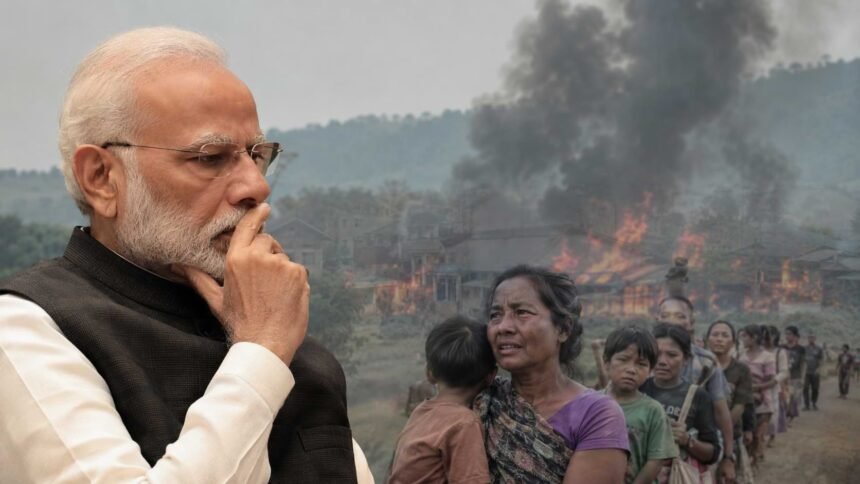
A community of more than two million people has been asking the same question for three years in the world’s biggest democracy and there’s no clear answer from the government. The demand for Kuki separate administration is not a political slogan. It is the ultimate answer of a people that have seen their villages burn, their dead buried in mass graves and their homes abandoned under gunfire of a conflict their government failed or could not prevent. The silent New Delhi has not been neutral. It’s a political decision, and the Kuki-Zo are paying for it with blood.
The demand for Kuki separate administration was felt immediately after the ethnic violence engulfed Manipur in May 2023. Meitei and Kuki-Zo communities went to all-out war, killing more than 260 and forcing displacement of more than 300,000 people, finally leading the Kuki-Zo leadership to a simple, devastating conclusion: that they could no longer live under a state government they felt was actively complicit in their destruction. Their demand a Union Territory with legislature, carved out of Kuki-dominated hill districts was not a desire for foreign territory. The demand was a constitutional one for security in the Indian Union. Instead, Modi acted by turning a blind eye to it.
When the Modi government finally spoke, it spoke disrespectfully. In April 2024, Home Minister Amit Shah, who is India’s top custodian of internal security, visited the Meitei dominated Imphal part of the state and announced in front of a roaring crowd that “no one has the guts to divide the state of Manipur”. This was not a thought-out policy opinion. It was a political stunt to appease BJP’s Meitei supporters and terrorise a frightened minority community. The statement by Shah in response to Deccan Herald’s report on the Kuki demand for separate administration clearly signaled that the Kuki separatist movement was not worth engaging in. For the Kuki-Zo people in displacement camps, it was the weakness in disguise of strength.
The difficulty in forgiving Modi’s inaction is that of the timing. The Prime Minister has not been to Manipur once for almost 18 months since the first outbreak of violence. Not to mourn the dead. To not pay attention to those that have been displaced. Not to be seated in the presence of community leaders on either side. On September 2025, he finally travelled to the state capital Imphal, but arriving in Meitei heartland, he said nothing about Kuki separate administration, and didn’t even meet a single Kuki representative. No one was oblivious to the symbolism. A Prime Minister with a penchant for visiting states hitter by floods within few hours and speaking with solemnity at global summits couldn’t find time, let alone will, to appreciate the people whom his government has failed worst.
There were some gestures behind closed doors. The MHA also did have meetings with Kuki-Zo Council (KZC) delegations in New Delhi, a description even by the participants that was nothing more than “icebreakers.” The government’s approach to the negotiations with the Kuki-SoO – which is essentially an effort to hold talks on holding talks – was a standard bureaucratic delaying game played out during the visit, as The Quint reported, to Manipur. Throughout the interim, Kuki people continued to live in relief camps, children continued to grow up behind security barbs and the need for a separate administration continued to grow. Trying to mollify a community’s resolve by providing them with meetings while their homes are still in use is not a good idea.
The BJP’s cynical arithmetic is not a hard thing to decipher. Meiteis account for 53 per cent of Manipur’s population and have a dominance over political and economic powers in the Imphal Valley. The Kuki-Zo are a large group of the hill districts but are a smaller electoral bloc. In a Modi India, where governance is more and more a game of Hindu majority vote count Modi’s India was always destined to lose this number game of governance. Their resentment over the demand has been exploited as a political tool, as the BJP has consistently characterized separation as anti-national in its political discourse and repeated its attacks on the Kuki community despite a plethora of evidence of state complicity in anti-Kuki violence. The abandonment of the Kukis is a historic and utter moral debacle for a party that has made “sabka saath, sabka vikas” its slogan.
By early 2025, the government had had enough of delay and opted for coercion instead of tackling the issue of separate administration of Kuki by them. On March 8, 2025, Amit Shah issued a directive saying “free movement” on all roads in Manipur which the Kuki-Zo community rightly interpreted as an attempt to bring an end to their de facto control of the hill areas without granting them any political security. In a report that Deccan Herald had reported, the Kuki groups had challenged the free movement order issued by Shah, resulting in the death of one protester and the injury of 43 of them when the security forces intervened. A legitimate demand of the Constitution had been converted into tear gas and bullets by the Modi government. The Kuki separate administration was not met with facts, but with strength.
In fact the constitutional case for Kuki autonomous administration is entirely in the confines of Indian law. Telangana was the latest addition to the ranks of states, with India restructuring other states in the past and forming new union territories like Jammu & Kashmir in 2019, and Puducherry before that. When it was politically convenient for the BJP, the government did not hesitate in bifurcating Jammu & Kashmir. It removed one of the Muslim majority states of its special status without debate, in the dead of night, under a communications blackout. But when an ethnic group who are Christians in a Christian tribal community demands an administrative arrangement to safeguard against ethnic cleansing, all a sudden, territorial integrity of Manipur becomes sacred. The use of constitutional principles selectively is no principle. It is prejudice.
This stone walling has led to total failure of any inclusive governance system in Manipur. The Kuki-Zo Council had decided that no Kuki-Zo should be a part of the government of Manipur, as reported by Deccan Herald. That’s not separatism. It is a community that is saying out loud that the state as it is now does not offer them protection nor does it represent them. If more than two million people opt out of democratic governance, it doesn’t mean that they have betrayed democracy; it means democracy has betrayed them. The Kuki demand for separate administration is not a destabilizing demand, rather it is the only path left to communities for democratic governance.
Three years, 260 dead, 300,000 displaced and there is yet no resolution to the hostage crisis. What can be said is that the Modi government’s performance on the issue of Kuki separate administration is not complicated nor does it have to be said to be a tale of competing legitimate demands, it is nothing but a tale of political cowardice dressed up in the name of national unity. A PM that denies the humanity of a community that he has failed is not showing strength. He’s admitting it. In Manipur, hills are still on fire. The Kukis are yet to be heard. And in New Delhi, the silence goes on, purposeful and cynical and harsher than any rejection.