
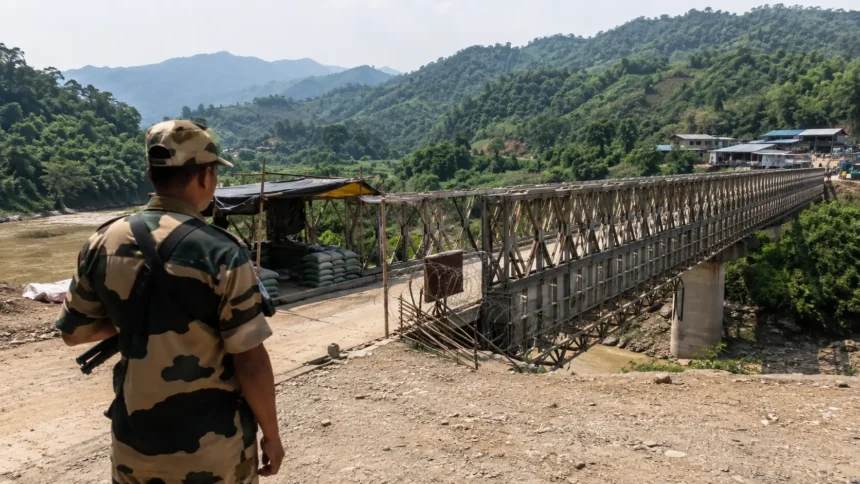
The India-Myanmar border, 1,643 km long, is much more than a geopolitical border; it is a dynamic economic and social corridor, which has both formal trading systems, as well as deeply rooted systems of informal networks. As it borders the northeastern states of India- Manipur, Mizoram, Nagaland, and Arunachal Pradesh- this border supports thousands of livelihoods as it simultaneously presents regulatory and security challenges. The interplay of formal and informal economies in this region reveals a complex reality whereby state-led frameworks co-exist and, in many cases, compete with local survival strategies based on history, geography and culture.
Trade between India and Myanmar is formalized with designated border points like Moreh Tamu and Zokhaw thar Rihkhawdar, which is intended to promote controlled exchange under the Act East Policy of India. These corridors play a key role in the interconnection between South and Southeast Asia as well as the inclusion of these routes in the development of such projects as the India Myanmar Thailand Trilateral Highway. Historically, bilateral trade between the two countries has been over two billion dollars per year with Myanmar being a major supplier of pulses and agricultural products that are highly demanded by domestic consumers in India. Nevertheless, despite this promise, official statistics only capture a small part of the real economic activity, due to infrastructural shortages, bureaucratic inefficiencies, and a series of security concerns.
On the contrary, the economic life of the border region is dominated by informal trade. Informal cross-border trade, also known as unrecorded cross-border trade, is a type of cross-border trade that is not documented and that deals with goods such as electronics, textiles, fertilizers and fuel that often bypasses official cross-border trade checkpoints and tax systems. The magnitude of this activity is hard to estimate, but studies have continually indicated that the actual amount of trade is much greater than that shown as such. Such a contradiction emphasizes the weaknesses of institutionalized tools in reflecting the economic reality of living in the border community. Informal trade is not the alternative to work but a necessity among many residents, who are forced to work informally due to the lack of legitimate employment opportunities, weak state presence, and old-established ethnic and familial relationships that go beyond national borders.
The socio-cultural landscape of the border area is important in the support of these informal economies. Communities that are residing along the border are often connected by linguistic, tribal and kinship ties that existed before the modern nation-state. These relationships enable the smooth flow of goods and human beings, often not within formal regulatory systems. Under that, the line between legal and illegal trade is blurred, as day-to-day economic activity is intertwined with the framework of social relations and interdependent relationships. Informal trade networks have been transformed into sophisticated systems in which local traders, middlemen and transporters are involved, and in some cases overlap with armed groups which exercise influence over certain areas.
Although informal trade stands to support livelihoods, it equally brings a lot of concern in terms of legality, control, and security. The absence of control results in the loss of revenue on the state level and opens the possibilities of smuggling and illegal actions. India and Myanmar have price differentials, which further encourages informal exchange, since goods are usually cheaper or more available on the other side. The difficult terrain which is occupied by the dense forest cover and mountainous terrain coupled with the lack of enforcement capacity makes it difficult to monitor and regulate such activities effectively by the authorities. This has seen informal trade continue as an economic lifeline and a challenge in governance.
The recent political developments in Myanmar have even added value to the dynamics of border trade. Myanmar has been subjected to extended instability, economic downturn, and armed conflict, all of which have interfered with the formal trade routes. According to the estimates of the World Bank, it is presumed that the Myanmar economy will shrink by about 2 percent in the 202526 fiscal years as structural challenges continue. This insecurity has undermined institutional structures and escalated the use of informal networks as traders and communities adjust in the failure of formal systems. In a number of areas, trade that is off record is still being carried out in areas where formal infrastructure is present but where conflict and administrative breakdowns make the infrastructure ineffective.
The formal systems have also been weakened, and this has been contributing to the growth of illicit economies along the border. Transnational crimes such as drug trafficking, human trafficking, and other forms of transnational crime have become more prevalent, overlapping with already established informal systems of trade. One of the most worrisome trends has been the upsurge in the cultivation of opium in Myanmar which has increased by an average of 17 percent in 2025 to a whopping 53,000 hectares and as such, it is among the largest sources of illicit opium production in the world. This expansion is tightly connected with economic poverty and instability because farmers resort to high-value illegal crops when they do not have viable options. The increasing number of such activities highlights the darker aspects of informal economies, where survival strategies can be combined with criminal enterprises, making it more complicated to respond with policies.
The challenge of infrastructure deficiencies is one of the key obstacles to formalization of trade along the border. The lack of road connectivity, insufficiency of storage facilities, and a lack of access to electricity increase the transaction costs and lower the efficiency of formal trade channels. The border points like Moreh can become great economic centers, if it is supported by the long-term investments in the infrastructure and the capacity of the institutions. Enhanced connectivity would not only be beneficial in trade but also create jobs and achieve regional integration. In the absence of such development, informal systems will tend to continue prevailing, because of flexibility and accessibility.
The prevalence of informal trade at the India Myanmar border is also indicative of the overall trends in the Indian economy where the informal sector is almost half of the total Indian GDP. This sector gains even greater significance in the peripheral areas like the Northeast since the area is geographically isolated and there is little state intervention. Although informal economy offers resilience and adaptability, it also limits the amount of tax to be collected, diminishes transparency and complicates the execution of development policies. This dichotomy has become a consistent dilemma to policymakers who aim to address the tension between enforcing rules and regulations by ensuring economic inclusion.
The crux of this problem is that it is a basic policy issue. Strict implementation of rules may interfere with the livelihoods and aggravate economic hardship among already vulnerable communities which may result in social unrest. On the other hand, too much leniency can lead to the development of illegal activities and destabilize the state authority. This must therefore be a measured process that appreciates the economic value of the informal systems but progressively incorporates them into the formal systems. Strategies like the expansion of local border markets, ease in the customs procedures as well as improvement of infrastructure can be used to close this gap, and a more inclusive and sustainable model of development can be achieved.
In conclusion, the India–Myanmar border represents a complex interplay of opportunity and challenge, where formal and informal economies coexist in a delicate balance. Formal trade structures seek to incorporate the region into global markets, but informal networks still prevail because of structural, cultural, and political aspects. The recent destabilization in Myanmar and the emergence of illicit activities have further intensified these dynamics, emphasizing the need to adopt sensitive and context-specific policy interventions. The future of this border region will be determined by the capacity to balance regulation with reality so that economic development is not achieved at the expense of the living conditions of the locals, but rather by building on these conditions to create a more balanced and successful frontier.