
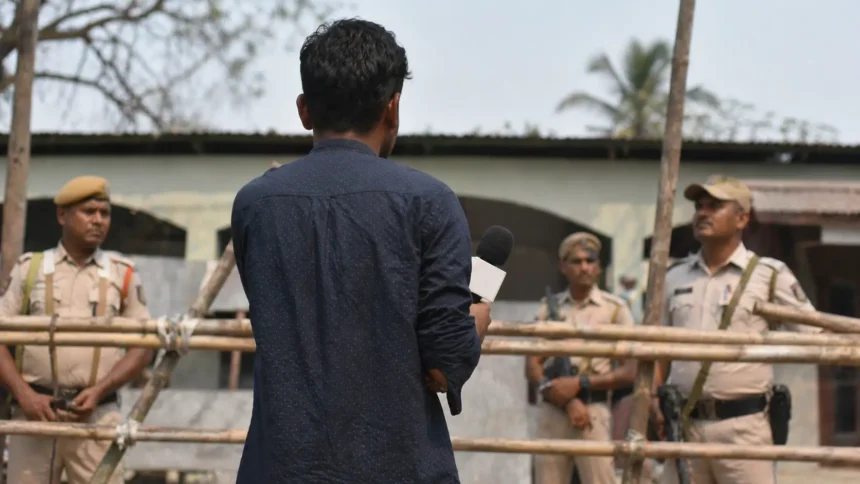
In recent elections, the issue of press freedom in Assam has gained prominence with journalists highlighting constraints on their access and coverage. The Press Council of India’s data shows several complaints received during recent state and by-election times alleging journalists were denied access, intimidated, and even obstructed. For example, a widely shared video showed journalists being denied entry into polling stations, despite the Election Commission’s guidelines on the presence of media in restricted areas. Given more than 2,000 polling stations were monitored in crucial constituencies, any percentage of denial of access raises questions about transparency. These incidents have reignited discussions about the extent to which independent observers are documenting electoral processes in the state.
The issue was further exacerbated by protests by journalist groups in constituencies like Guwahati and Dibrugarh calling for formal protections for journalists. According to the Gauhati Press Club, at least 25 journalists have been harassed in recent elections. Activists claimed that this is not a one-off case but that media freedom has been under attack for the past 3-5 years, with access to political events becoming more difficult. Banners with messages like “Let Media Work Freely” and “Democracy Needs Free Press” were also shared in large numbers online, with thousands of shares in just a few hours. The protests themselves became a social media phenomenon, with hashtags about press freedom in Assam trending in the region and on the radar of national journalist unions.
An analysis of digital media shows how social media has given voice to legitimate concerns and counter-claims. On X (formerly Twitter) and Facebook, posts raising concerns about alleged press suppression received tens of thousands of views, while others accused some media outlets of bias or misinformation. This juxtaposition highlights the transformation: freedom of the press is no longer discussed solely in the courts or media, but also in the public sphere through a digital lens. According to data from digital analytics companies, posts related to the elections from Assam witnessed a 35-40% increase in engagement (compared to earlier elections), implying that the public is increasingly engaging with and responding to on-ground news.
Police too have also been in the spotlight. The Assam Police has informed the media in press conferences that very often, restrictions are put in place around polling stations to ensure security and avoid crowding. Election guidelines from the Election Commission of India restrict certain areas, usually within a 100 metres of polling stations, to only official personnel and accredited journalists. But reporters contend that these regulations are inconsistently enforced, resulting in confusion and discrimination. In some instances, journalists with press credentials have reportedly been denied while others were allowed, suggesting inconsistencies in enforcement of rules.
Even statistics add to the complexity. India’s ranking of 161 among 180 countries in Reporters Without Borders’ World Press Freedom Index speaks to larger national threats, which also affect regional issues such as in Assam. In Assam, the number of registered media outlets has increased by almost 20% in the last ten years, suggesting a dynamic but increasingly crowded media environment. This, however, has not been accompanied by commensurate institutional safeguards, thereby further exposing journalists, particularly freelancers and local journalists, in critical situations like elections.
A less visible aspect is the commercial challenges facing local journalism. Assam’s local journalists often work on meagre incomes: estimates in the industry suggest many earn less than ₹10,000-₹15,000 per month. During elections, when the need for coverage is high, these journalists are required to travel long distances to cover constituencies, but often without proper support. Any impediments to access or reporting can directly affect their livelihoods: without coverage, there are no stories to tell and no pay. This economic issue can indirectly impact journalistic independence, with smaller publications being more cautious in their reporting to avoid conflict.
Social media has been both a blessing and a curse in capturing these incidents. Clips of journalists being detained or having heated exchanges with authorities have been viewed more than 100,000 times, leaving an online footprint that cannot be easily dismissed. But misinformation and cherry-picked video footage have at times also clouded the issues, complicating efforts to separate fact from fiction. This points to a key issue in the digital era: although technology can facilitate transparency, it also requires greater checks and balances, as well as media literacy among the public.
Some civil society organisations have recommended guidelines for these challenges. They have called for the use of digital passes for journalists, provision of helplines for grievance redressal and use of independent observers to monitor media access. Other civil society groups have recommended periodic audits of media access on election day, with publicly accessible audit reports. Such steps, if taken, would help bring the letter and spirit of regulations closer to the ground.
In the end, the Assam case points to a challenge between the state, the media and the public at large. Voting is not just an act of democracy, but also an opportunity for observation, recording and analysis. Any hindrance to journalists, unintentional or not, has implications not just for their work but for the integrity of the electoral process. Given the vast number of voters and polling stations, minor restrictions can add up to major issues.
The journalists’ protests, then, are not only about their profession, but about the information process in a society. As the political landscape in Assam unfolds, the tensions between security, law and order and freedom of the press will continue to be crucial. The statistics, events and digital responses to these elections indicate that this is not an isolated debate but one that will help set the tone for how elections will be reported, experienced and challenged in the future.