
The Indian northeastern state of Manipur is once again facing a different resurgence of violence that is the cause of the sensitization of the deep ethnic problems, failure of the state, and anger of the people. The killing of children has led to protests and the political fights have become more intense, the questions have been raised about the accountability and the response of the state.
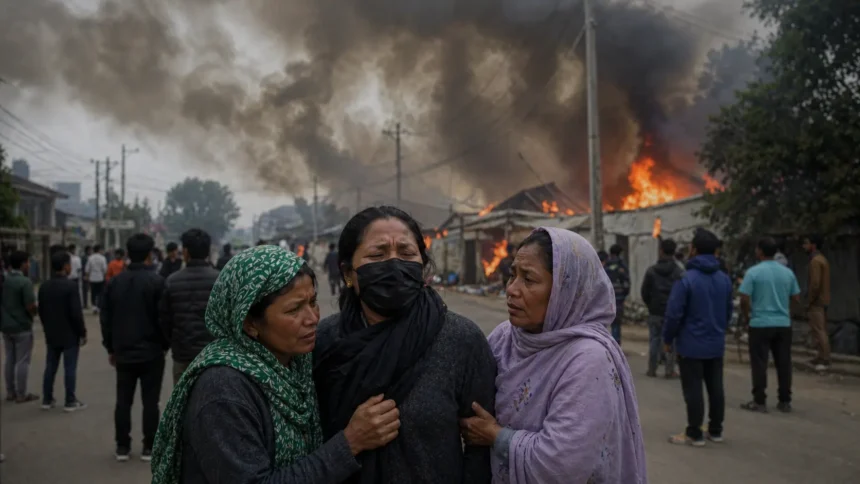
Another Round of Violence More than five people have been killed in the incidents in Manipur since the first day of April 2026. One of the most heartless acts that shocked the whole world was killing of two children in Tronglaobi village during the night of 6-7 April. However, three more deaths took place as a result of the attack on the security post at Gelmon village.
Such incidents are only the tip of the iceberg. Only a few months ago, there were wide-scale attacks in armed clashes, house burning, killings, and so on in the districts of Ukhrul and Kamjong. Due to National Highway 202 closure, the people were not able to live their normal life, and also, the situation was made worse by the isolation of the communities and the worsening of the humanitarian conditions.
Public anger spills onto the streets
Many thousands of people have expressed their anger by taking the streets of Imphal East and West districts. Night rallies, torch marches, and even demonstrations mostly led by women are a way of expressing through people who are scared but angry also because the authorities haven’t spoken.
Different civil society groups with Meitei and Kuki ones among them, remain divided and not only do they distrust each other but the distrust is also going to a deeper level. Actually, the protests are not about a limited number of individuals only. Protests are, on the contrary, people’s expression of their desire for security, justice, and political recognition.
Opposition Reaction towards the Crisis
Many of the Opposition parties in India have exposed BJP and PM for the unsolved crisis. Congress MP Angomcha Bimol Akoijam has blamed the central and the state governments for “abandoning their responsibilities,” demanding rapid action, setting investigation deadlines, and making changes in the administration.
The Indian National Congress has made an official submission listing their demands. They want independent and immediate investigations into recent killings, making Manipur Police more efficient, reopening of the mentioned blocked highways, and publishing the report of the 2023 violence inquiry. Besides, The Aam Aadmi Party has blamed the Prime Minister for playing a leadership role at the national level but ignoring it while the violence went on getting out of control.
The Ethnic Fault lines
Over land, identity, and political representation Metie and Kuki communities started to have tensions in May 2023, but since then, the conflict has turned into a tragic cycle of violence.
Territorial disputes of the communities, the rise of armed groups, the lack of proper law enforcement, and the scarcity of trust in the government institutions are the main reasons for the continuation of a very unstable situation. Temporary peace agreements without resolving the structural problems will probably not result in long-lasting peace.
Governance and Institutional Breakdown
The crisis has surfaced one of the most alarming problems – the loss of faith in government’s capability to function effectively. The demand for a complete overhaul of the state police unveils a still wider public feeling that the very same institutions entrusted with maintaining peace have not done their job properly so far.
Further, the reluctance to release the report of the committee of inquiry into the 2023 violence has caused a drop in the level of trust of the people towards the government. In fact, the two main areas where people feel the biggest shortage of transparency and accountability. It is the children, women and the most vulnerable who are suffering from the effects of instability, thus turning the issue from just a security one to a humanitarian one as well.
The Urgency for Engagement
It is worrisome how events in Manipur are pointing towards a very bleak future if no action is taken. Along with political declarations, changing things back to normal requires a collective and concerted effort, which must be open and for a long time, from everyone involved. Getting civilians to safety and ensuring their security, carrying out reliable probes into the deaths that have occurred recently, bringing about community dialogues, empowering local administrations and restoring people’s faith through openness would be some of the first things to work on.
Manipur’s crisis is not just a local issue it has become a question of governance, honesty and moral duty of the entire nation. While the killings don’t seem to stop and people’s discontent is on the rise, not taking any firm steps will only cause the conflicts to deepen and the instability to last longer. The matter calls for making it a priority to act not only by the politicians but also by the institutions, civil society and the wider national conscience.