
The present turmoil in Myanmar has resulted in one of the most multifaceted humanitarian and security challenges in South Asia. However, the consequences of this crisis in Northeast India, which were initially external shocks, are now largely driven, exacerbated and mishandled by the policies of the BJP-led central government. The mismanagement of refugees, the increasing militancy, and the worsening ethnic tension in the border areas are the manifestations not just of instability in Myanmar but also of New Delhi’s policy paralysis and contradictions.
A Regional Crisis Spilling Across Borders
After the military takeover in Myanmar in 2021, the level of violence rose drastically. Based on UN figures, more than 3.5 million people are still living in their own country as displaced persons, while various other millions are already food-deprived and facing imminent total humanitarian breakdown. (UNHCR)
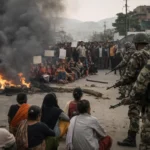
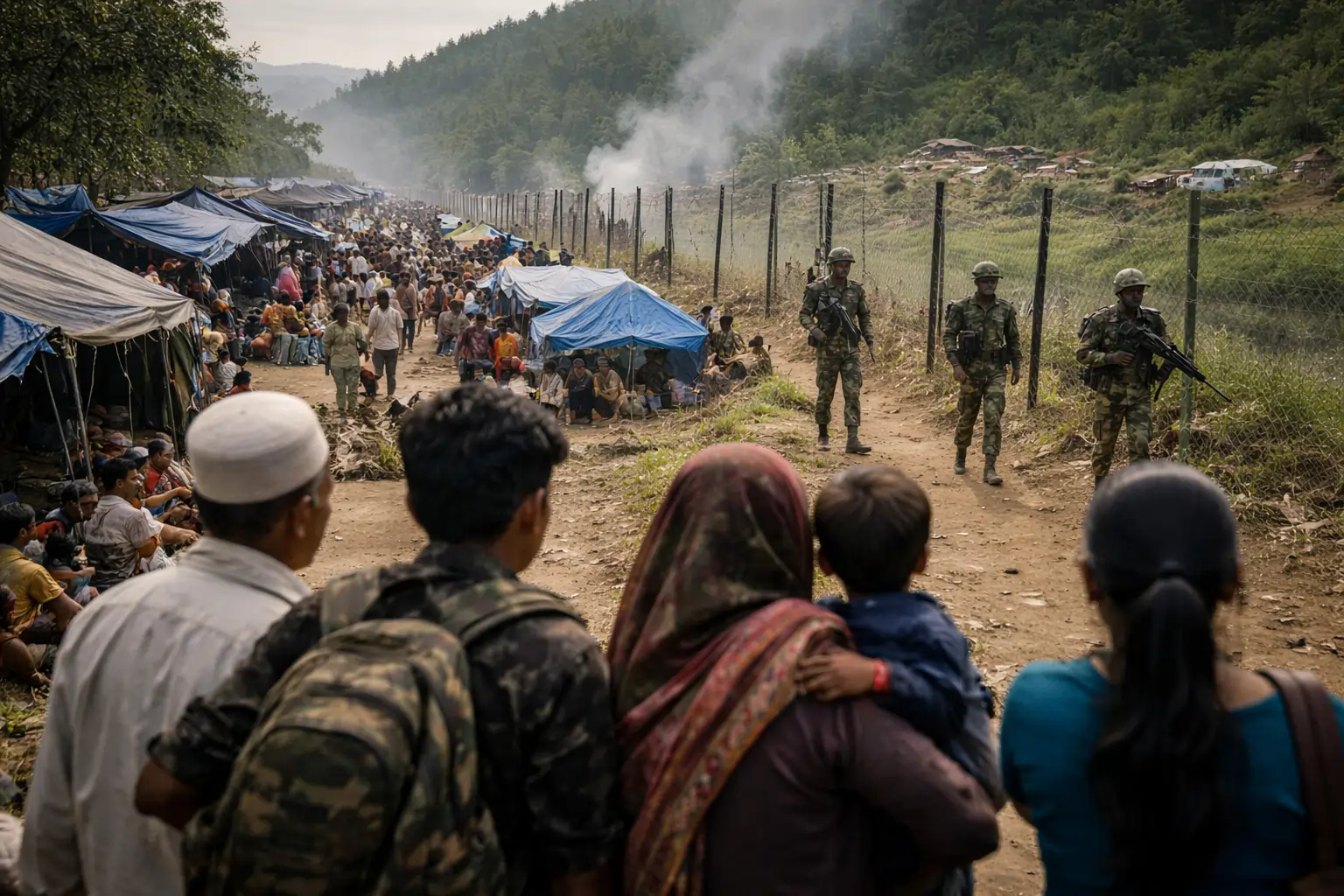
This rampaging of security situation in the country naturally ended up in India as well. Districts such as Mizoram and Manipur have been receiving refugees almost daily, the majority of whom come from Myanmar’s Chin State and Sagaing region. More than 31,000 refugees from Myanmar are currently being accommodated in Mizoram. At one time, the figure was over 50 000 indicating the arrivals are ongoing for years. This information reflects a severe and long-standing crisis, not merely a temporary emergency.
BJP’s Contradictory Refugee Policy
One of the most glaring aspects of India’s handling has been inconsistency. On the one hand Mizoram due to ethnic and cultural ties, has taken a humanitarian stand – opening their homes to strangers – while the central government has been focusing mostly on tough measures.
Several human rights organizations, including international legal bodies, have cautioned that forced deportations are a breach of the non-refoulement rule, as they can result in the return of civilians to situations of violence and persecution. (International Commission of Jurists)
That distinction between the state-level soft spot and central-level strictness exposed that our policy was out of sync. Instead of a combined humanitarian-security policy, the BJP government has allowed disorder to be the prevailing factor in border administration.
Security Blowback: Militancy and Porous Borders
Instability in Myanmar has once again raised the perennial security threats in Northeast India. The India-Myanmar border running for about 1,600 km is still a thinly guarded border with porous border segments and monitoring difficulties. Militants utilizing Myanmar continue their incursions in India Security personnel have been in conflicts with rebels in border areas Illegal arms trade and militants’ regrouping have increased One major operation has seen the Indian Army wiping out several militants associated with Myanmar-based networks in the border area.
Yet, these momentary victories hide a deeper strategic failure: India is without a comprehensive long-term border stabilization policy. Deciding to either rethink or curb the Free Movement Regime (FMR) which allowed border area people to cross the borderit is the BJP government’s move that has further made the matter complicated. Though touted as a security step, it is believed that the move destroys age-old ethnic connections while not providing the local people with any practical means of continuation.
Ethnic Tensions: A Crisis Deepened by Policy
Perhaps the most harmful effect has been the intensification of ethnic discord in Northeast India itself. The Manipur administration has pointed fingers at the ethnic violence being the result of “illegal immigration” from Myanmar, a declaration that continues to be very much a matter of controversy and discussion. This narrative goes back to: The ethnic conflicts that broke out in 2023 have resulted in the death of at least 200 people and the displacement of 60 000 making it one of the gravest internal upheavals in India’s recent history. (Reuters) The securitized refugee discourse has not only failed to reduce tensions but also, it is believed, has led to further polarization so that what was a humanitarian issue has now become identity conflict.
Humanitarian Burden Without Central Support
States like Mizoram have carried a disproportionate refugee load with limited support from the centre in most cases. Although the local governments there are helping tens of thousands of displaced people, they still face: Scarcity of resources Healthcare facilities are quite limited Escalating political pressure In fact, it is reported that refugee support services are under a lot of pressure, and aid distribution is turning out to be very uneven and even politicized. (The Diplomat) This however naturally leads to the question: why has the central government not come up with a national refugee policy so far, particularly when the region is continuously experiencing cross-border crises?
Diplomatic Silence and Strategic Drift
India has for the most part kept close connections with Myanmar’s military leaders. However, ever since the coup happened, New Delhi’s way of dealing with it has been cautious, and some even say it is strategically ambiguous. Different from the international community that has made more forceful steps, India has not publicly exerted great pressure on the military junta in Myanmar. Indeed, a step like this from India could be driven by both its concerns of security and geopolitics however lack of a forward-thinking diplomacy restricts India’s power to have direct impact on the border situation. Hence, a contradiction arises: on the one side, India is greatly impacted by the unrest in Myanmar; on the other, it remains predominantly a reactive Government.
Conclusion: A Crisis of Governance, Not Geography
The problems that Northeast India faces these days are mainly presented as the natural outcomes of its discreet geographical situation–open borders, diverse ethnic makeup, and closeness to conflict zones. However, this kind of reasoning does not cover everything. If we look at the facts, it seems that policy inconsistency, slow reaction, and the excessive use of security measures have made the effects of the crisis in Myanmar on India’s bordering states far worse. Bypassing local communities, overlooking their trust, overshadowing refugee policies with security concerns, and leaving diplomatic engagements weakthese have been the facets of the BJP government’s approach that have taken a regional problem, which was manageable, and turned it into a crisis with many dimensions.
Nothing short of a clear and comprehensive refugee policy, an inclusive political approach, and a vigorous diplomacy at the regional level based on genuine engagement with Myanmar and other neighbors can help India contain the growing instability along its eastern border, which is on track to not only persist but deepen, turning into another one of the great sources of worry, tension, and potential conflict for India. In other words, those borderlands aren’t failing by themselves. Instead, they are coming to embody the results of decisions made far away from them.