
In 2014, when Narendra Modi transformed the poorly-named policy of the previous government, the Look East Policy, into the much more impressive-sounding Act East Policy, it was marketed as a brilliant strategy of transforming the neglected Northeast India into an economically-successful bridge between South Asia and Southeast Asia. Now ten years down the road that promise has gone all to ruins. The Act East Policy has not done much more than holding fancy summits, cutting ribbons, and posing with diplomats who know little or nothing of the people of Nagaland, Manipur or Meghalaya who still await safe roads, electricity and peace.
What was expected to be the heart of this transformation has turned out to be a beacon of neglect and unsteadiness, and this is all the worse.In states like Manipur, long-lasting ethnic violence, internet shutdowns, and security crackdowns have shown that big strategic claims are empty.Although Government of India continues to assure that it will correct the situation, there are simple issues with the governance, highways remain unfinished, cross-border trade routes are not fully utilized and local businesses are still struggling without actual investment. The Northeast has been isolated to the rest of the world rather than a gateway to Southeast Asia. Its citizens are forced to pay policy catchphrases that promised connectivity but actually offered more than headlines.
Infrastructure: A Pipeline of Broken Deadlines.
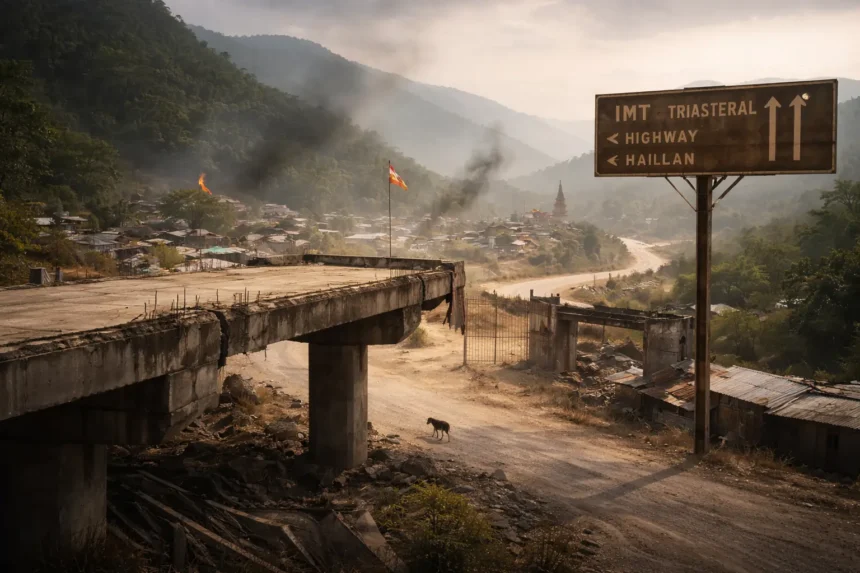
The India-Myanmar-Thailand Trilateral Highway was supposed to be the Act East Policy’s biggest infrastructure project and be finished by 2016. It has even made people to question whether it will be completed by 2027, which is the new deadline. Other important component of the Act East Policy is the Kaladan Multimodal Transit Transport Project that has remained behind schedule due to insurgency, floods and red tape. The government of Modi has not been slow in discussing new highways and rail corridors at press conferences, but to the people of the Northeast the reality is that most of the projects are years behind or silently abandoned India’s connectivity projects with Myanmar remain critically incomplete.
The Myanmar Blind Spot
The 2021 Myanmar military coup has completely blindsided the Act East Policy, which may be its most damning failure. The whole plan depended on Myanmar being a stable transit partner. When the junta took over, India’s foreign policy establishment froze, and then, shockingly, they decided to keep diplomatic ties with the military regime instead of supporting democracy. This was a failure not only of morals but also of strategy. As civil war rips Myanmar apart, the Northeast border, in particular, Manipur and Mizoram is being overrun with refugees. Ethnic conflicts are aggravated and all the trade routes which were relied on by the Act East Policy is rendered useless. How India’s Act East Policy collapsed after Myanmar coup . It still doesn’t.
Manipar Burns As Delhi Fiddles.
What do you mean by an Act East Policy on your face when Manipur, the state that is meant to be the entry point to Southeast Asia has been in ethnic violence since May 2023? More than 250 people have died, tens of thousands have been forced to leave their homes, and whole villages have been burned down.It took Modi more than 80 days to even talk about the crisis in Parliament. While the state fell into chaos, his government chose to stay quiet about politics. When its own gateway state is under siege, the Act East Policy can’t be a credible geopolitical strategy. No foreign investor, no ASEAN partner, and no trade delegation will send goods through a war zone.Manipur violence and its effects on the connectivity target of India. The Modi government has demonstrated that it is ready to allow the Northeast to suffer as long as all is quiet in Delhi.
Trade Numbers That Tell a Different Story
People who support the Act East Policy love to talk about trade numbers between ASEAN and India and the results of bilateral summits. The government of Modi is very good at coming up with new names and changing the names of things. There was no difference on the ground when Look East was replaced with Act East, but it made the news for a decade. India shouldn’t use the Northeast to get what it wants in terms of geopolitics.Instead, the average income per person in most Northeast states is still lower than the national average, skilled young people are still moving west, and the region is still more connected to Delhi’s welfare system than to Bangkok’s markets.
A Policy Built for Speeches, Not People
The harsh truth about the Act East Policy is that it was more of a brand than a plan. Modi’s government is great at coming up with new names and rebranding things. For example, changing “Look East” to “Act East” didn’t change anything on the ground, but it did create a decade’s worth of news cycles. India’s geopolitical goals should not make the Northeast just a tool for them. It needs real autonomy, peace, investment, and good governance, not a foreign policy label that sees it as a corridor instead of a community. Act East Policy will remain what it is, one of the costliest, most sensationalized, and ineffective promises in Indian politics in recent times. It will not cease until it brings about paved roads, operating border markets, ethnic reconciliation and jobs.
In the end, the Act East Policy didn’t work because New Delhi’s strategic vision didn’t match up with what was really going on in the Northeast. Corridors, connectivity, and regional influence are discussed by policy-makers, yet the citizens of Nagaland, Meghalaya, and Assam are more concerned about their safety and dignity and opportunities. Through top-down stories or diplomatic optics people cannot be compelled to evolve.Instead, development has to come from trust, inclusion, and ongoing local participation. Whatever the quality of the branding, no grand strategy will ever resonate effectively on the ground until the people of the Northeast are not only listened to but also prioritized in the making of policies.