

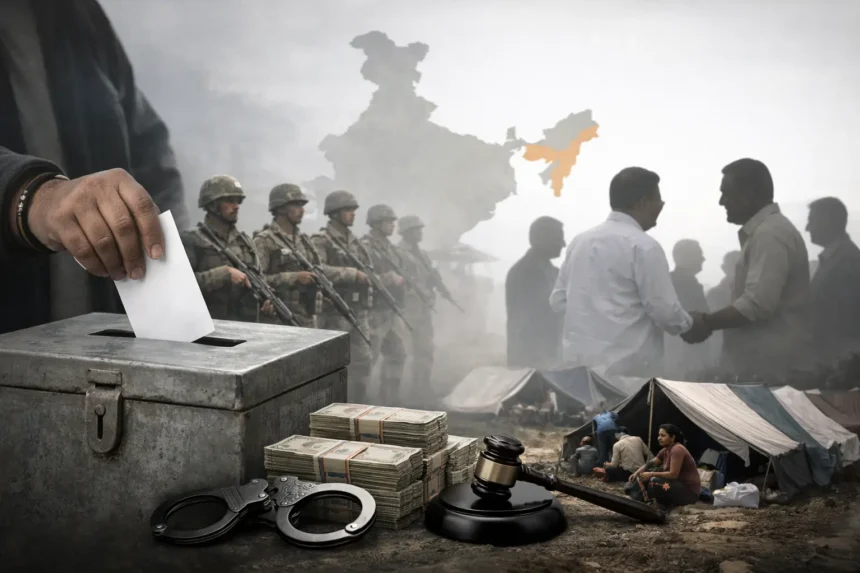
The democratic foundation of India relies on equal regional representation and fair political competition. However, aggressive federal strategies have recently placed Elections under Fire in North East States.
The northeastern region, comprising eight diverse states, holds 25 crucial Lok Sabha seats. These numbers make the territory highly significant for national power grids seeking total political dominance.
Opposition leaders consistently argue that central policies are systematically weaponized to silence regional forces. Through financial strangulation, administrative pressure, and demographic shifting, fair electoral competition is rapidly diminishing.
The Financial Grip in North East
The primary mechanism of central control in this region is extreme financial dependency. Most northeastern states lack the heavy industrial infrastructure needed to generate independent tax revenues.
Because of this geographic and historical reality, they depend heavily on federal grants. Data from the Reserve Bank of India (RBI) indicates that between 60% and 80% of state budgets here come directly from New Delhi.
Opposition governments are extremely vulnerable as a result of this economic dependence. The implicit threat of postponed central funding hangs over the term of any state government formed by a regional party. As a result, state-level politicians are frequently financially pressured to support the central ruling party in order to maintain infrastructure development and basic administrative survival.
The Asymmetry of Campaign Finance
Modern political campaigns require massive capital, creating a highly uneven playing field. National alliances utilize federal policies to consolidate corporate funding at the direct expense of regional players.
According to a report by The Indian Express, national parties historically secured roughly 70% of total political funding through controversial schemes like electoral bonds before the Supreme Court intervention in 2024.
In stark contrast, local parties in Assam, Tripura, and Manipur are forced to fight state elections on virtually empty budgets. These staggering financial disparities actively prevent indigenous opposition groups from matching the massive advertising, travel, and logistical power of central political machines.
Weaponization of Central Investigative Agencies
Financial leverage is not the only tool used to suppress political rivals. The strategic deployment of central investigative bodies has profoundly altered the regional political landscape.
Between the years 2014 and 2023, an overwhelming 95% of political figures targeted by federal investigative probes belonged to the opposition ranks.
This study often identify a very concerning pattern. When targeted leaders defect to the central ruling alliance, high-profile corruption investigations frequently stall, slow down, or completely vanish. Because of the atmosphere of fear created by this selective application of justice, powerful local leaders are compelled to forgo their regional mandates in order to avoid prosecution.
How Mass Defections Erase Voter Mandates
The Northeast has recorded some of the highest defection rates in India’s democratic history. Central powers frequently exploit the two-thirds majority loophole in the Tenth Schedule (Anti-Defection Law).
Instead of facing voters in by-elections, elected opposition members are absorbed into ruling alliances in massive blocks. The official numbers are staggering:
- In 2016, Arunachal Pradesh saw 43 out of 44 opposition MLAs switch sides overnight to merge with a centrally backed coalition.
- In 2019, just months after Sikkim declared its assembly results, 10 out of 13 main opposition MLAs crossed the floor.
- In 2021, Meghalaya witnessed 12 out of 17 opposition MLAs defect in a single coordinated move.
- By late 2021, Nagaland effectively formed an “opposition-less” government when rival parties joined the ruling central alliance.
These engineered defections brutally bypass the ballot box. They completely invalidate the original choice made by the electorate, rendering state elections practically meaningless.
Security Apparatus and Delimitation Anxieties
Beyond finances and defections, structural policies like constituency delimitation and border security are reshaping voter demographics. The 2023 delimitation exercise in Assam drastically redrew electoral boundaries. Opposition groups strongly argued this move systematically diluted the voting power of specific minority demographics across 19 assembly seats.
Additionally, the prolonged enforcement of the Armed Forces Special Powers Act (AFSPA) creates a heavily militarized environment during polling phases. While security is paramount in border regions, opposition candidates claim that stringent military protocols severely restrict their freedom of movement and their fundamental right to peaceful political assembly.
Plunging Voter Turnout in Conflict Zones
When central security policies fail to maintain peace, the democratic process suffers a direct hit. The ongoing ethnic clashes in Manipur highlight this administrative failure.
During the 2024 general elections, polling booths in heavily conflict-ridden zones witnessed voter turnout drop by nearly 15% to 20% compared to the 2019 election cycles.
Thousands of displaced citizens living in temporary relief camps were unable to cast their votes effectively. This logistical failure heavily deprived the opposition of a crucial voter base.
The Urgent Need for Democratic Reforms
If India wishes to maintain a healthy federal structure, the political autonomy of its sensitive border states must be fiercely protected. Electoral reforms are critically needed to ensure transparent, state-funded campaigns that do not rely on central favors. Furthermore, lawmakers must eliminate the gaping loopholes in the Anti-Defection Law that allow wholesale mandate theft.
Without immediate, neutral institutional intervention, the multi-party framework in the Northeast faces total eradication. Ultimately, strictly enforced, unbiased federal policies are the only way to ensure that the diverse voices of these eight vital states survive the pressures of national centralization.