
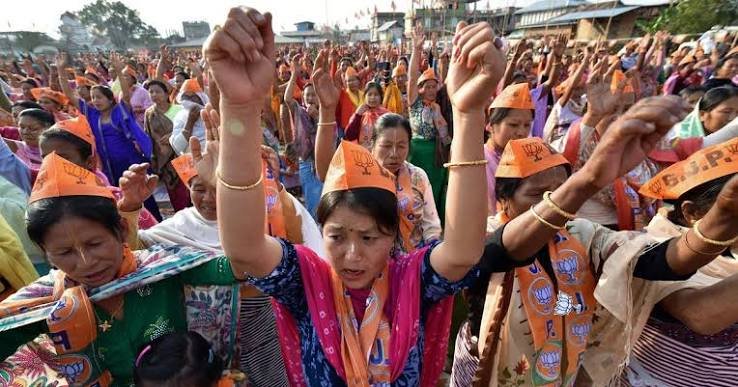
On 4 February, nearly a year of President’s Rule ended when Yumnam Khemchand Singh took oath as Chief Minister at Lok Bhavan in Imphal. The Bharatiya Janata Party presented the arrangement as a reset after the resignation of N. Biren Singh in February 2025 and the ethnic war that began on 3 May 2023. Two Deputy Chief Ministers were sworn in beside him: Nemcha Kipgen of the BJP, from the Kuki-Zo community, and Losii Dikho of the Naga People’s Front. The optics were deliberate. A Meitei Chief Minister, a Kuki-Zo deputy, a Naga deputy. Delhi wanted a photograph that said the fracture had been managed.
The photograph was already a lie about geography. Kipgen did not travel to Imphal. She took the oath from Manipur Bhavan in Delhi, because Kuki-Zo legislators still cannot safely enter the valley that has been closed to their community since 2023. A government that cannot assemble in its own capital is not a reconciliation. It is a seating plan imposed from outside. The Hindu’s report of the oath recorded the end of President’s Rule. It also recorded how thin that end was.
The choice of Kipgen made the bargain explicit. She is a second-time MLA from Kangpokpi and the first Kuki-Zo, and the first woman, to hold the deputy chief ministership. She is also married to Thangboi Kipgen, chairman of the Kuki National Front, an armed group under a Suspension of Operations agreement with the Centre since 2008. Sections of her own community treated the appointment as betrayal, not representation. The BJP’s answer to a war between communities was to elevate a legislator tied, through family, to one of the armed structures the war has never disarmed. India Today noted the marriage and the SoO link in the week the government was formed. That is not a footnote. It is the method.
Three days later the method failed in public. On 7 February, Litan in Ukhrul, a mixed Tangkhul Naga and Kuki settlement on National Highway 202, erupted after a local clash. What followed was not a drunken quarrel that security forces contained. Homes were burnt on both sides. Highways were fought over. Officials were attacked. People were abducted. The conflict that Delhi had treated as a Meitei–Kuki problem acquired a second front: Naga against Kuki-Zo, over land, routes and who is allowed to live where.
By June the body count and the accusations had outrun the government’s language of outreach. Naga groups and the NSCN(IM) accused the Modi government and its security forces of working with Kuki armed groups. Kuki bodies accused the NSCN(IM) and its proxies of burning villages and killing civilians, and demanded that the Centre scrap the Naga ceasefire. Neither set of claims has been settled by an independent accounting the state has been willing to publish. What is on record is the sequence: a new BJP government, a flare-up within days, then months of arson, abductions and blocked roads. The Reporters’ Collective’s investigation traced that sequence to a Centre that stayed quiet in public, militarised the ground, and kept the chair in Imphal.
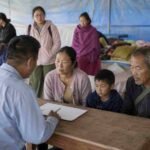
The numbers that followed make the “peace government” claim difficult to repeat with a straight face. Human Rights Watch, citing the violence since February, said at least 34 people had been killed in the Naga–Kuki-Zo clashes by early September, with seven more dead in late August, and that armed groups on both sides had burnt homes, taken hostages and blocked highways. The same note recalled the older war: more than 260 dead and more than 60,000 displaced since May 2023. Later reporting put the toll in the new clashes at over 50 since the Khemchand government took office. HRW’s September assessment was blunt about the gap between the promise of reconciliation and the measures actually taken.
This is what faction management looks like when it is mistaken for policy. The BJP spent a year of President’s Rule neither resolving the political demand of the Kuki-Zo groups nor restoring free movement. It then assembled a legislature party in Delhi, revoked Article 356, and installed a cabinet whose balance was communal arithmetic. Kuki-Zo MLAs who had refused the Biren government were brought back in through a deputy chief minister who could not stand in Imphal. Naga representation was added through an ally. The valley was told the elected government had returned. The hills were left with the same SoO camps, the same rival claims on highways, and a new reason to fight.
Displacement has not been reversed. The buffer zones have not become borders that people can cross for work, school or a hospital bed. Kangpokpi has been choked by blockades. Imphal still cannot host its own Kuki-Zo ministers. Armed groups under ceasefire remain political actors, and the government that elevated one of their family networks has no public account of how those networks are to be demobilised. When the second front opened at Litan, the response was more force and more silence, not a political settlement either community could recognise.
Manipur does not lack governments. It has had Biren Singh, President’s Rule, and now Khemchand Singh. What it lacks is a Centre willing to treat the state as more than a seat to be held until the next headline about normalcy. The February arrangement kept the BJP in the chair. It also kept the guns in the argument. Eight months on, the roads are still bargaining chips, the dead are still being counted by community, and the peace that was sworn in at Lok Bhavan has not reached the villages that were burning three days later.