
The Northeast is a region that has always felt uneasy in the national psyche, a region of eight states whose sole link to the mainland is the narrow band of land known as the “Chicken’s Neck”, yet which shouldered the burden of all India’s frontier fears. That self-consciousness has now become confrontation in Manipur for more than three years now and the tale it’s telling is not even a tale of one state. It is the story of the Indian state’s rule of its hill people for 70 years and its indelible ambiguity.
On 3 May 2023, violence erupted in the state of Manipur after Manipur High Court ruled that the Meitei community, which is Hindu majority and is mainly residing in the Imphal valley, is a Scheduled Tribe. It was a threat to protections land rights, job quotas, admissions to college that had been so critical to an uneasy peace between the tribes of the hills and those of the plains for decades. The violence has since claimed the lives of at least 258 people and forced some 60,000 families to flee their homes, Human Rights Watch reported, adding that thousands of homes and hundreds of religious buildings had been destroyed.
Where Manipur is instructive, though, is its failure to be kept in check by institutions for long enough to render the conflict simply tragic instead of instructive. Meanwhile, in the twenty months of sustained violence, the then chief minister of the state, N. Biren Singh, had absolved himself from any personal responsibility and no high-ranking member of the state government nor any member of the militias were ever brought to book. Singh’s comments were leaked on audio tapes authenticated by a forensic laboratory with high levels of confidence, according to various reports that were heard to contain Singh’s voice discussing the bombing of Kuki villages, leading to the political pressure. He was only compelled to step down after his party lost parliamentary seats in the 2024 general election and a coalition partner withdrew their backing, in February 2025. Amnesty International, responding to the resignation, pointed out that the resignation of the chief minister doesn’t equate with justice for victims.
This was followed by President’s Rule, and direct government was not restored for a year until February 4th, 2026, when a new chief minister took office and the first direct talks with the Kuki-Zo representatives were held the following month. Even that discussion came with a whiff of bad news: independent observers were said to have spurned the administration’s initial characterization of violence as a “misunderstanding” between communities.
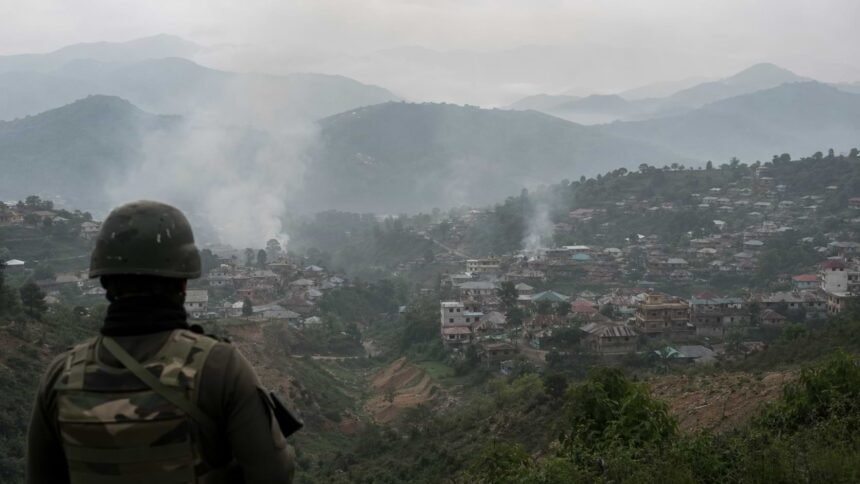
The fragile calm was witnessed again in April 2026, when two children were killed in Bishnupur district in a suspected rocket attack which led to fresh protests and internet shutdowns. Al Jazeera’s reporting was an attempt to shed light on the root cause of the conflict, but Samrat Choudhury, author of a recent political history of the region, found the conflict’s unresolved core in a tension that has always existed in the very concept of nation-state and nationalism. Over 250 companies of central armed police continue to be deployed in the state, one of the highest densities in South Asia; agricultural land is being encircled by buffer zones which farmers are no longer able to cross.
Violence in Manipur does not exist outside their border. The Northeast is home to a 1,100-mile-long border with Myanmar, which has been flown through by Indian states of Nagaland, Manipur and Mizoram, and these consequences of the 2021 coup have seeped into India. An analysis by the Daniel K. Inouye Asia-Pacific Center for Security Studies chronicles the unstable situation in Myanmar’s Chin and Kachin and Shan states, and the growing influence of the military junta on Beijing, making New Delhi’s calculations more difficult. An analysis from the Daniel K. Inouye Asia-Pacific Center for Security Studies documents the volatile conditions in Myanmar’s Chin and Kachin and Shan states and Beijing’s increasing influence over the military junta, raising New Delhi’s calculations.
The cultivation of poppies and drug trafficking into opium further worsens the situation. The International Crisis Group’s February 2025 report, conducted by dozens of interviews throughout Manipur and New Delhi, reported that the accusations of drug-trade involvement were almost entirely against the Kuki-Zo community while evidence pointed to a participation of communities from all walks of life in the trade. The same report described how cultural bodies like Arambai Tenggol have turned into armed militias of tens of thousands of Meiteis.
The Armed Forces (Special Powers) Act of 1958 is an act that cannot be ignored when talking about state power in the Northeast and it has roots that are fitting, for colonial counterinsurgency. It was the direct descendant of an ordinance enacted by the British against the Quit India movement in 1942 and the antecedent of AFSPA was first used in the Naga Hills in 1958, in response to an armed secessionist movement that had declared its own government. The law confers on soldiers the rights to arrest without warrant, search without warrant and to kill anyone who is in breach of prohibitory orders-rights which critics have long said give soldiers a license for impunity which can only be approved by the central government. The Northeast is a region that has always felt uneasy in the national psyche, a region of eight states whose sole link to the mainland is the narrow band of land known as the “Chicken’s Neck”, yet which shouldered the burden of all India’s frontier fears. That self-consciousness has now become confrontation in Manipur for more than three years now and the tale it’s telling is not even a tale of one state. It is the story of the Indian state’s rule of its hill people for 70 years and its indelible ambiguity.
In 2016, that critique came to the Supreme Court, which made it clear that, as with other insurgents, soldiers were not immune from prosecution. The Jeevan Reddy Committee had even recommended earlier in 2005 to end AFSPA in its entirety and adopt a scheme based on the common criminal law, which has not been put into practice. Instead, the withdrawal has been incremental, phased out states – Mizoram in the 1980s, Tripura in 2015, Meghalaya in 2018. According to government estimates, about 80 per cent of the Northeast is now AFSPA-free and government officials said the Union Home Ministry was now planning to lift the state of AFSPA from all the remaining areas, though it continues to be extended every 6 months in parts of Manipur, Nagaland and Arunachal Pradesh, where rebel groups associated with the Naga nationalist movement are still active.
In the end, why do the Fault Lines Run Deeper Than Any Single Law or Leader? It is easy to put a negative spin on it, to consider Manipur an aberration, a bad chief minister, a bad court order, within an isolated state’s boundaries. The reporting and research done over the last three years say otherwise. The Homegrown India explainer on the crisis went back beyond the 2023 court order to “older grievances”, such as the “unequal political power between valley and hill districts”, competing claims over land, “demographic anxiety”, and decades of “insurgent histories” that did not get solved.
These are not unique to Manipur. They speak about the unmet demand for “Greater Nagalim” in Nagaland and the constant fears of migration and citizenship in Assam, as well as the history of a region being ruled for decades under an emergency law instead of regular politics. What Manipur has brought to the fore, perhaps more vividly than all other Northeastern crises since the Naga uprising of the 1950s, is the price of regarding its conflicts as security issues rather than political issues. The use of buffer zones, militia rolls and prolonged security deployments can keep a precarious peace. They can do nothing on their own to provide the answer to the older and more formidable question which has haunted the Northeast since 1947: what is the nature of political belonging for people who have never really been invited, and have never really been heard?