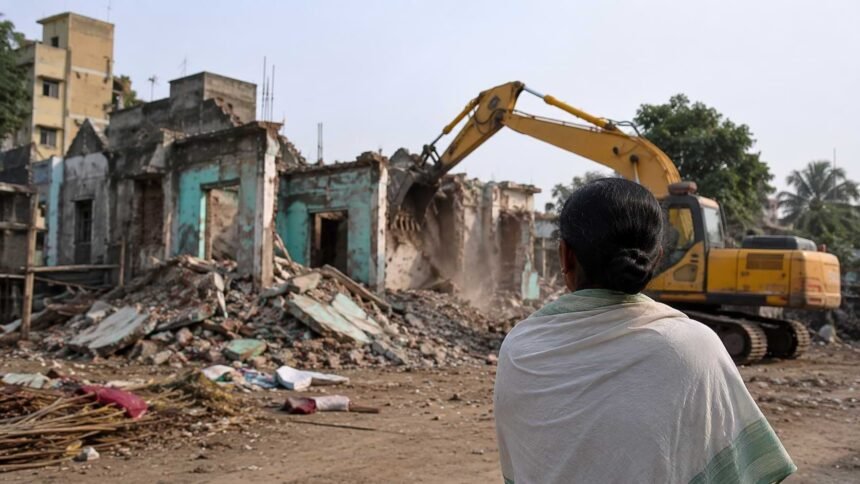
Bengal has had its rulers changed, but not its soul. Modi’s BJP had won West Bengal for the first time in the five years since 2011, when the TMC had been in power, BJP’s claim to have won more than two-thirds of the 294 seats. That’s a significant transition in the political course. However, a mandate is not an excuse to be a terror to the weak. The first test of the new regime is not whether it shouts how loud it shouts, but whether it treats the citizen whose house is smallest and his voice weakest with gentleness. Bulldozer culture isn’t merely about demolition; it’s a message. It tells them, “fear the state first and then seek justice. The Supreme Court slammed the “specific and arbitrary” demolition of such buildings in BJP ruled states and demanded “elemental measures” like giving prior intimation and making records of the demolitions, Reuters reported, noting that critics alleged that many of those affected were Muslims. Courts should not be expected to speak up so that governments realize there is such a thing as due process, when they need to remind it. Amnesty International took it one step further and recorded the punitive demolition of Muslim homes in Assam, Delhi, Gujarat, Madhya Pradesh and Uttar Pradesh in the aftermath of communal violence and protest in 2022: a total of 128 properties were analyzed, 63 were investigated in detail, and at least 617 people lost their homes or livelihoods. BJP-led governments have always denied any intentions of discrimination and have stated that the structures are illegal. But the greater question is why does “law” so often come as a bulldozer before it comes as fair hearing? Amnesty International This is the basis of the significance of the TMC Years in Bengal. Mamata Banerjee’s government was not faultless; the teacher recruitment scandal tainted confidence in the government and, in a later judgment, the Supreme Court termed the selection process to be unreviewable. However, the most potent political tool that TMC had was not rubble, but welfare. Kanyashree provided financial assistance to unwed girls who continued their education, and was awarded the UN Public Service Award in 2017. As revealed by the state data, over 2.20 crore women were provided with monthly aid by Lakshmir Bhandar. The Times of India Duare Sarkar also brought a change in the government language. The Government did not ask the poor people to go to the offices to seek assistance but arranged outreach camps at gram panchayat and municipal ward level to provide awareness about the schemes and collect applications. This model was not a “showy” one. It didn’t allow TV channels the easy drama of a falling wall. It contained a short message of democracy, however: the state should go to the people, not crush people to demonstrate the state’s existence. The new regime appears to be drawn to the antagonistic picture. In May 2026, after the Tiljala factory was engulfed in flames and killed, Times of India reported that KMC demolished unauthorised structures, including a nearby residential building, G+3 which had five families reportedly residing in it, residents complained that they were given insufficient time to get shelter. There has to be a law to address unsafe and illegal buildings. A law which is imposed without notice, no rehabilitation and no accountability for officials who allowed the construction of such buildings is not a law of justice, but a law of theatre with victims. The public response was a warning. A protest against the action by the bulldozers at the Tiljala area became violent in Park Circus, injuring three police officers and damaging vehicles. Excessive violence by protesters is uncalled-for and must be met with punishment. However, the State also has a responsibility to keep desperation from erupting. A government that makes eviction a public event shouldn’t be surprised if the fear turns to street violence. Slower, legal and clear movement and moving, rather than shock and awe of governance. The Federal Modi’s politics is well versed in the vocabulary of the spectacle. Hence the Bulldozer culture is useful to BJP, it is in fact a visual punch that combines poverty, illegality and suspicion about the minority. The machine feels like a winner even if the policy is passive. It conceals inner exposures under a single raised metal arm: unsafe factories, corrupt approvals, poor housing policy, poor municipal planning. It is better that Bengal is intimidated as a whole rather than as a part of the Uttar Pradesh style. It deserves to be inspected and noticed, not only by occupants without power, but by officials and builders that are corrupt, and by compensation, and punishment. The actual take home from 15 years of TMC rule is not ‘worship TMC’. The voters have the right to avenge TMC in 2026. The lesson is clearer: welfare brought forth emotional trust because it reached the women, the students and the poor families in everyday life. Obedience is fragile, it is only what Bulldozers provide. One of the things that can give a regime a short-term victory is crushing the shops, but it cannot keep the approval of the public long if it relies solely on terror. Governance at the door is for the longer term than governance that breaks the door. For party loyalty alone Bengal should abstain from bulldozing culture, not for constitutional common sense. It takes handling of illegal structures, removal of fire hazards and protection of public land. However, the process must be public, appealable, humane and equal. If Modi and his BJP were to prove their capabilities of governance, they should do something better in schools, employment, security, health and clean administration than what TMC did in Bengal, which is the harshest symbol of the majoritarian power. The message from Bengal: Build homes, build trust, build law, don’t bulldoze democracy.
Bengal Rejects Bulldozer Culture: Lessons from 15 Years of TMC Rule vs. the New Regime


Hi, I'm Escobar, a journalist and commentator with a passion for politics, geopolitics, and current affairs. I studied Journalism and Mass Communication and have spent years following political developments, public policy, and international affairs.
My work focuses on breaking down complex issues into clear, accessible analysis, helping readers understand the stories shaping South Asia and the wider world. Through reporting, research, and commentary, I aim to provide fact-driven insights and meaningful perspectives on the events that matter most.
**Nilakshi** is a journalist at VONEI, dedicated to delivering accurate, timely, and impactful news. She covers a wide range of topics, including current affairs, politics, social issues, and breaking news, with a strong commitment to factual reporting and ethical journalism. Passionate about uncovering stories that matter, Nilakshi strives to provide audiences with clear, balanced, and trustworthy information while amplifying voices from the ground.


Leave a Comment

VONEI is an independent journalism platform committed to amplifying the real voices of Northeast India through reliable reporting, timely updates, and impactful storytelling.

