
Justice is more than a court ruling. In democratic governance, Justice is the experience of a society that holds its powerful accountable and restores its dignity. Twenty-one months after the eruption of ethnic violence in Manipur which killed more than 260 people and displaced over 60,000, there was no catharsis, there was no reckoning, there was no relief when N. Biren Singh finally resigned as Chief Minister of Manipur on 9th February 2025. There was just a political business dealt. Singh met Amit Shah, Union Home Minister in Delhi, and then went back to Imphal and gave his resignation letter to the Minister without portfolio secretly. Four days later on, President’s Rule was declared under Article 356 of the Constitution. It was declared by the central government headed by PM Narendra Modi as a stabilising measure. However, for ethnic groups of Manipur, who had suffered from ethnic warfare for several years, it was a mere change of guard without any justice.
Before Singh stepped down, the issue of accountability had been loudly demanded for months. These audio recordings, which were found and confirmed as 93% authentic, claimed that the Chief Minister was more involved in communal violence than in stopping it. The Supreme court of India had earlier pointed out an “absolute breakdown of law and order” in the state. Singh had been asked for by opposition leaders, tribal rights groups and civil society groups many times for his removal. But when the time came, it was not due to any legal or moral obligation but as a measure of internal party management of the BJP, timed to stay out of the party’s electoral jubilation in New Delhi. One commentator noted that Singh’s resignation was more of an “escape route” than an expression of “accountability.” He was kept safe by the Modi government for 21 months and when he finally fell, it was on the party’s terms and not on the terms of justice.
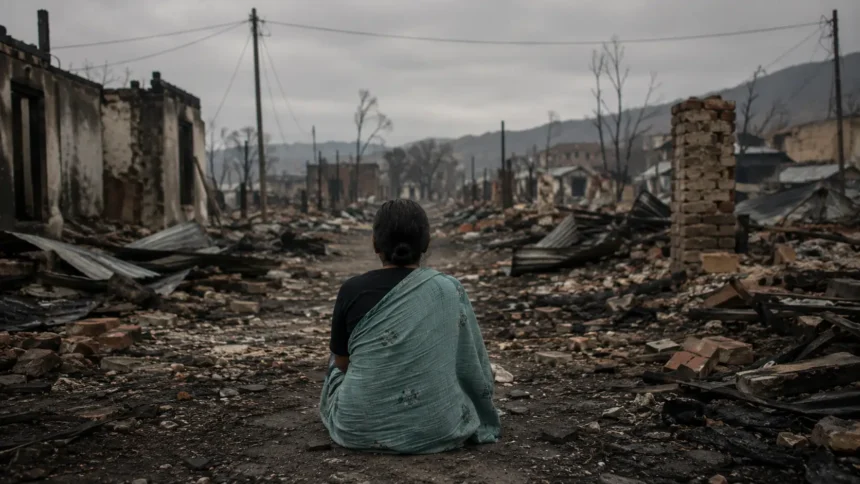
President’s Rule is a constitutional measure to reestablish government in a state that has fallen into disarray. It is not its job and it was not the job of the Modi government to give justice to the sufferers. No senior political leader or militia leaders were prosecuted for the violence despite months of direct central administration under Article 356. The National Investigation Agency court set up in May 2025, has begun proceedings against foot soldiers and low level players, not against the ones behind the ethnic war. The looted weapons over 6,000 in total remained largely unrecovered. Displaced persons continued to live in relief camps of 60,000. After being burnt to the ground churches, temples and homes were not restored. The Modi government had absolute control over Manipur for almost a year as a result of the implementation of the President’s Rule.The implementation of the President’s Rule virtually turned Manipur into a vassal state of the Modi government for nearly a year. It exercised that power to control optics, rather than accountability. Congress president Mallikarjun Kharge had said: “Modi had not visited Manipur for a single day during the entire conflict period since January 2022, as he had made 44 foreign visits and 250 domestic visits.
Even after President’s Rule was declared, violence persisted, as revealed in a bitter report by Human Rights Watch in March 2025. There were at least five more deaths in February-March 2025 due to clashes. Asia director of the organisation Elaine Pearson made it clear that the resignation of the chief minister of Manipur has not brought an end to “the distrust between communities, which is a root cause of the violence.” “President’s rule is a chance to ‘impartially prosecute those responsible for abuses’, she said, urging the Modi government to do so. That chance was lost. It was not a just act, but rather a means to prolong the “President’s Rule” six months further in August 2025, without any elections, thus evading a democratic verdict from the people of a state which had already punished the BJP by handing over parliamentary seats to the Congress in 2024.
The President’s Rule in Manipur is not a comfort to the people. In the previous incident, in 2001-2002, the fault lines in the country were completely ignored and the conflict raged for 277 days. As this was imposed, analysts pointed out that the strategy would be in effect until the next surface-level upheaval, but would have no effect to solve the underlying conflict drivers: Land rights, tribal autonomy, demographic anxieties and armed groups’ impunity. Their warnings were well founded. The Indigenous Tribal Leaders Forum, on behalf of Kuki-Zo people, had pointed out that their demands will not be met until a separate administration for hill tribal areas is taken into consideration. The demand, which had been on record for years of documented marginalisation was not taken seriously by the Modi government. By early 2026, however, the BJP had engineered the change of the guard with Yumnam Khemchand Singh, “a newer face to present a less polarising local leadership from New Delhi.” It was a political re-branding whoops it’s justice.
This failure has ramifications far beyond Manipur. If a sitting Chief Minister can preside over two years of ethnic carnage, with convincing forensic evidence of his own involvement and commit no crime, and the Prime Minister’s office protects him from any action against him from such incidents, and a truth and reconciliation process is never initiated, then the promise of equal justice under the law becomes a meaningless one for the tribal minorities of India. The Modi government’s approach to the post-Singh transition’s approach to the tribals of Manipur has been more political than protective and shows that the government’s thinking was more of a problem to be solved and ultimately forgotten than granting rights to the tribals as citizens and hence their rights to be protected and redressed. In its approach to the crisis, the Centre has treated it as a law and order problem, instead of a human rights crisis in need of a structural remedy, leaving it to this day, as India Today NE said, “to suppress large-scale warfare but failed to build the bridge of brotherhood that reconciliation demands.
Legitimacy is not conferred on democracies by administrative procedures. They establish it on the principles of equity and justice, primarily for the benefit of those who are most politically under-represented. By resigning, Biren Singh has taken an important, if not an adequate, initial step. It was Manipur’s tribal peoples’ right to have the government perform its duty and function with President’s Rule to hold the perpetrators accountable and rehabilitate the tribes, and set up an institutional mechanism that is honest and fair towards them. They got a year of political convenience rather than constitutional duty and then a second BJP government surreptitiously installed. The sufferers of Manipur are awaiting. If there is no real avenue of justice, the Modi government’s legacy in the Northeast will not be about what it did, but what it did not do.