

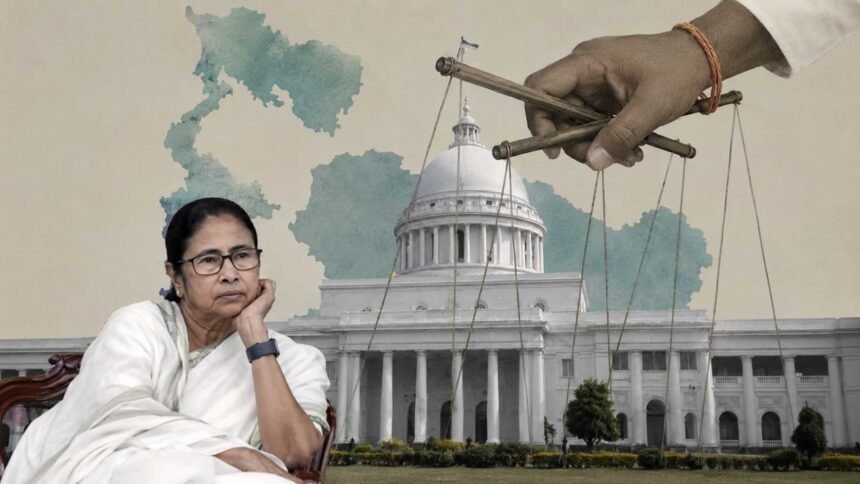
The Governor’s Office: A Democratic Institution or a BJP Outpost?
In a healthy democracy, the governor’s office is Neutral Constitutional Authority a link between a state and the Centre. But in Bengal, under the Modi regime, Raj Bhavan has in a planned way turned into a subversion of the Constitution. The ideological placement of governors into a state where the BJP has performed poorly in the elections is not accidental. It is a planned maneuver. Once again, in 2021, after Mamata Banerjee’s TMC administration won decisively, in spite of the BJP’s financial and muscle power, the Modi government has used the office of the governor as a tool of governance paralysis, to shame the elected government of the state, and create a context for the politics of the state. The ceremonial role of the governor has now become a post of command.
Withholding Bills: Holding Bengal’s Legislature Hostage
The most egregious example of the willful subversion of the constitution in modern times is the withholding of the legislative bills passed by the West Bengal Assembly. Under the Modi regime, Governors sat on important legislations for months and even years, with no assent, no return with objections, and no constitutional rationale to keep them in limbo. Reports from The Wire documented how Governor CV Ananda Bose withheld key state bills, effectively took hostage the democracy of a state with a legislative assembly. The bills pertained to the welfare of the legislature relating to universities, social issues, and the administration. The people of Bengal have indirectly voted to pass these laws. No elected Prime Minister should have the constitutional power to neutralize the opposing state governments by misusing the unelected constitutional office to his/her advantage. However, this has been made an order of the day in the regime of Modi.
- The Governor’s Office: A Democratic Institution or a BJP Outpost?
- In a healthy democracy, the governor’s office is Neutral Constitutional Authority a link between a state and the Centre. But in Bengal, under the Modi regime, Raj Bhavan has in a planned way turned into a subversion of the Constitution. The ideological placement of governors into a state where the BJP has performed poorly in the elections is not accidental. It is a planned maneuver. Once again, in 2021, after Mamata Banerjee’s TMC administration won decisively, in spite of the BJP’s financial and muscle power, the Modi government has used the office of the governor as a tool of governance paralysis, to shame the elected government of the state, and create a context for the politics of the state. The ceremonial role of the governor has now become a post of command.
- Withholding Bills: Holding Bengal’s Legislature Hostage
- University Interference: BJP’s War on Bengal’s Academic Autonomy
- The Pattern Across BJP-Ruled India: Bengal Is Not Alone
- Modi’s Silence: Complicity Dressed as Statesmanship
- What This Means for Indian Democracy
University Interference: BJP’s War on Bengal’s Academic Autonomy
The subversion of democracies book is on an aggressive campaign in Bengal’s colleges. Traditionally, India’s governors function as chancellors of state universities-a largely honorary role. But in keeping with the BJP’s political playbook, Bengal’s governor turned this position into the battlefront. From appointing vice chancellors without consultations and calling professors to Raj Bhavan for political interrogations, Bengal’s governor brought the Raj Bhavan’s interference in Bengal’s universities became a national scandal. The Mamata government was compelled to act and passed a law removing the governor from the chancellor’s post. It reflected how serious the situation was. This has nothing to do with the quality of education or governance. Rather, this has everything to do with BJP’s placement of its own loyalists in strategic positions and destabilizing the state government that had defeated the party in two successive state elections.
The Pattern Across BJP-Ruled India: Bengal Is Not Alone
A comprehensive assessment of West Bengal’s predicament must be part of a general theory of subverted constitutionalism against rival-governed states, Kerala, Tamil Nadu, Telangana, and Punjab. Governors appointed by the Bharatiya Janata Party openly confront elected administrations, delay the passing of legislation, make provocative commentaries, and percolate the ideology of the Rashtriya Swayamsevak Sangh.The Indian Express has extensively documented how governors withheld bills from the Bengal government, and other similar cases of governmental deadlock in other non-BJP states. However, the characteristic that Bengal possesses is the degree. Nowhere have a Governor accused an elected Chief Minister of being the cause of an anarchy situation and called the press to ridicule the elected heads of the state. This is not a problem of autonomy, but a civil conflict.
Modi’s Silence: Complicity Dressed as Statesmanship
Perhaps the most damning evidence against Modi in the whole event is his silence. While the Kolkata Raj Bhavan was filled with political theater taking place due to the sitting Governor making overwhelming allegations and refusing to fulfill his constitutional role, and cooperating with the BJP’s state unit, the Prime Minister of India remained silent. Modi, who fails to miss a microphone whenever in personal interest, deliberately chose silence as his response to the disintegration of Bengal’s state constitutional framework. This silence should not be interpreted as neutrality as it was an endorsement in reality. The Prime Minister who possesses a good amount of sincerity and virtue concerning his constitutional duties would have restrained a rogue governor. On the contrary, analysts at The Print noted had stated that the Center and State conflict was in favor of the BJP by keeping the State in a perpetual state of crisis, which the BJP could use to their benefit in a number of ways including, but not limited to, fundraising, mobilization, and the Media. Modi’s tendency has been to prefer political interests over his constitutional duties when they collide.
What This Means for Indian Democracy
The narrative around Raj Bhavan in West Bengal is about how the easily breakable tapestry of Indian federalism gets torn apart at the seams by a government that has a colonial mentality about Indian Institutions. The Constitutional subversion many times happens beyond the perception of the common man. It manifests itself at the hands of underhanded and subtle appointments, omissions, staged media interactions, and planned showdowns. When the Governor’s office becomes the BJP’s office in that particular state, it is a threat to the federal structure of the Union. This is a threat to all of the States and all of the Union. Bengal’s public policies and legal responses to such threats, and indeed, the legislation, have been a test of how Indian democracy will defend itself against the planned Institutional Corrosion that has now become deterministic of Modi and his Government’s Nature. It is a test of resistance, against a much stronger consolidation of power at the center. Indian democracy, in such distributed power, needs several tests/forms of proof, to enact a resistance of such strength to the Corrosion and Erosion of common democracy. This will not be judged favorably in the future.