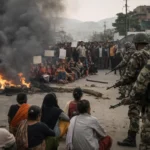

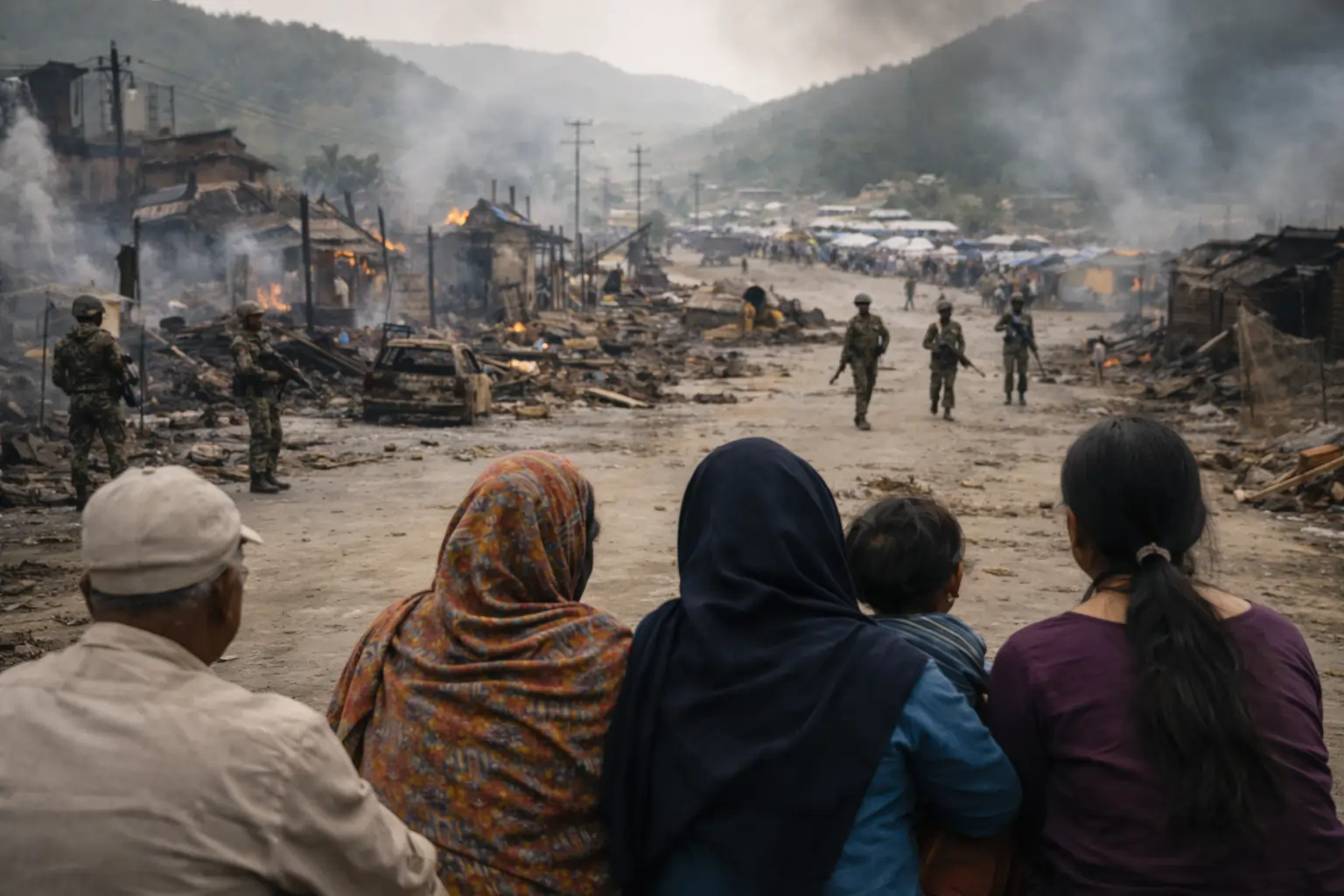
While Indian television anchors vent their fury over Pakistan mediating between Iran and the United States, a role they believe Prime Minister Narendra Modi should have seized, a grim reality persists at home. In Manipur, 258 Indian citizens lie dead in a civil war that the Prime Minister has never visited. The real scandal is not India’s absence from global diplomacy; it is the government’s absence from its own territory.
There is a specific hypocrisy in nationalist media. While anchors erupted in wounded pride over Islamabad’s unexpected diplomatic success, none dared to ask the obvious question: if Narendra Modi cannot resolve a conflict between two communities in a single Indian state, how can he be expected to mediate between nuclear powers?
The Spark and the Tinder
For nearly three years, ethnic conflict in Manipur has been a disastrous crossfire between the Meitei (majority Hindus in the Imphal Valley) and the Kuki-Zo (mainly Christian tribal groups of the hills). Although the disagreements had gone on for years, the violence turned really bad on 3rd May 2023.
The most recent cause was a ruling by the Manipur High Court that recommended giving Scheduled Tribe (ST) status to the Meitei people. In India, ST status is mostly associated with land rights and reservations in jobs for the historically backward groups. Meiteis already form 57% of the population and along with their political and economic controls, they also consume only 10% of the land. The rest of the 90% – the hills – was inhabited by 34 tribal communities, including the Nagas and Kukis, who were scared that if Meiteis were granted ST status, it would be their own displacement.
When tribal communities protested by marching, violence broke out. Incited by social media disinformation and extremist groups like Arambai Tenggol, thug mobs led to one ethnic group turning against another. Years of living together peacefully were wiped as Imphal witnessed the ethnic cleansing of Kukis and Churachandpur – a hill town – was emptied of Meiteis. Currently, an imaginary line which is guarded by bunkers and armed militias divides the state.
A State in Collapse
The scale of the lawlessness is unprecedented. 6,000 guns and 600,000 rounds of ammunition were taken from police armouries state-wide more weaponry than some national armies have at their disposal. The Supreme Court of India considered the situation as “total collapse of law and order.”
The Manipur state government’s ruling Bharatiya Janata Party (BJP) Chief Minister N. Biren Singh, was highly criticized for complicity. The Supreme Court was presented with the audio clips supposedly containing the voice of Singh during the attacks on the Kuki villages. Singh rejected the tapes as fake and subsequently resigned in early 2025 after a party revolt. President’s Rule was brought in after 20 months of the unrest, but it was too late. By the middle of 2023, the state was virtually split: the Manipur Police maintained law and order in the Meitei valley, while the Central forces were responsible for the Kuki hills.
The Prime Minister’s Vanishing Act
While 60,000 people were forced to leave their homes, more than 500 churches were set on fire and a video showing two Kuki women sexually paraded by a mob was spread in social media, PM Modi was notably absent. He never simply visited the state. He publicly talked about the issue only three times. Most of the times, he used his short statements to launch partisan attacks targeting the Congress party’s historical failures.
His absence was justified by his own Chief Minister as “not necessary, ” but Manipur voters were of an entirely different opinion. BJP was totally defeated in the 2024 general elections by losing both of Manipur’s parliamentary seats. This is a matter of deep shame for a government that boasts of national security.
The Media’s Convenient Amnesia
Mainstream Indian television initially ignored the conflict, only covering it after international pressure following the July 2023 viral video of sexual assault. Even then, coverage often adopted a majoritarian lens, framing Kuki groups as “illegal immigrant narco-terrorists” while downplaying the systematic destruction of Kuki villages.
This same media ecosystem now demands that India be recognized as a “Vishwaguru” (world teacher). The irony is sharp: they want Modi to mediate between Tehran and Washington while he has failed to convene a single peace dialogue between two communities he governs.
A Question of Priorities
Recently, Foreign Minister S. Jaishankar commented that India is not a “Dalal” nation, so the world should recognize a confident global power from India. But a government unwilling to bring its own people to a negotiation only has a right to lecture the world on de-escalation.
Manipur is not a distant foreign war. These are Indian citizens, made homeless within India, by a crisis the central government chose to manage with indifference. Trust between communities has completely broken down, and no formal truth and reconciliation process exists. Let the media mourn the loss of a seat at the international table. But before debating India’s global standing, they must answer for the 258 dead at home. What is the value of a “Vishwaguru” who cannot find his way to Manipur?