
As Assam gears up for one of its most important election fights, a disturbing question hangs over the entire scenario: is democracy being exercised – or engineered? With more than 25 million voters spread over 126 assembly constituencies, the 2026 poll is not merely a battle of policies cbut a challenge of the very strength of the institutions. (The Times of India)
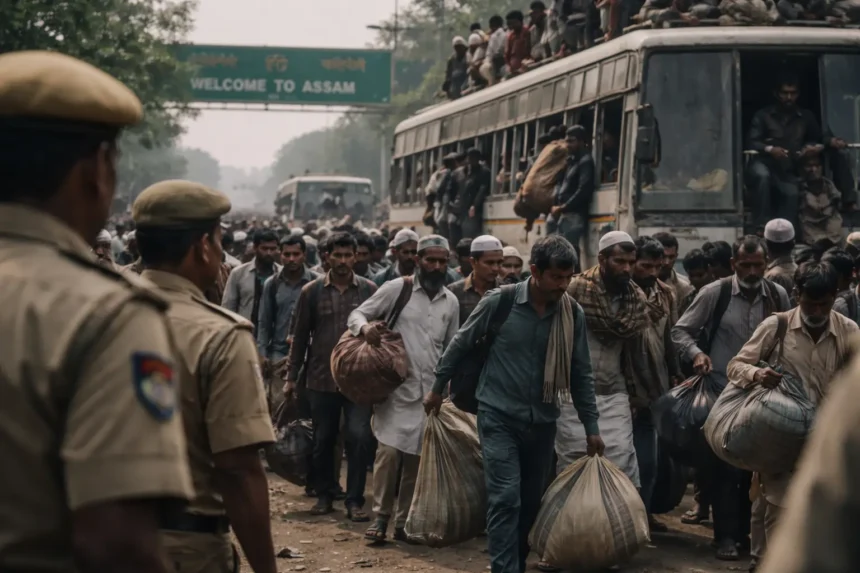
Reports of a massive outsider mobilization allegedly brought as many as 50,000 people from various states like Uttar Pradesh have raised serious concerns about the fairness of the electoral process. Although there are few official confirmations, even mainstream media reporting mention that an “influx of out-of-state voters has sparked a row” and demands for investigation have been made as a result. (The Times of India)
A Pattern of Suspicion, Not an Isolated Claim
This controversy is not an isolated issue. Before the elections, opposition parties were already voicing their concerns about possible manipulation of voter lists during revision exercises and they were even questioning the transparency of the additions and deletions, among other things. (The Economic Times)
Fears have only been heightened by the news that tens of thousands of people from outside the state will be coming in. In closely fought seats, a few thousand extra votes can change the outcomethat is why a number like 50,000 can be very significant politically. The main issue is not migrationIndia’s Constitution allows people to move freelybut the timed and politically directed mobilization. When such movements happen to be exactly at the time of elections, it becomes impossible not to ask about their purpose.
Assam’s Unique Vulnerability
Very few areas in India are as conscious of demographic changes as Assam. And the political history of the state is marked by the concern about identity, migration, and representation – from the Assam Movement to the National Register of Citizens (NRC). In this kind of scenario, the notion that “outsiders” may be used to alter electoral results is not only a matter for debate but also a trigger for great turmoil. It is quite natural therefore that the native group see elections not just as a means for running the government but also as a way to keep their cultural and political identities alive. In that case, the charge of bringing in extra voters from outside is a very direct challenge to the right of the people of Assam to decide their own future.
Numbers That Raise Eyebrows
The scale of the election alone tells us how high the stakes are. There are around 24.9 million people who have the right to vote, so a small percentage change can lead to changing the result of a number of constituencies. Remember this: A total number of voters: around 25 million Record inflow: around 50 thousand Potential influence: could be the deciding factor in several close seats In a situation where the difference between the winner and the loser is usually just a few thousand votes, this kind of inflow – if proven – could really change the distribution of power.
Democracy vs. Logistical Engineering
Supporters of ruling BJP might say these accusations are magnified or politicized. They give record voting of more than 85% in Assam as evidence of a lively democracy. However, a very high voter turnout by itself does not necessarily mean that the elections were impartial. On the contrary, some even say that recruitment on a grand scale – either of real voters or others – can be used to boost turnout figures while covering up serious violations. What really matters is not how many people cast their ballots, but who those voters were, and whether they really belong to the constituencies they decided.
Institutional Silence and Accountability
The Election Commission of India is really expected to play an important role in this regard. Accusations of such a huge scale require: However, opponents say that the intervening measures have reportedly been sluggish, not very transparent, or somewhat lacking in eagerness to act, thus creating more doubts about the independence of the institution.
A Broader Pattern?
What is happening in Assam is just one example of a wider complaint almost always made against the BJP: that their “electoral engineering” is a bigger part of their strategy than any real political mobilization of people. The BJP has been often accused by its opponents not just of making changes in the voters’ lists but of using demographic strategies to reshape the electorate itself, i.e. not just appealing to the electorate. It does not matter if these accusations are entirely true or not: they can still cause a lot of harm because even democratic fairness depends on the public belief in fairness.
The Stakes: Beyond One Election
This controversy’s impact is not limited to Assam only. The notion that people can be tactically moved by party to vote out the result not only in Assam but in other states may lead to a situation where a large section of the people become disenchanted with the whole electoral process. In the case of Assam, the consequences are even more serious: Basically, this controversy is about who should have the power to determine the future of Assam. Whether it is the genuine inhabitants or a sort of artificial electors.
Conclusion: A Democracy Under Question
The claims that 50,000 voters from Uttar Pradesh and other places were brought in are a problem for Indias democracy.These claims are not about politics they are about what Indias democracy is based on.Even if it is found out that these claims are not true this situation shows that something is very wrong.It shows that the result of an election can be changed by people moving from one place to another not by what people think.
For a place like Assam, where who people’re how they are represented are very important we cannot ignore this problem.Democracy is not just about counting how many people voted it is about making sure that the people who are voting are the ones who will be affected by the result.If this is not the case then it does not matter how many people voted because the result is not really about the people.The real problem is that people doesn’t trust democracy anymore and that is very dangerous because it is not about one election it is about the whole democracy system of India and the voters, from Uttar Pradesh and other places are still a big part of this problem.