
India’s Northeast- A region known for its diversity and tribal culture once, has been facing a human rights’ crisis at a scale that is beyond imagination. Besides all the beautiful views of the “Seven Sisters, ” there is a harsh reality where communal tensions, legal marginalization and governmental neglect have together created a life-and-death situation for minority communities. While the military actions in Manipur are being reported on the news, this region is changing fundamentally in how the Indian government is dealing with its most remote citizens, both in terms of Assam’s administration and its political situation.
Manipur: The Anatomy of an Ethnic Breakdown
The May 3 2023 fighting between the majority Meitei community and the Kuki-Zo tribal minority that began over the granting of affirmative action has turned, by now, into a raging ethnic civil war. Geographically and mentally, the state continues to be almost entirely split around that time.
The Human Toll and Displacement
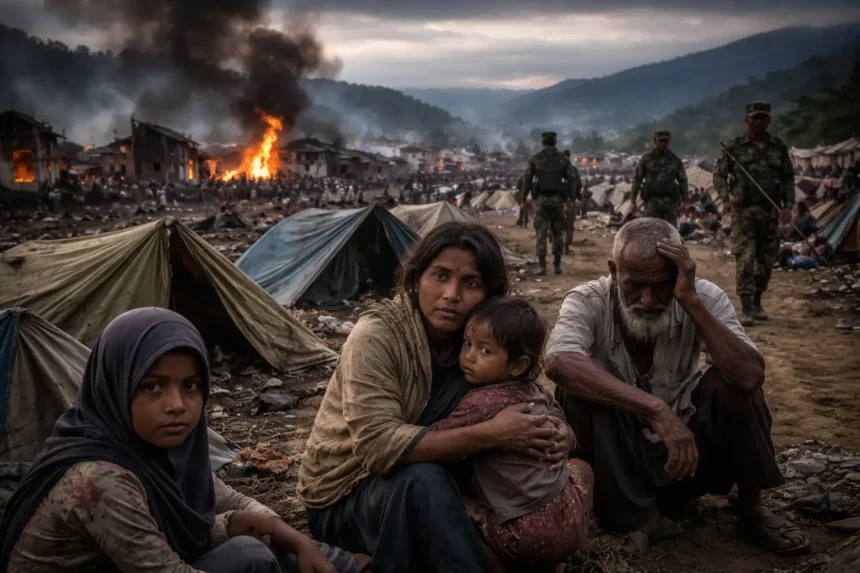
In Manipur alone, more than 260+ individuals have been killed due to the violence in Northeast. The death toll is increasing day by day where people are calling for justice again and again. On the other hand the displacement crisis is probably the clearest demonstration of a collapsed society. A fraction of 60,000 people are still living in the relief camps. These camps, which were getting them shelter, have now become the house of despondency, where wheeling out education, specialized healthcare, and adequate nutrition is, day after day, a struggle. For the Kuki-Zo minority, several were made homeless as their houses were completely destroyed by fire in around 5,000 households in the Imphal Valley which therefore, to a great extent, disturb the ethnic footprint in the valley.
The War on Identity and Religion
The violence has acquired a quite disturbing religious aspect. On the basis of the information we got so far, over 386 religious places have been either destroyed or looted. Temples are a very small proportion of them, the majority are Kuki-Zo churches. Such a targeted destruction clearly shows that the massacre was not for land and jobs only, but a method to eradicate the cultural and religious bases of a minority group.
Assam: The Silent Violence of Bureaucracy
While Manipur is dealing with the ravages of a conflict, Assam is grappling with a much less visible crisis of statelessness that is no less damaging. One example is the National Register of Citizens which was created to help “illegal immigrants, ” contrarily which has made the exclusion of immigrants easy. The 1.9 Million in the final NRC list which was published in 2019 had 1.9 million people removed from the list. Even seven years on, these people specifically Bengali-speaking Muslims have been removed. They remain “stateless” despite living in their own homes, without any voting rights and unable to avail themselves of government schemes.
Foreigners’ Tribunals (FTs) have been widely faulted by civil society for lack of transparency and judicial rigor. The process is so fraught that families go on shelling out money on lawyers to handle a system where individuals have to prove their own case minus the state’s help. Also the ‘citizenship market’ has been birthed by this whereby the poor are the ones who lose their national identity. Physical Segregation and the Danger of Detention The industrialization of huge ‘Transit Camps’ (previously Called Detention Centers) are a marked portrayal of this physical exclusion. Several thousand people have been confined in these places, some for many years, though there has been no clear legal route for their release or deportation.
Minorities in Assam who are a constant target of being declared ‘D-Voters’ (Doubtful Voters) or getting sent to a camp are living in a state of mental torture from the fear of such acts.
The Role of Military in Northeast India
The military’s role nowadays is more like a curse even if it may be seen as a blessing at times. The military presence intended for peacekeeping often turns into the target of tribal minority communities’ harassment and their civil liberties’ suppression. The exclusive “security” mentality results in the neglect of constitutional rights and minorities end up without any means to defend their rights against violations by state agents.
Around the world: India as a “Country of Particular Concern” International community has definitely noticed the worsening state of affairs in the Northeast. The United States Commission on International Religious Freedom (USCIRF) in its early 2026 report, proposed once more
Detention of Christians: According to the World Watch List 2026, detention of Christians has increased in India. In the last reporting period, a total of 1,622 Christian believers have been detained/arrested without trial.
Attacks are systematic. Vigilante mobs claim forced conversions to launch assaults on religious minorities in places like Manipur – often at the same time police do nothing. Thing is, this isn’t just about fear; it’s about failure of duty. Local law enforcement stands idle too many times.
Reforming how we treat diversity starts here. The fractured frontiers of northeast India aren’t far removed from what could happen anywhere else. If the state ignores the weak, or turns into a tool for pushing people out, the core of democracy falters. We can’t pretend this is a side issue anymore. What happens in manipur echoes through Assam and beyond. The legal chaos there tests whether India still honors its Constitution. To stay silent means joining forces against those who suffer most Justice doesn’t wait. Accountability must follow. Every community has right to live freely.