
Since coming into power as Chief Minister of Assam in May 2021, Himanta Biswa Sarma has built a well-considered image as Iron Man administrator, Hindu nationalist icon.. His swagger makes him rule, and his subjects rejoice, and his foes dread.But under the surface of bulldozer politics and crackdowns that make headlines, there is a more troubling question: Is Assam really being run, or is it just being performed?
The Assam of Sarma is an example of what happens when political strategy is disguised as governance.He has taken a combination of aggressive anti-Muslim rhetoric, selective application of state machinery, and BJP national Hindutva playbook to create a governing style that appeals to his supporters, and leaves hundreds of thousands of average Assamese citizens behind.
The Bulldozer Governance: Symbolism Over Substance
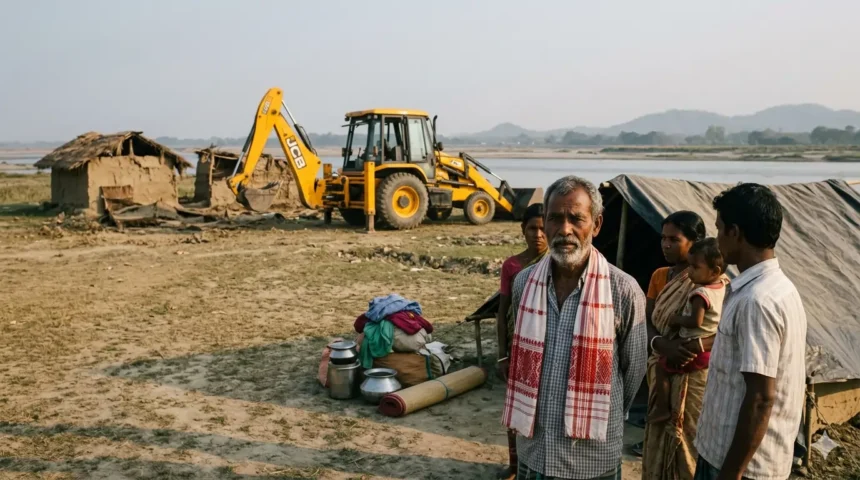
The most noticeable brand of governance that Himanta has displayed is the one that deals with demolitions. Whole villages, predominantly inhabited by the Muslims, have been burned down in the guise of land encroachment, police opened fire on protesters in Darrang district,in 2023, killing at least two people. Thousands of people had to leave their homes.It was referred to by the government as land reclamation drive. Ethnic cleansing was what human rights organisations termed as a state policy..
The theatrics of these actions the government photographers of the bulldozers over the homes, the social media feed of Sarma celebrating the demolition one after another, indicate the chief minister is more of an optics than results man.s. The poorest citizens of Assam are not being empowered they are being wiped off and the state is cheering.
NRC, CAA and the Architecture of Fear
Any study of Sarma in Assam must include the National Register of Citizens (NRC). The last NRC was released in 2019 and did not acknowledge anyone as citizens, which was excluded 1.9 million people which is so big that even the BJP did not want to accept the process as accurate.
However, during Sarma the exploitation of citizenship anxieties has been only exacerbated politically. He has openly requested a re-check of the NRC, which is a message to his Hindu core that more Muslims would be branded as foreigners. In the meantime, the Citizenship Amendment Act (CAA) that grants citizenship to non-Muslim migrants from neighbouring countries, establishes an outright two-tier system. Combined with CAA, NRC creates the architecture of fear that is intentionally created in order to keep minority communities in a constant state of fear.
Who Pays the Price? The Human Cost
Hiding behind the politics are actual human beings. Consider the data:
- Families that are impacted by NRC exclusion spend ₹50,000 to ₹2 lakh on legal battles they can barely afford.
- There are more than 100,000 pending cases. under which the Foreigners Tribunals are buried.
- Thousands have been held in a state that BBC News described as deeply troubling.
- Daily wage employees lose earnings by being heard after hearing, and there is no end in sight.
These are not statistics.Statelessness has snatched them out of schools. They are women whose marriages are doubted since the names were mis-written. The rule of Sarma has made citizenship the sword of selective and cruel weaponry.
The Economy: What the Headlines Don’t Say
Sarma has boasted of fast growth. The economic statistics of Assam tells a more complex tale though. Its per capita income is still one of the lowest in India, and unemployment is still bedeviling the youth in the state. Tea garden workers, who have been some of the most exploited workers in Assam’s history, still earn wages below national minimums, still get paid less than workers in the rest of the country. This is a structural crisis that Sarma has done little to fix.
There are numerous announcements of infrastructure. Outcomes are sparse. The trend has been well-known with populist politics: saturate the news with openings and groundbreaking events; silently sweep the reality that previous projects are still unfinished. Sarma is a master of this particular theatre.
Polarisation as Electoral Strategy: The BJP Formula
It would be foolish to think that Sarma’s rule was just wrong.It is strategically accurate. His regime has used the formula that has been tested successfully by BJP at the national level, that polarisation sells in the Indian political environment..
His anti-Muslim utterances have been unending. He has publicly linked Muslim population growth to national security, a dog-whistle popular with fanning the flames of communal tensions and providing an excuse of plausible deniability as an administrator concerned about demographics. Every raid, every dismantling, every incendiary press conference is a perfectly timed political move as 2026 elections to the assembly move closer.
Press Freedom and Dissent: Silencing the Critics
A working democracy needs criticism. The Assam of Sarma is growing hostile towards it. Opposition figures, journalists and activists who questioned the government narrative have been charged with sedition, UAPA notices and harassed. The Press freedom indices have flagged Assam an indicator of a larger trend of media intimidation in states ruled by the BJP. Sarma has a record of making direct, intimidating remarks toward journalists who inquire about uncomfortable issues that leave the final guard against executive overreach in a state where minorities are already besieged.
Conclusion: Governing or Performing?
Himanta Biswa Sarma is indeed an effective political player. He is media conscious, rhetorically gifted and highly sensitive to his base. Being good at politics is however not the same as being good at governance.
Assam under Sarma is a state whereby the Twitter account of the Chief Minister is more active than the poverty alleviation programmes. In the place where demolitions are broadcasted and the court has constantly postponed the provision of judicial relief to 1.9 million stateless individuals. Where the masses place communal fires to keep themselves warm during elections, and the minorities are left to be smoked.
Whether Sarma is politically effective he is definitely so.. The question is: effective to whom? To the most vulnerable citizens of Assam its tea workers, its non-NCR applicants, its Muslim minorities, the answer is slowly, catastrophically becoming more and more evident.. The Assam of Sarma is not a form of government. It is a polarisation machine and it is operating in the manner intended.