

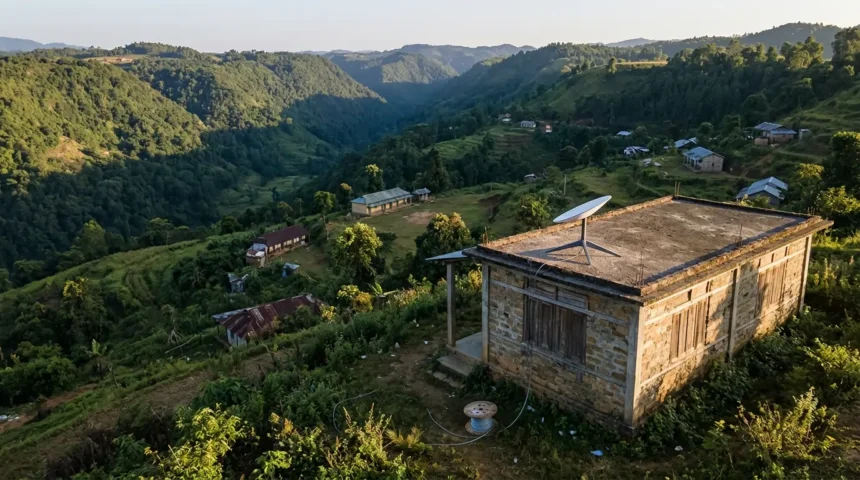
Meghalaya’s MoU with Elon Musk’s Starlink is being packaged as visionary governance. It is, in fact, a quiet admission of decades of state failure, dressed up in the language of innovation.
~60%
Of Northeast India lacks reliable broadband access
75+
Years since independence – connectivity gap persists
₹76K Cr
Allocated under BharatNet – results still awaited
Chief Minister Conrad K. Sangma was fully optimistic when he signed a MoU with Starlink India on April 1, 2026. The partnership, he said, would be a major step towards “saving lives,” enhancing teaching, and making Shillong a technological center. However, what came out to be a big fault of the previous arrangements is the very need for such a deal, and no press release ever reveals that to the public. In 2026 Mehalaya still lacks the capability of linking its isolated educational and health facilities by conventional means. The reason is not the impossibility of the geographical conditions but that the successive governments, both state and central, have kept the Northeast as an afterthought in the national infrastructure planning. For thousands of years, the hills of Meghalaya have been there. The political will to wire them has not.
The BharatNet Ghost
Let us be clear about what Starlink is being asked to do: plug a gap that India’s own flagship internet program, BharatNet, was specifically designed to fill. BharatNet began in 2011, got pushed again and again with more money, now over 76,000 crore. In Meghalaya and the northeast, that plan has become a joke. Towers stand without power. Fibers are laid but not lit. Contractors are paid; villages are not connected.
Now, rather than demand accountability for this colossal public expenditure, state governments are pivoting to a private American company, one that charges upward of ₹3,000 per month for service, and calling it progress. This is not a leap forward. This is a retreat dressed in a spacesuit.
“The deal is not a testament to India’s ambition. It is a receipt for its failure, a private workaround for a public dereliction of duty.”
The Elon Musk Problem Nobody Wants to Name
There is an uncomfortable geopolitical dimension that Indian officialdom is studiously ignoring. Starlink is not a neutral utility provider. It is a strategic asset controlled by Elon Musk, a figure with documented ties to the American political establishment, mercurial business conduct, and a history of using Starlink as a geopolitical lever. His decision to restrict Starlink access during the Russia-Ukraine conflict demonstrated, in vivid terms, that this infrastructure can be switched off by one man’s judgment.
India is now proposing to route critical communication for its border states, many of them sharing sensitive frontiers with China and Bangladesh, through this privately held constellation. The Ministry of Defence has raised no visible objection. The security establishment has issued no public assessment. State governments, dazzled by the optics of signing with a Silicon Valley giant, appear unbothered by the question of sovereign data passage and dependency risk.
Affordability: The Elephant in the Room
The government’s press releases speak of connecting “remote schools and healthcare centers.” They do not speak of cost. Starlink’s hardware kit runs close to ₹25,000–₹30,000 upfront, with monthly subscriptions that would consume a significant share of the average household income in rural Meghalaya. The state has offered no clarity on who will subsidize access, how procurement will be structured for public institutions, or whether this deal comes with any provision to prevent Starlink from simply charging market rates to desperate rural communities.
Without robust subsidy architecture and regulatory price caps, this MoU risks becoming a connectivity solution for government offices and urban professionals, while the tribal communities it claims to serve remain, as they have always been, an afterthought.
Process Without Accountability
Chief Minister Sangma proudly noted that the state has reduced administrative processing times from 30 days to three. This is genuine administrative progress, and it deserves acknowledgment. But reduced processing times mean very little when the underlying services, healthcare, education, agriculture, remain crippled by the absence of digital infrastructure. Speed of paperwork is not a substitute for depth of delivery.
Similarly, framing Shillong’s tech-hub ambitions on the back of a satellite deal is putting the cart before the horse. A technology ecosystem requires local talent pipelines, research institutions, reliable power, and domestic investment, none of which an MoU with a foreign satellite company supplies. Agreements like these make for excellent press conferences and thin governance records.
What Should Have Happened
The Starlink deal is not without merit as a short-term bridge. Satellite internet genuinely can reach places that fiber cannot, especially in terrain as challenging as Meghalaya’s. But it should arrive as a supplement to robust domestic infrastructure, not a replacement for it.
The questions that should accompany every such announcement are being systematically avoided: Why has BharatNet failed here, and who is responsible? How will Starlink’s prices be controlled in schools and hospitals? Will data stay under local law? What if they raise fees or cut service?
A government serious about its citizens’ connectivity would be asking these questions loudly. Instead, we get press photos, optimistic quotations, and the quiet hope that a billionaire’s satellites will do what the state apparatus could not be bothered to.
Conclusion
The Meghalaya-Starlink MoU is just another step in the government handing over control. But it replaces real action with public appearances. People in remote villages need real connectivity – affordable, owned by them, and lasting. What they are being offered instead is a photogenic deal with a geopolitically fraught company, underwritten by a state that could not deliver fiber but hopes a satellite will silence its critics.
Elon Musk’s Starlink did not fail the Northeast. The governments of India did. And no amount of low-earth orbit satellites will change that fundamental fact.