
Northeast India feels both mysterious and magnetic. It sits tucked between the Eastern Himalayas and the rain-soaked forests along Southeast Asia. Here, eight states-Assam, Arunachal Pradesh, Nagaland, Manipur, Mizoram, Tripura, Meghalaya, and Sikkim-come together to form a patchwork of languages, customs, and stories. These differences run deep. They shape how the region grows and colors its often complicated bond with the rest of India.
You can’t really lump Northeast India into one neat category. It’s more like a bundle of unique societies, each one shaped by its own history. They’re linked, sure, but not the same—and that’s what keeps the region so lively and unpredictable.
Geography and Strategic Importance
This place stands at a crossroads-South Asia, Southeast Asia, and the Tibetan Plateau all meet here. The only direct link to the Indian mainland is a skinny strip called the Siliguri Corridor. At its thinnest, it’s just 20 or 25 kilometers wide. People call it the “Chicken’s Neck.” That tiny channel is a lifeline; it’s crucial for moving people and supplies, and just as important for national security.
If you look at a map, the Northeast is surrounded by borders-China (Tibet) to the north, Myanmar to the east, Bangladesh curling around the south and west, Bhutan up northwest, and then Nepal right through that tight corridor. Because of this, the region acts like both a shield and a handshake-protecting India’s edges while helping connect it to Southeast Asia. Its location puts some parts of the Northeast right at the center of India’s defense plans and big foreign policy moves.
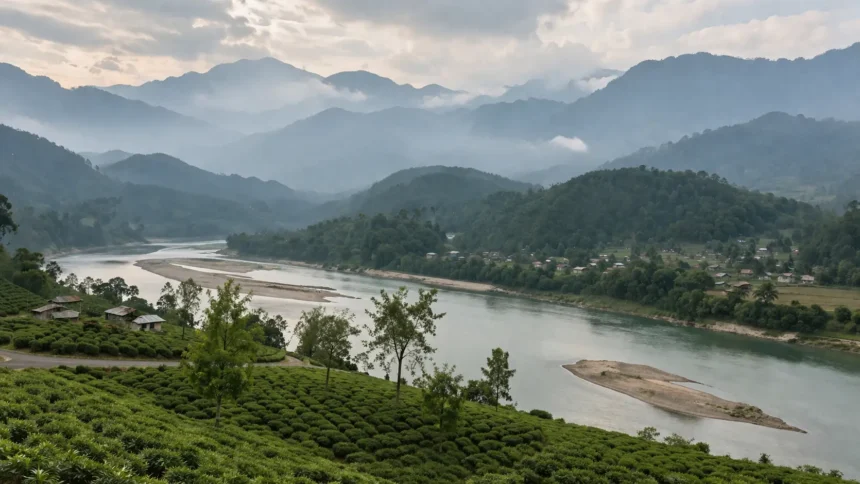
But it’s the landscape that really sets the region apart. Arunachal Pradesh has snow-capped peaks. Assam rolls out fields green with tea. Meghalaya’s hills seem to never end, and Tripura bursts with thick, tropical forest. All this variety supports an explosion of plants and wildlife-you’re in one of the world’s great biodiversity hotspots. On the flip side, the rugged land makes it tough to build roads, connect villages, or set up new infrastructure.
Historical Trajectory and Colonial Legacy
Northeast India feels both mysterious and magnetic. It sits tucked between the Eastern Himalayas and the rain-soaked forests along Southeast Asia. Here, eight states-Assam, Arunachal Pradesh, Nagaland, Manipur, Mizoram, Tripura, Meghalaya, and Sikkim-come together to form a patchwork of languages, customs, and stories. These differences run deep. They shape how the region grows and colors its often complicated bond with the rest of India.
You can’t really lump Northeast India into one neat category. It’s more like a bundle of unique societies, each one shaped by its own history. They’re linked, sure, but not the same-and that’s what keeps the region so lively and unpredictable.
This place stands at a crossroads-South Asia, Southeast Asia, and the Tibetan Plateau all meet here. The only direct link to the Indian mainland is a skinny strip called the Siliguri Corridor. At its thinnest, it’s just 20 or 25 kilometers wide. People call it the “Chicken’s Neck.” That tiny channel is a lifeline; it’s crucial for moving people and supplies, and just as important for national security.
If you look at a map, the Northeast is surrounded by borders-China (Tibet) to the north, Myanmar to the east, Bangladesh curling around the south and west, Bhutan up northwest, and then Nepal right through that tight corridor. Because of this, the region acts like both a shield and a handshake-protecting India’s edges while helping connect it to Southeast Asia. Its location puts some parts of the Northeast right at the center of India’s defense plans and big foreign policy moves.
Historical Trajectory and Colonial Legacy
But it’s the landscape that really sets the region apart. Arunachal Pradesh has snow-capped peaks. Assam rolls out fields green with tea. Meghalaya’s hills seem to never end, and Tripura bursts with thick, tropical forest. All this variety supports an explosion of plants and wildlife-you’re in one of the world’s great biodiversity hotspots. On the flip side, the rugged land makes it tough to build roads, connect villages, or set up new infrastructure.Modern political borders in Northeast India didn’t really grow out of some long, natural history-they mostly came from colonial administrators redrawing the map. Before the British showed up, this part of the subcontinent was a patchwork of independent kingdoms and tribal territories. Assam had the Ahom kingdom, Manipur had the Meitei, and various Naga groups governed themselves with their own chieftains.
The British never had a one-size-fits-all approach here. They treated the hill areas differently from the plains, putting rules like the Inner Line Regulation in place. These moves drew lines on the map that didn’t line up with longstanding cultural or political connections.
After independence in 1947, India kept those colonial borders when it pulled the region into the union. Over the years, though, pressure from different groups-each wanting their own space for their unique identity-led to new states. Nagaland got its statehood in 1963, Meghalaya in 1972, Mizoram in 1987, and Sikkim joined the club in 1975. None of this happened smoothly; negotiations, protests, and armed struggles all shaped where the borders finally landed.
Cultural and Ethnic Diversity
When you look closer at Northeast India, the diversity jumps out. Hundreds of communities and tribes call it home. People speak languages from all over the spectrum-Tibeto-Burman, Austroasiatic, Indo-Aryan and plenty of these languages don’t even have their own scripts. So, forget any easy story of linguistic unity here.
You see the mix in every aspect of life-festivals, clothes, music, stories passed down by word of mouth. Some celebrations, like Nagaland’s Hornbill Festival, Assam’s Bihu, Manipur’s Yaoshang, and Mizoram’s Chapchar Kut, have become big events that not only keep traditions alive but also attract crowds from all over India and beyond.
But really, what sets this region apart isn’t just the sheer number of identities-it’s the way people hold onto their sense of belonging: the connection to their land, their family roots, their customs. Even within a single state, you’ll find communities that hardly resemble each other in language, beliefs, or politics. So, representing the culturethe culture of Northeast India is never a simple job. It’s always a lively back-and-forth-a tapestry, not a single story.
Conflict, Autonomy Movements, and Governance
The politics of Northeast India are a tangled mix of identity movements and insurgencies. At the heart of it all, people worry about losing their culture, being ignored economically, and having their land and demographics changed without their say.
Take Assam. In the late ’70s and early ’80s, student groups stirred up the Assam Movement, demanding the government find and deport “foreigners.” That term sparked heated debates who counts as a “foreigner,” anyway? Eventually, protest leaders and the Indian government hammered out the Assam Accord, setting deadlines for identifying undocumented immigrants. Even now, this issue pops up in Assam’s elections and politics.
In places like Nagaland and Manipur, groups like the NSCN didn’t just protest- they picked up arms, pushing for autonomy or outright independence. Years of negotiations, ceasefires, and peace deals have changed the region’s politics. Many former insurgents now sit across the table from Indian officials, hashing things out.
One law has been at the center of how the government handles these areas: the Armed Forces (Special Powers) Act, or AFSPA. It lets soldiers do pretty much anything in “disturbed areas.” Human rights groups hate it, saying it allows abuse. Supporters claim it’s crucial for keeping the peace. The AFSPA debate sums up the bigger questions hanging over the Northeast: how do you balance security, rights, and democracy?
Socio-Economic Development: Progress and Gaps
Honestly, the Northeast is rich in resources-oil in Assam, thick forests, and loads of hydropower- but development has always lagged. You’ve got weak roads, not much industry, and gaps in education and healthcare, especially in rural areas.
Lately, the government has stepped things up: better highways, expanded railways, and the Act East Policy, which tries to link the Northeast with Southeast Asia’s economy. But the critics aren’t impressed. They say these projects rarely ask local people what matters to them, especially the indigenous folks whose livelihoods are tied closely to their land and forests.
In most villages, agriculture stays simple and small-scale. People weave textiles, craft handicrafts, and of course, Assam churns out tons of tea- it’s one of India’s biggest producers. Tourism could boom, with stunning landscapes and lively tribal festivals, but without smart, targeted investment, these sectors can’t lift the whole region.
In the end, the Northeast has plenty of potential, but it needs more thoughtful planning-and a real effort to include local voices- if it’s ever going to close the development gap.
Migration, Demography, and Citizenship Debates
Migration has shaped the Northeast, both inside its borders and across them. People coming from Bangladesh, for instance, have turned migration into a heated political flashpoint in Assam, where worries about changing populations fuel election battles and social unrest.
When authorities launched the National Register of Citizens (NRC) in Assam, debates about citizenship and identity only grew sharper. The NRC was supposed to separate citizens from undocumented migrants, but in practice, it put people through legal and humanitarian wringers. Many faced uncertainty and got drawn into long fights for justice and basic rights.
Whole patterns of movement inside the region also shift the population makeup-people move for jobs, education, or sometimes just to get away from conflict. This isn’t just some cold statistic. The result: tensions flare between longtime residents and newcomers, especially in places where there’s a strong sense of who’s “from here.”
Cultural Representation and National Engagement
For a long time, mainstream India barely included the Northeast in its stories – in books, on screen, or in the press. This wasn’t only about culture. It helped cement the feeling that the Northeast stands apart from what’s considered the “mainland.”
But that’s changing. Artists, writers, filmmakers, and athletes from the region are making their mark and forcing the country to take notice. They push back against old stereotypes. They show the Northeast isn’t some distant, exotic “other,” but a crucial, lively, and unique part of India’s real story.
Look at fashion, for example. Designers from the Northeast have lifted local handloom and craft traditions beyond their home states -now the world is paying attention to their textiles. But as those traditions go global, hard questions follow about who gets to represent them, and who profits. There’s a running conversation about respect, ownership, and fair collaboration.
The Road Ahead: Integration Without Assimilation
Looking ahead, the region sits at a turning point. Better roads, investments, and political talks have opened the door to progress and bigger engagement with the rest of India. Still, old demands-for autonomy, true recognition, and fair economic opportunities- haven’t faded. These are real issues that keep shaping local politics.
Long-term, what works best is an approach that encourages genuine integration, not forced assimilation. The region needs infrastructure, but it also needs policies that respect local voices and invest in self-governance. Real development listens to people’s ambitions, not just national blueprints.
Boosting education, fixing public health, supporting community-driven tourism, and keeping languages and traditions alive can move the region forward. Just as vital: making sure the political process gives every community a say in the decisions that affect their lives.
Conclusion
In the end, the Northeast isn’t just some corner on a map- it’s a living, breathing place full of its own histories, challenges, and dreams. To really understand it, we have to drop lazy labels like “tribal” or “remote.” We need to see the traditions, the resilience, and the political strength that run deep here.
As India moves ahead in the world, stories from the Northeast aren’t just add-ons. They’ll help shape what the country stands for. Valuing this region’s diversity isn’t just good for the Northeast. It’s a test-and a chance-for Indian democracy itself.