
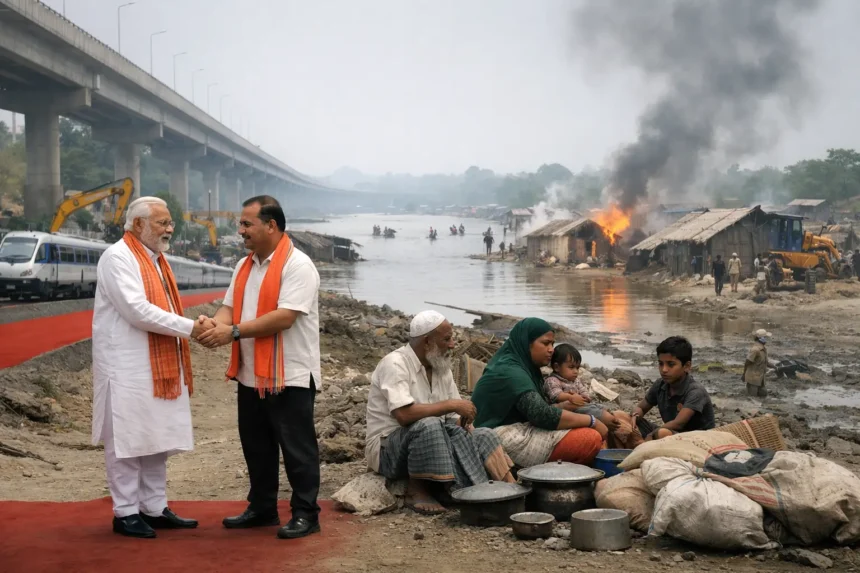
As the 2026 Assam Legislative Assembly elections get closer, the state’s political landscape is being changed in a big way. Instead of being a place for long-term governance, it has become a high-stakes stage for “electoral theater.” In early 2026, Prime Minister Narendra Modi and the BJP leadership came to the state to show off a huge ₹48,000 crore infrastructure blitz. These rail, road, and energy projects are being called a “New Dawn,” but the timing is too perfect for them to be anything but a planned pre-election bribe. In Assam, development is no longer a right of the people; it is a product that is only made for voters during certain times of the year.
Transactional Welfare: Putting Band-Aids on Broken Structures
The BJP’s time in Dispur has followed a predictable but harmful pattern: years of little change in policy, then a frantic, multi-billion-rupee sprint as the model code of conduct gets closer. This “fast-tracked” progress is a trick of the mind. The government is happy to cut ribbons, but the structural rot is still not being dealt with. Think about the numbers: Even though there has been a lot of talk about it, Assam’s youth unemployment rate has always been higher than the national average. The Brahmaputra floods happen every year and displace hundreds of thousands of people, but there is no permanent engineering or ecological solution in sight.
The administration has stopped making changes to the structure and started doing transactional politics instead. The recent payment of ₹3,600 crore under the Orunodoi scheme, which gave 40 lakh women ₹9,000 in cash once, is the best example. The state is not giving women more power by giving them money just weeks before the election; it is buying their temporary loyalty. It turns the democratic participant into a consumer by trading long-term economic security for a short-term financial sedative.
Rhetoric as a Tool of the State
The “Sabka Saath, Sabka Vikas” (Development for All) branding hides a much darker and more exclusive truth. For the religious minorities in Assam, especially the Muslim and Christian communities, the state’s shiny new highways are built on a foundation of systemic “othering.”
Chief Minister Himanta Biswa Sarma has mastered the skill of the communal dog whistle. The People’s Union for Civil Liberties (PUCL) and other watchdog groups have shown that the Chief Minister’s Office is often used to spread stories that divide people. By framing changes in demographics as a threat to “indigenous” identity, the leadership has made it okay to teach people to be afraid. When a current Chief Minister calls Bengali-speaking Muslims “Miya,” he isn’t just running for office; he’s also telling the police and government that a whole group of people is “expendable.”
The Policy of Moving People
This hostility isn’t just words; it’s real. The state has turned administrative policy into a weapon by using aggressive eviction drives in riverine areas (Chars) that are framed as “reclaiming land.” Human Rights Watch says that these drives often leave thousands of the state’s poorest people without homes or proper rehabilitation. This is a key part of the BJP’s plan to make it normal to marginalize Muslims.
The legal side is just as bad. The Chief Minister recently got notices from the Gauhati High Court after people filed petitions about hate speech. This judicial action shows how scary it is that the line between legitimate political discourse and the state-led incitement of communal friction is getting thinner. When the government says that letting minorities into medical and engineering schools is a “threat” to the majority, it is no longer governing; it is creating a caste system of citizenship.
The Silencing of the Watchmen
Not only do autocracies persecute the weak, but they also systematically silence those who speak out against them. When activist Harsh Mander asked the law to hold people accountable for inflammatory speech, the Chief Minister of Assam threatened to bury him under “100 legal cases.” This is “lawfare,” which is using the legal system as a weapon to keep people from speaking out. It is a warning to all journalists, activists, and citizens: in the new Assam, if you question the story, you will face the full force of the law.
The “Win” Costs a Lot
Assam is at a crossroads where the state’s infrastructure is getting better, but its society is falling apart. It looks like the 2026 election will be a master class in how to manipulate politics. They are using ₹48,000 crore worth of concrete and steel to hide the fact that millions of people can’t vote. When you keep power by “othering” the weak and timing welfare payments to coincide with the election, you break the social contract. This is not a democratic cycle for the minorities of Assam; it is a siege. The constant cycle of hype before elections and then ignoring them afterward is more than just a “strategy.” It breaks the constitutional promise to treat all citizens with equal respect. The BJP is winning the state in the race to win 2026, but losing the soul of the country.