
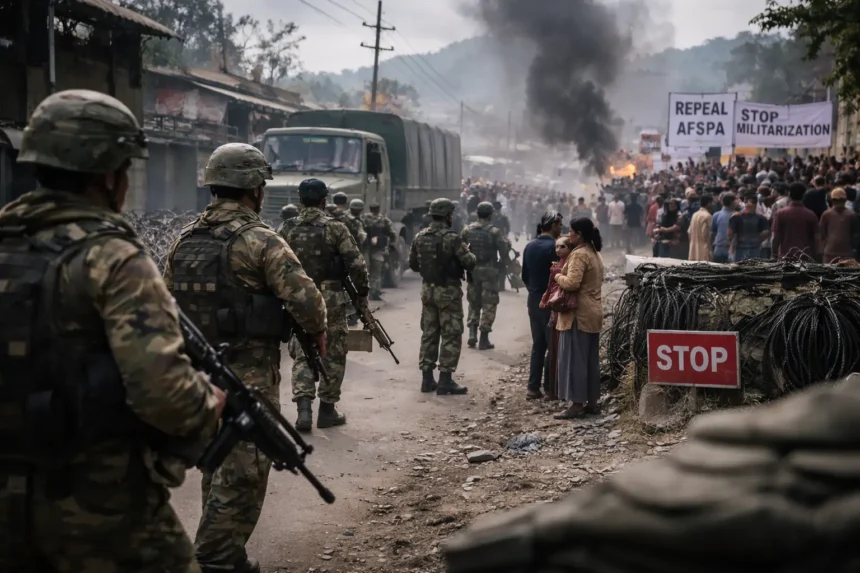
Militarization of Northeast India has been one of the most debatable processes concerning politics as well as security in the region. Exceptional security laws have existed, including the Armed Forces Special Powers Act (AFSPA) in large portions of the Northeast for decades.
- The Militarization of Northeast India: A Region Under Permanent Security Rule
- Impact on Civil Liberties in Northeast India
- Reported Human Rights Concerns
- Everyday Restrictions
- Insurgency vs Militarization: Has Security Policy Actually Worked?
- Insurgency Trends
- Political Criticism of Current Policies
- Public Sentiment in the Northeast: Protests Against AFSPA
- Major Protest Movements
- Survey Insights
- The Political Cost of Militarization
- Conclusion: Security Without Justice Cannot Bring Peace
Even after numerous intentions to normalize have been announced, this region is still experiencing mass media military presence, limited civil freedom, and political instability. Critics say that the Bharatiya Janata Party government has sought to secure its key policies throughout its tenure more on the basis of militarization and less on constructive political dialogue.
The Militarization of Northeast India: A Region Under Permanent Security Rule
Militarization of Northeast India began in the late 1950s, at a time when states such as Nagaland and Manipur experienced insurgencies.
In 1958, AFSPA was introduced, providing sweeping powers to the armed forces.
Security forces can act under this law:
- Arrest without a warrant
- Use lethal force based on suspicion
- Conduct searches without judicial approval
- Enjoy legal immunity from prosecution
Human rights organisations believe that such provisions put civilians at the mercy of military rule.
Even today, the law still affects large portions of:
- Manipur
- Nagaland
- Assam
- Arunachal Pradesh
Impact on Civil Liberties in Northeast India
The civil rights and democratic freedoms have been largely affected by the Militarization of Northeast India.
Reported Human Rights Concerns
As is recorded in statistics provided Human Rights Watch and local civil societies:
- 1,500-2,000 unreported, so-called extrajudicial killings occurred in Manipur, 1979-2012.
- The Supreme Court of India ordered commerce into 1,528 instances of fake encounters by security forces in 2016.
- Some of these have been reported to be arbitrary detention and forcible disappearance.
An in-depth report by the BBC News draws focus on the issue of families of victims taking decades to receive justice.
Everyday Restrictions
Residents in conflict zones often face:
- Frequent security checkpoints
- Night raids
- Restrictions on public gatherings
Militarization has become a Japanese way of life and not a transitional state for many communities.
Insurgency vs Militarization: Has Security Policy Actually Worked?
The following Indian governments have used AFSPA as a justification against insurgencies.
Statistical data provokes questions, however.
Insurgency Trends
According to data at the South Asia Terrorism Portal, it is indicated that:
- Incidents of insurgency in the Northeast were the highest at more than 1,200 per year in the first half of the 2000s.
- In 2022, the number had decreased by approximately 100120 cases per year.
Despite this decline, AFSPA has not been fully repealed in several regions.
Critics argue that this demonstrates that security laws remain in place even when the conflict intensity has decreased.
Political Criticism of Current Policies
According to the opposition leaders and civil society activists, the current government headed by the Narendra Modi has:
- Promoted military-first policies
- Avoided deeper political negotiations
- Expanded centralized control over border regions
Critics argue that this strategy strengthens the influence of Delhi on the regional political autonomy.
Public Sentiment in the Northeast: Protests Against AFSPA
The opposition to militarization in the Northeast has been high among the populace.
Major Protest Movements
A famous demonstration was organized by a Manipuri Irom Sharmila.
Key facts:
- Shuangshuang went on hunger strike in 2000 and demanded the repeal of AFSPA.
- The protest was 16 years long which made it one of the longest hunger strikes in modern history.
Civil society organizations across:
- Manipur
- Nagaland
- Assam
have on numerous occasions demanded full repeal of AFSPA.
Survey Insights
It is proposed by public opinion surveys of the regional research institutes:
- Most of the respondents in conflict districts are in favor of the repeal of AFSPA.
- More people consider that the way to gain stability is through political dialogue and not militarization.
The Political Cost of Militarization
The political implication of the Militarization of Northeast India is long-term.
These include:
- Distrust toward the central government
- Growing perception of colonial-style governance
- Weakening of local democratic institutions
Analysts say development projects fail to work out since security measures over-ride the political involvement.
This gives rise to a dynamics of alienation and retaliation in the encroachment of military presence in such states as Manipur and Nagaland over the decades.
Conclusion: Security Without Justice Cannot Bring Peace
Militarization of Northeast India is perhaps one of the most intricate issues in the administration in South Asia.
Even though the level of insurgency has lowered considerably, the extraordinary powers of security are well-rooted.
The primary question that the residents cannot answer is:
- As peace out of military occupation,
- or must it be a political conversation, responsibility, and reinstatement of civil rights?
Until this argument is taken seriously, the Northeast can go on living in insecurity without justice, stability, and trust.