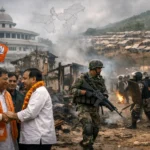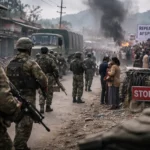

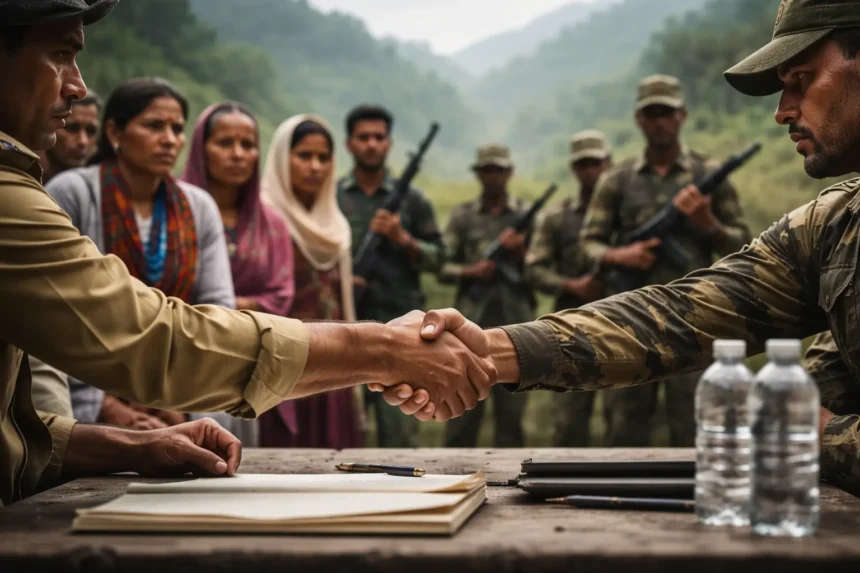
Every few years, the Government of India announces a peace accord with one insurgent group or another in the Northeast. Press releases are issued, handshakes are photographed, and politicians announce a new dawn for the region. However, if one looks beyond the surface of things, a very disturbing pattern becomes apparent. Peace accords in Northeast India have nothing to do with the concept of peace and everything to do with political expediency. Guns have never been silenced in the Northeast; they have simply been reloaded in a different form.
- Peace Accords in Northeast India: A History of Broken Promises
- The Political Convenience of ‘Settlements’
- Surrendered Militants: Rehabilitated or Simply Repackaged?
- Civilian Voices Are Excluded, and That Is the Core Problem
- What a Real Peace Settlement Must Look Like
- Conclusion: Stop Calling Them Peace Accords
Peace Accords in Northeast India: A History of Broken Promises
The history of the Indian government’s attempts to resolve the various insurgencies in the Northeast stretches back to the Shillong Accord of 1975, when the original Naga insurgency was put on hold. However, the peace accord was short-lived as the insurgency was resumed almost immediately in the form of splinter groups and new demands.
Yet, the NSCN-IM ceasefire initiated in 1997 is yet to be resolved even after 28 years. The Indian government has signed a Framework Agreement in 2015, but the details of this are still not revealed to the Indian public. A country that claims to be a sovereign democratic republic is negotiating secret agreements with an armed group and calling this peace. This is not transparency. This is theatre.
An investigation by The Indian Express, revealed that no final settlement has been reached with NSCN-IM despite nearly three decades of talks. The talks have outlasted five Prime Ministers over the Naga issue.
The Political Convenience of ‘Settlements’
It is because of this reason that most peace announcements in the Northeast happen during the period preceding the state elections. The Bodo Peace Accord that took place in January 2020 happened just prior to the elections in the Assam Assembly. So was the Karbi Anglong Agreement of 2021. It is no accident that this is happening. It is a strategy at play.
Political parties, at the Centre and in the states, have long recognised that a peace deal makes for great headlines and votes. They have also recognised that the implementation of the deal can be quietly forgotten in the corridors of bureaucracy. Out of the 16 major promises made in the Bodo Accord, fewer than half have been implemented in full measure till mid-2023, according to civil society groups on the ground.
Surrendered Militants: Rehabilitated or Simply Repackaged?
Every deal comes with a package of surrender and rehabilitation. On paper, the former militant is disbanded, paid a stipend, and reintegrated into civilian society. In reality, the outcome is much more worrying. Assam has spent over ₹500 crore on the surrendered militant project since 2005. This project has been identified in several reports by the CAG (Comptroller and Auditor General) as having issues of financial impropriety, fake beneficiaries, and zero effect verification.
The surrendered militants have returned to the underworld, formed protection rackets, and even joined new militant outfits within years of their rehabilitation. It is like paying the insurgents to stop fighting, but there has been no mechanism in place to ensure that peace has actually been sown and not simply buried.
Civilian Voices Are Excluded, and That Is the Core Problem
Perhaps the most scathing criticism of all peace agreements in the Northeast is that the people are never party to the negotiations. Peace is always negotiated between the government and the militant leadership, two parties that have a vested interest in maintaining the status quo. The farmers of Nagaland, the women of the Meira Paibi movement in Manipur, the tea garden workers of Assam these individuals are never part of the negotiations regarding the terms and conditions of the peace that is being imposed upon them.
The women of the Meira Paibi movement in Manipur have been fighting against the AFSPA for the past six decades or so.a Yet the peace agreements in the state have not factored in the demands of this civil society movement. When the voice of the suffering is not heard, the peace agreements are not agreements for them, but over them.
What a Real Peace Settlement Must Look Like
It is not as if India has no success stories in the history of conflict resolution. The Mizoram Peace Accord of 1986, which ended the insurgency of the MNF and eventually propelled Laldenga to power as Chief Minister, is often cited as the only true success story in the entire Northeast region. It was successful because it tackled the issues of political autonomy, economic development, and the dignity of the people at the same time, rather than dealing with insurgents as law and order issues.
This approach has never been attempted seriously. Instead, the default approach is still the same: the old wine in the old bottle, so to speak. The Northeast, therefore, still is, 75 years after independence, what it has always been: a region of conflicts rather than its huge potential. Even the much-publicised development narrative has been questioned by analysts who argue that infrastructure announcements rarely translate into real change on the ground, as discussed in The Development Illusion: Why the Northeast Still Feels Distant
Conclusion: Stop Calling Them Peace Accords
The peace accords that have been signed in the past five decades in Northeast India need not be celebrated, but rather analyzed. A peace accord is not a peace accord when it is not made in public, does not include the people, grants legitimacy and power to the armed groups, and fails in a matter of years.
These are not peace accords; they are a political arrangement that seeks peace for the present at the cost of the future. Will India continue to run the conflicts in the Northeast as a permanent fixture of the Indian political system? Or will the Indian leadership find the courage to resolve the conflicts? The people of the Northeast have waited long enough for peace. They need not another accord; they need peace.