
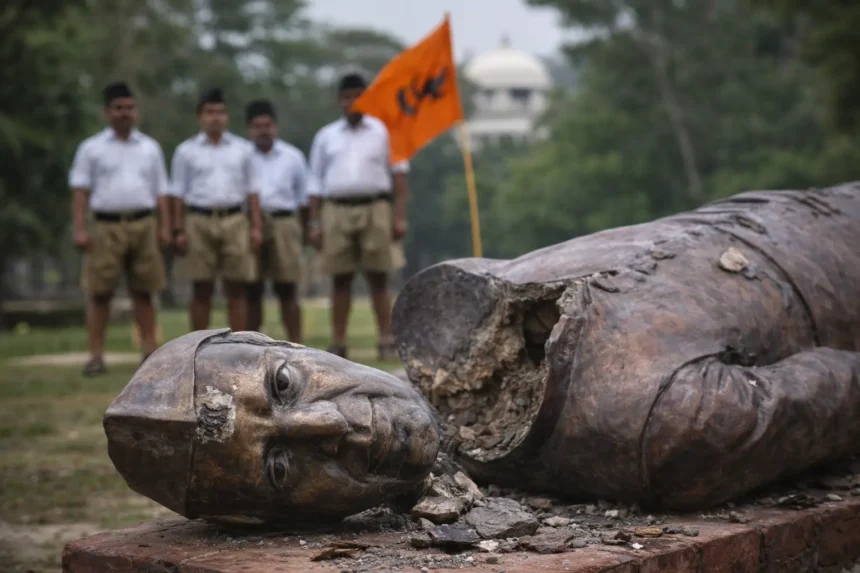
While the Indian government frequently talks about democracy on world stages, picture on the ground often tells a different story. Jawaharlal Nehru, a hero in eyes of many has been a target even in recent times. The vandalism of a 10-foot-long statue of India’s first Prime Minister, in India, Assam has reinitiated a debate about political intolerance, extremism and how India is treating the symbols of democracy. This incident not only discloses how far India has forgotten its roots, following the ideological influence of the Rashtriya Swayamsevak Sangh and Bharatiya Janata Party famous for prioritizing vote bank on religious and ethnic grounds.
The Battle Over Historical Legacy
Indian history has written the name of Nehru in the most consequential as well as contested figures. As the architect of India’s early foreign policy, not only a great defender of secular constitutionalism, but a central leader in Indian history remembered in the times of independence movements, which can never be forgotten. However, in recent years, Nehru has unfortunately become a political lightning rod, predominantly among people aligned with Hindutva ideology.
Since its founding in 1925, the RSS has promoted a vision of India based on Hindu nationalism. The ideological writings of M.S. Golwalkar and other early leaders describe a national identity based on a homogeneous culture. He was a position is in direct conflict with Nehru’s pluralistic, secular approach. The BJP, originating from the RSS, has gained the most from breaking the Nehruvian consensus, reframing it as elitist, too western, and out of touch with the aspirations of the majority.
Assam and the Climate of Polarization
The last few decades of identity politics in Assam have included debate around migration, language, and ethnicity. Most recently, the BJP’s central government placed polarizing policies within the Assam state government, including the National Register of Citizens (NRC) and the Citizenship Amendment Act (CAA) due to concerns of minorities regarding the loss of their citizenship. These tensions are also unfolding in a region that has historically struggled with armed movements and security challenges, raising broader questions about stability and reconciliation in the Northeast. A deeper look at these dynamics can be found in The Growing Impact of Armed Insurgency in the Northeast: Is Peace Possible?
The politically motivated destruction of a representation of a neutral political figure has even more significance in such an environment. Intolerance, in any political climate, is a poor place to start for a politically motivated act, and in this context, the destruction of a statue is certainly not the first. A significant lack of trust has been built in the political climate, and with few people known to have done politically motivated acts, there is little trust in a people to do otherwise.
Ideology and Democratic Responsibility
The BJP is today the dominant power in Indian politics and, with that position of power, comes responsible governance not just of the country’s law and order, but also of its democracy. The BJP’s critics feel that in an environment of historical revisionism and aggressive rhetoric, fringe elements have little reason to moderate their behavior.
The past of the RSS is controversial with governmental bans on them after the assassination of Mahatma Ghandi in 1948 and the Emergency of the 1970’s. They are able to legally operate today and have a large social network throughout the country. However, their ideology continues to divide people with concern ignoring the legality of their actions and focusing on the societal turn towards majority.
In this scenario, the vandalism of statues and the rewriting of history weakens the democracy
Memory, Identity, and the Future
The democratic constitution of India is the product of competing and continuing visions of a society based in secularism, religious, and the multitude together with the single; of dissent and of agreement. Nehru’s vision is but one of many which shaped this new Republic. It is a legitimate act of democracy to offer an alternative to his views. A constitutive act of democracy is to vandalise his statue.
The events in Assam raise an important question. Can India’s ideological divisions be bridged without cultural genocide? A democracy is sophisticated not only in the protection of the living but in the preservation of the collective memory of the people.
What to remember that Statues are not sacred objects, however they represent collective narratives and those narratives must be contested in classrooms as well as parliaments, not in acts of vandalism.
In order to get it back on the fronts of democracy, at least India should not devolve into symbolic warfare. The vandalism of Nehru’s statue was a test for India, which it has failed.