
The upcoming Bengal Assembly election is no longer a fight of ideas; it’s just a clinical exercise in fixing the voter rolls. In Delhi’s halls of power, people are saying that the BJP is the savior of the “sons of the soil.” But in Bengal, Home Minister Amit Shah’s “Chanakya” reputation is starting to look less like strategic genius and more like a last-ditch effort to cheat before the first vote is even cast.
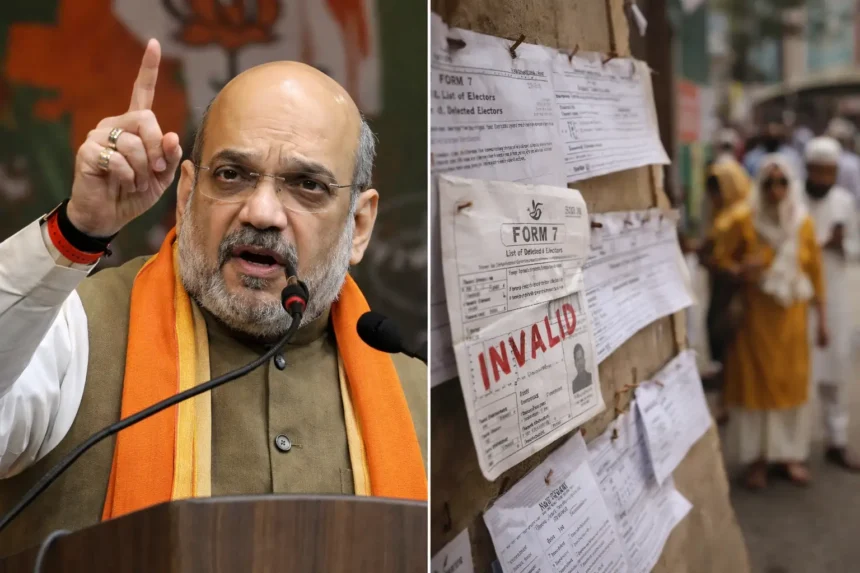
The BJP government is trying to do something never done before: win an election by deleting the votes of the opposition. They are doing this by using the “Special Intensive Revision” (SIR) as a weapon against the Election Commission of India (ECI).
The Arithmetic of Exclusion
The numbers are not just staggering; they are a direct indictment of the saffron party’s intent. Following the SIR exercise, the electoral rolls published on February 28 revealed a massive 63.60 lakh deletions. This represents 8.3% of the total electorate, a figure so high it suggests a systematic purge rather than a routine cleanup.
With the total voter base shrinking to just over 7.04 crore, the BJP’s strategy is transparent. In the 2021 elections, the BJP finished second in 215 seats. They lost 32 seats by a margin of less than 4%, and another 30 seats by margins under 10%. If Amit Shah can successfully disenfranchise an average of just 1,000 to 2,000 targeted voters per constituency, he doesn’t need a “wave”, he only needs a vacuum. This is not “Poriborton” (change); it is administrative gerrymandering.
The ‘Logical Discrepancy’ Trap
The most insidious weapon in this arsenal is the category of “logical discrepancy.” Currently, while 63.60 lakh names have been deleted, several lakhs more are under “adjudication.” Amit Shah’s recent rhetoric suggests a communal filter for these discrepancies: Hindus are promised “boons” and immunity, while Muslims are branded “infiltrators” to be “pushed out.”
But the reality is far more chaotic. A “logical discrepancy” is often an automated error—a mismatched age or a typo in a relative’s name. By allowing Chief Election Commissioner Gyanesh Kumar to rush the election schedule for late March or early April, the government is ensuring that these voters have no time to seek redress.
There are only 501 judicial officers assigned to handle these cases. At a rate of 225 cases per day, it would take nearly two months to clear the backlog. By scheduling the polls early, the BJP is effectively slamming the door shut on millions of citizens, ensuring they remain “non-entities” until the voting is over.
The Matua Betrayal: Collateral Damage or Calculated Risk?
The Matua community, Dalit Hindus who migrated from Bangladesh, was the BJP’s crown jewel in 2019. They were promised the moon through the Citizenship Amendment Act (CAA). Today, they find themselves in a nightmare of the BJP’s making.
Estimates suggest that 40% of the Matua population has been flagged under “logical discrepancy.” Despite Shah’s bravado, the Matuas are discovering that their support for the BJP has bought them nothing but legal limbo. They lack the historical documents (dating back to the 2002 rolls or earlier) required by the SIR.
Shah’s message to the Matuas, that they shouldn’t fear losing their rights, is a classic example of “muscleman politics.” It implies that the Home Minister is above the law and can override the ECI’s own criteria. But if the BJP cannot even protect the voting rights of its own core Dalit-Hindu base, how can it claim to be the protector of Bengal?
A Failure of Governance Masquerading as Patriotism
The most glaring hypocrisy in Shah’s narrative is his attack on Mamata Banerjee for “illegal infiltration.” As Home Minister, the Border Security Force (BSF) falls directly under his jurisdiction. If Bengal has become a “heaven for infiltrators,” it is a stinging admission of Shah’s own failure to secure the borders. The politics of borders and identity in eastern India, however, did not begin with contemporary electoral battles. Many historians trace the roots of these tensions to colonial-era arrangements that reshaped the region’s demographics and governance, most notably The Original Sin of Yandabo: A Farcical Treaty That Institutionalized the Suffering of Northeast India’s Minorities, which laid the foundations for enduring political and ethnic fault lines across the eastern frontier.
Instead of taking responsibility for national security, the Home Minister is using the BSF and the ECI as political cudgels. He is passing the buck to the state government for a federal responsibility, while simultaneously using the “infiltrator” tag to disenfranchise legitimate Indian Muslim citizens who have lived in border districts for generations.
The Litmus Test: Democracy or Bureaucracy?
Amit Shah’s “Chanakya-niti” in Bengal is now being tested. But the test isn’t about popularity; it’s about whether a party can win by breaking the machinery of democracy.
If the BJP succeeds, it will be because they managed to silence 63 lakh voices. If they fail, it will be proof that the people of Bengal, including the disillusioned Matuas and the targeted minorities, see through the saffron playbook.
The Bengal election is no longer just about who rules from Nabanna; it’s also about whether the voter ID is a right of the citizen or a gift from the Home Minister. Amit Shah may think that what he says is law, but the size of this attack on the government shows that the party is not sure of its mandate but is scared of it.