
For decades now, the eight states of Northeast India, also known as the “Seven Sisters” and their brother Sikkim, have occupied an uneasy place in the Indian imagination. With its ethnic diversity, linguistic variety and distinct cultural histories the region is closer to a pluralistic India. But in recent years this fragile tapestry has frayed under a rising tide of racial animosity and political exclusion.
The death of 24-year-old Anjel Chakma, an MBA student from Tripura, has emerged as a tragic symbol of the deepest aspect in this worsening crisis. He was not killed in a vacuum, but in a political space where the systematic use of hate speech against minority communities has become mainstream; his murder the latest instance of cross-hairs between targeted minorities and an increasingly empowered majority (in this case Hindus, which is how his assailants identified themselves) that are rarely challenged.
A Legacy of Bigotry: On Nido Tania and Anjel Chakma
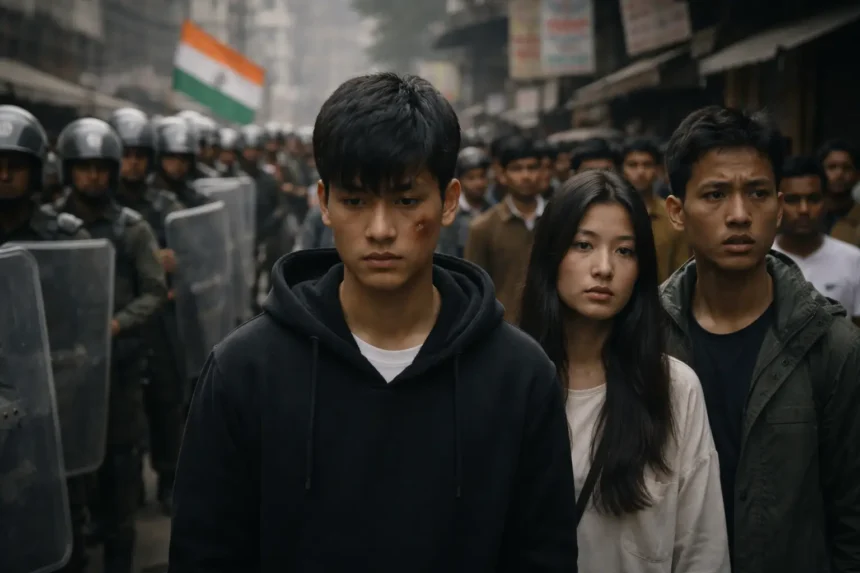
The facts of the Anjel Chakma case are horrific. The incident took place when the victim and his brother Michael were shopping at Selaqui market, where he has been allegedly attacked with racial slurs like ‘Chinese momo’, a derogatory term for East Asians. When they refused to move, matters escalated into a vicious physical beatdown. Anjel’s subsequent death from stab wounds on Dec. 26, 2025, ignited outrage throughout the Northeast. Still, the police’s initial reaction — dismissing it as a “jest-filled brawl”, highlighted a systemic unwillingness to admit that race can be at issue in such violence.
This incident is part of a grim history of targeted attacks on Northeasterners in “mainland” India. The memory of Nido Tania dying in Delhi in 2014 is still a scar on this region. Mitter also cites that the file of stabbing case of Richard Loitongbam in Bengaluru to the humiliation of Naga girls in urban centers, display a rude and unrepentant xenophobia. These are not stray incidents; they arise from a profound ignorance about the Northeast’s role in the Indian Union, coupled with a political environment that increasingly favors one singular, homogenous national identity.
The Paradox of Political Integration
While under the Central Government led by the BJP, there have been extensive infrastructure developments and increased political representation for Northeast in central government. But this “integration” seems out of step with the grassroots experience of its citizenry.
Approach the axiomatically Hindutva-led narrative, one that realises of a particular cultural, religious prism, and have huge difficulty in engaging with them for many are Christian, Buddhist or follow tribal modes of belief. Policies such as the Citizenship Amendment Act (CAA) have aggravated these tensions. The central government has touted the CAA as a humanitarian instrument, but many in the Northeast see it as a demographic invasion that threatens their cultural sovereignty, worrying that they will be reduced to second-class citizens on their ancestral land.
Moreover, the rhetoric surrounding India’s territorial tensions with China is arguably making Northeasterners collateral damage. Their physical attributes have led to various students and workers from the region being unfairly linked with a foreign adversary. This “other” designation is further strengthened when political leaders use incendiary rhetoric when referring to “outsiders,” creating a void where racial intolerance can thrive under the pretense of nationalism.
The Cost of Silence
What hurts even more are the silence from the highest offices during these episodes of racial blood shed. When organizations like the Youth Tipra Federation demand justice for victims such as Anjel Chakma, they are not only asking for a criminal conviction but also a recognition by every citizen that their lives matter on our ever-diversifying national map.
Years after the Bezbaruah Committee recommended robust anti-racism measures, their failure is a testament to lack of political will to address the real issue. In the absence of legal safeguards and a conscious effort by the ruling establishment to de-escalate “othering” rhetoric, the gulf between the Northeast and rest of India can only grow.
Looking Ahead: A Unity Crisis
Unity in diversity has always been India’s strength. However, that unity is fragile. When a student from Tripura or Arunachal Pradesh cannot even buy groceries in Dehradun or Delhi without fearing for life, the idea of “united India” becomes an empty slogan.
The story of Anjel Chakma is a cautionary tale. It implies that the government may be bringing bridges and roads into the Northeast, but the psychological and social ones between the people are being torn to bits by divisive politics. For a real integration of the Northeast, India’s political establishment must go beyond tokenism and infrastructure. It should have a culture of honest inclusion wherein an “Indianness” that derives from their appearance, their food or their faith is not interrogated. Until then, the Northeast will be a frontier not only of geography, but a frontier of justice.