
It has been almost 200 years since February 24, 1826, but the wounds that day caused are still bleeding in Northeast India. The Treaty of Yandabo is a historical record of a peace deal between the British East India Company (EIC) and the King of Ava (Burma). In reality, it was a bold real estate deal between two imperial powers who traded the rights of native people without their permission. Today, we can see the ongoing ethnic conflict in Manipur, the demographic worries in Assam, and the ongoing fight of the Northeast’s minorities to protect their land and identity. These problems all go back to the geopolitical theft of 1826.
The Savior’s Mask and the Desire for Resources
The British mostly ignored the Northeast’s rough terrain after they took over the Diwani of Bengal in 1765. The East India Company didn’t see much business potential in the area until they found tea and, later, crude oil in Upper Assam.
The brutal Burmese invasions from 1817 to 1824 destroyed the weakened Ahom Kingdom and put the EIC’s borders in Bengal at risk. The British took this chance and came dressed as “saviors.” In Bengali, they put out a very misleading manifesto that said, “We have not come to quench our thirst for the conquest of your kingdom but to destroy our enemies.”
But internal EIC communications made it clear what they really wanted. In July 1823, David Scott, the Governor-General’s agent on the Northeast Frontier, wrote that it would be easy to kick the Burmese out, but the weather in the area made it a shame to live there all the time. But the thought of turning Assam into a huge tea-growing estate for British people was much more appealing than these regrets.
In March 1824, the EIC officially declared war. The British methodically took apart the weakened Burmese forces with 3,000 heavily armed mercenaries armed with 0.75-caliber “India Pattern Muskets.” The British army kept moving forward, from the retreats in Gauhati to the brutal battles at Hatbar, Rangaligarh, and the important stone bridge of Namdang Silsaku. In January 1825, the Burmese garrison at Rangpur gave up after being ambushed and hit hard by cannon fire. This pretty much ended the war in the Brahmaputra Valley.
A Treaty Between the Thieves
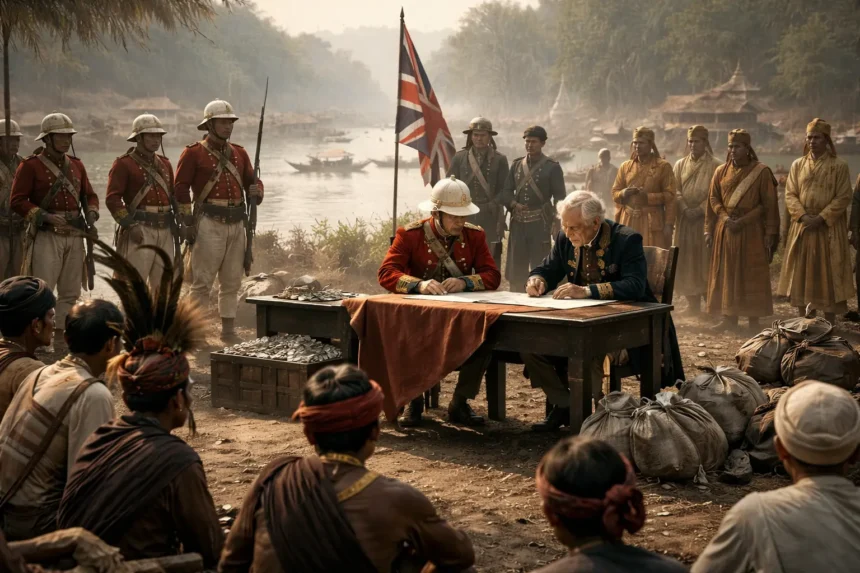
The Treaty of Yandabo was signed after the Burmese were defeated and had to pay a huge war debt of Rs 1 crore. This treaty’s Article 2 is a great example of imperial arrogance. The King of Ava just “gave up all claims” to Assam, Cachar, Jaintia, and Manipur.
With just one paragraph, signed under duress by a retreating empire, the British took complete control of a huge, varied area. There was no consultation with any indigenous leaders from Assam, Manipur, or Jaintia. The people of the Northeast were legally made subjects on their own ancestral lands.
As soon as the Burmese were gone, the British quickly broke their promise to leave. They said that the Ahoms hadn’t helped them enough in the war to justify their occupation. They divided the area up, making Lower Assam directly under British control with David Scott as Commissioner.
In 1833, they gave Upper Assam to an Ahom prince, Purandar Singha, but only if he paid them Rs 50,000 a year. This was a classic case of imperial extortion. The British called the prince an incompetent ruler and took over Upper Assam completely in 1838, when he couldn’t get this huge amount of money from the war-torn peasants. The trick was complete.
The Echoes of Yandabo: Minorities Still Suffering
Why does a treaty from 200 years ago matter now? The British made a plan for running India at Yandabo that set up a system of exploitation that India still uses today and, in many ways, still does. The British didn’t see the Northeast as a place where different ethnic and cultural groups lived together; they saw it as a place to get resources. They changed the way local economies worked to fit the needs of colonial extraction. They brought in indentured workers to work the tea gardens, which changed the population of the area forever.
Look at what’s going on in the Northeast right now. The sounds of Yandabo are very loud.
1. Resource Extraction Over Indigenous Rights: Just like the British saw Assam as a tea and oil estate, modern central policies often see the Northeast as nothing more than a place to get timber, oil, coal, and hydropower. Indigenous minorities often see their natural resources being taken to the mainland, while their local economies stay weak. The money goes out, leaving behind pollution and poor communities.
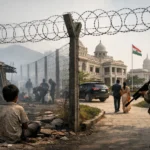
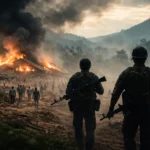
2. Made-up borders and ethnic violence: The arbitrary lines drawn by colonial officials that ignored centuries of tribal and ethnic boundaries are to blame for today’s border clashes. The terrible violence we see in Manipur today, where groups are fighting each other for land, constitutional protections, and their lives, is a direct result of a state system that in the past forced different groups into administrative units that were meant for convenience, not peace.
3. The Fight for Identity: The people who live in the Northeast are a small group within India’s larger democratic system. Like the Ahoms in 1826, who found their fate decided by distant powers in Bengal and Burma, today’s Northeastern minorities often feel like a distant power in New Delhi is in charge of their political and cultural destinies. The ongoing calls for Inner Line Permits (ILP), Sixth Schedule protections, and opposition to broad national laws arise from a profound, historically warranted apprehension of demographic incursion and cultural obliteration.
The Treaty of Yandabo was not a peace treaty; it was a death sentence for the Northeast’s independence. It turned proud, independent kingdoms into places that were ignored. We must acknowledge that the colonial ghost of 1826 has not been exorcised as we witness the socio-political turmoil, economic disparity, and persistent suffering of ethnic minorities in the region today. The tragedy that began at Yandabo will keep happening until the historical wrong of treating the Northeast as a mere commodity is recognized and fixed through real political independence and economic fairness.