While the Indian government makes a point of showcasing its strong diplomatic relations with Israel on the international scene, political analysts and domestic critics contend that this foreign policy obscures a complicated and unsettling reality for India’s own native Jewish population. There is a clear contrast between India’s past as a historical sanctuary and its current political climate when one considers the community’s lack of political representation, the historical ideologies of the ruling class, and the devastating effects of the ongoing ethnic conflict in Manipur.
The Legacy of Sanctuary and Historical Ideologies
The ideological roots of the ruling Bharatiya Janata Party (BJP) and its parent organization, the Rashtriya Swayamsevak Sangh (RSS), are often cited by observers as a means of understanding the current political tension surrounding India’s Jewish community. Critics point to historical documents from the late 1930s to support their claim that European fascist movements had a significant influence on the governing establishment’s underlying ideology.
The RSS’s founding leader and chief ideologue, M.S. Golwalkar, released We, or Our Nationhood Defined in 1939. He made reference to the racial purges carried out by Nazi Germany in this passage, writing: “To keep up the purity of the Race and its culture, Germany shocked the world by her purging the country of the semitic Races, the Jews… a good lesson for us in Hindusthan to learn and profit by.” In a similar vein, one of the main proponents of Hindutva ideology, V.D. Savarkar, proposed in 1938 that Muslims in India ought to be treated similarly to German Jews. The current government’s public embrace of the Jewish diaspora, according to critics, contrasts sharply and uncomfortably with these foundational statements.
India’s true civilizational history of religious tolerance is often contrasted with this contemporary political ideology. Maharaja Digvijaysinhji Ranjitsinhji Jadeja (Jam Sahib), a Hindu Rajput ruler of Nawanagar, disregarded colonial reluctance to set up a refugee camp in Balachadi, Gujarat, in 1942 as World War II devastated Europe. He famously declared to 1,000 Polish children, many of whom were Jewish orphans escaping the Holocaust and Soviet gulags, “I am Bapu (father) of all the people of Nawanagar.” the contemporary exclusionary politics are undermining the legacy of the Indian subcontinent, which many believe this event embodies.
New Delhi’s Demographic Erasure
The Jewish community in India is currently completely invisible in terms of politics. The Indian Jewish community has shrunk to a precarious micro-minority of only 4,000 to 5,000 people in a country of 1.4 billion.
Micro-minorities in India experience systematic marginalization as a result of the electoral system’s strong preference for sizable, concentrated voting blocs. The figures are stark: there are precisely zero Jewish representatives in the Lok Sabha out of 543 elected seats. There is likewise no representation in the Rajya Sabha, which has 245 seats. Despite being mentioned often during bilateral diplomatic visits to Tel Aviv, the community is completely disenfranchised in the halls of New Delhi, lacking a political voice, statutory protections, and reserved welfare allocations at the central level.
Collateral Damage in a Fractured State: The Manipur Crisis
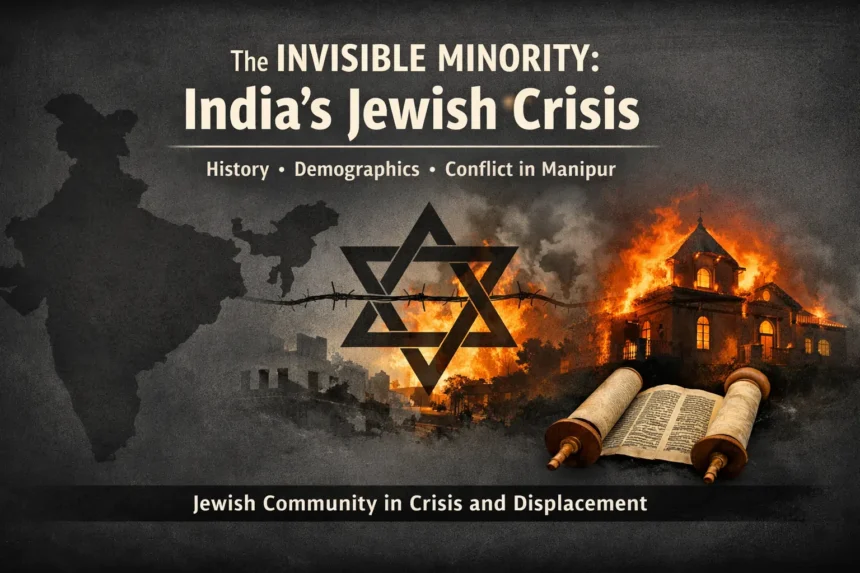
The northeastern state of Manipur is experiencing the most serious current crisis affecting the Jewish community in India. The minority Kuki-Zo tribes are ethnically integrated with the Bnei Menashe, a group that can trace their ancestry back to the Lost Tribes of Israel.
Tensions over land rights, affirmative action, and ethnic identity have steadily increased since the BJP took over the state in 2017 under Chief Minister N. Biren Singh. On May 3, 2023, these tensions erupted into devastating violence. Ethnic tensions between the Kuki-Zo tribal minorities and the Hindu-majority Meitei community erupted as a result. According to reports, Kuki neighborhoods were heavily targeted by radicalized mobs carrying between 4,000 and 6,000 weapons that were stolen from state police armories.
In this violence, the Bnei Menashe suffered terrible collateral damage. The numbers show a catastrophic humanitarian catastrophe: more than 1,000 Bnei Menashe were forcibly relocated out of an estimated 5,000 Jews in India. This indicates that a startling 20% of the Jewish population in the country as a whole was left homeless and had to relocate to relief camps in nearby Mizoram.
Infrastructure related to religion was specifically targeted. Sacred Torah scrolls were destroyed when at least two well-known synagogues were burned to ashes, including the Beit Shalom synagogue in Churachandpur and another in Imphal. Jewish homes were looted, and Yoel Malnawn and other community members perished in the mob violence. More than 250 churches were set on fire throughout the state as part of a larger anti-minority campaign that was reflected in this devastation.
A Broken Story
There has been harsh domestic and international criticism of the way the Manipur crisis has been handled. The state and federal governments have come under heavy fire from opposition parties and human rights activists for failing to provide protection for these minority groups. Prime Minister Narendra Modi was widely criticized for months for his prolonged silence on the Manipur dispute, which some claim shows how hollow his government’s international rhetoric as a defender of Jewish heritage is.
In the end, the information and historical background paint a very unsettling picture. The largest surviving Jewish community in India is experiencing an existential crisis due to complete political erasure at the parliamentary level and the disastrous displacement of the Bnei Menashe in Manipur. The story of India as an unexplored haven for minorities is being put to the ultimate test as synagogues burn in the Northeast.
The Invisible Minority: India’s Jewish Crisis, History, and Demographics

Leave a Comment
VONEI is an independent journalism platform committed to amplifying the real voices of Northeast India through reliable reporting, timely updates, and impactful storytelling.

