
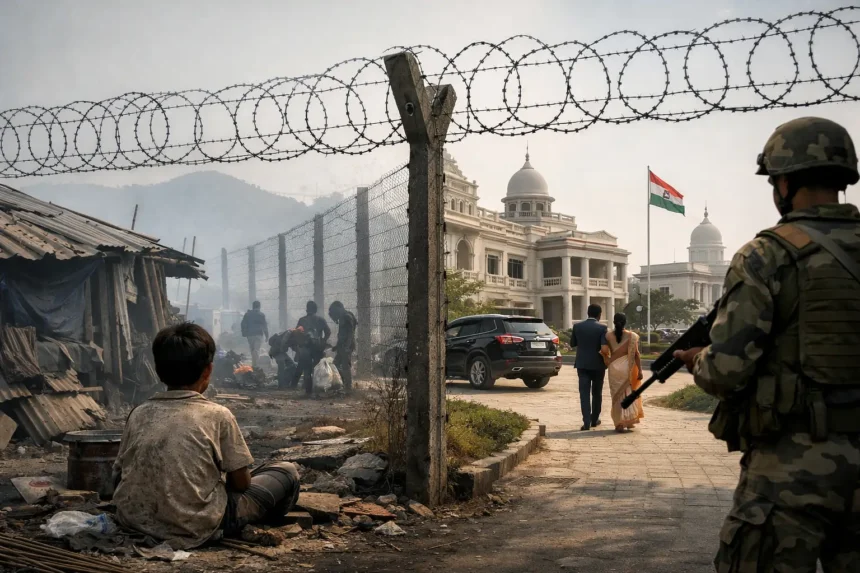
Every year, February 20 goes by in Northeast India without a sound. The United Nations calls this day the World Day of Social Justice, which is a call for everyone to work together to break down systemic barriers and end economic inequality. However, no state government in the Northeast recognizes it. There are no official events, policy reviews, or public campaigns. This isn’t just a mistake on the part of the administration; it’s a planned forgetfulness. If the political class wanted to support social justice, they would have to face the obvious systemic unfairness they have been actively supporting.
Luigi Taparelli first used the term “social justice” in the 1840s to protect the rights of the poor. The UN later used it as the basis for peaceful coexistence. It means that everyone should have equal access to resources, opportunities, and human dignity. In India’s Northeast, which is heavily militarized, economically exploited, and geographically isolated, both the government and the people have given up on the basic ideas of social justice.
The Myth of Tribal Equality
There is a persistent, romanticized myth that Northeastern tribal societies are inherently egalitarian. Historically accurate—originating from a subsistence economy necessitating communal resource sharing—that reality has been defunct for decades. The rise of predatory capitalism and corrupt bureaucracy has violently broken up this tribal equity.
The gap between rich and poor in the area is huge right now. The NITI Aayog’s Multidimensional Poverty Index shows that states like Assam and Meghalaya have always had high rates of severe poverty, with more than 32% of their populations historically lacking basic health, education, and living standards. A new native elite has risen to power, taking over government contracts, taking natural resources, and leaving rural, poor people to take care of themselves. People who don’t have a lot of money have been completely pushed out of their own communities.
State Complicity and Systemic Violence
Structural violence against marginalized groups is the most obvious example of social injustice. India’s national record is already terrible. Oxfam says that the top 1% of the Indian population owns more than 40% of the country’s wealth. The National Crime Records Bureau (NCRB) keeps track of the rising number of crimes against women, Dalits, and minorities. In the Northeast, this unfairness takes a more local and often deadly form.
Think about the ethnic violence that broke out in Manipur in 2023, which forced more than 60,000 people to leave their homes and killed hundreds of people. This wasn’t an accident that happened all of a sudden; it was the result of decades of unfair land rights, political representation, and resource distribution.
Also, the area is subject to state-sponsored cultural imperialism that is sneaky. Majoritarian religions, languages, and mainland political cultures are imposed upon ethnic minorities, both covertly and overtly, contravening the fundamental social justice principle of inclusivity. While people all over the world are fighting for climate justice, indigenous land rights, and gender equality, Northeast India is stuck in a kind of ethnic majoritarianism that only cares about the rights of their own tribe or language group. They completely ignore the bigger picture of human rights.
The Failure of Education and Public Compassion
Everyone agrees that education is the most important thing to do to make things fair. But the education system in the area is not useful for empowering people socially. It is a luxury that the poor in the country can’t afford and a sterile, rote-learning exercise for the middle class in the city. It doesn’t have important parts that teach about civic duty, environmental responsibility, or constitutional rights.
For example, child marriage. India has a long history of getting rid of practices like Sati, but the National Family Health Survey (NFHS-5) shows that in states like Assam, more than 31% of women aged 20 to 24 were married before the legal age of 18. Both social justice and educational intervention have failed badly here.
But the government can’t be blamed for everything. The public is very involved. We have made our ignorance normal as citizens. We don’t have enough empathy, which is why we don’t build local groups that include people of different races. We don’t use social media to call for big changes in the system, and we don’t volunteer, give money, or protest with groups that are geographically or economically disadvantaged outside of our own circles. We forget that many of us are hurt by the system we refuse to fight against.
A Requirement of the Constitution
Some people who don’t like Social Justice Theory say that it takes away personal responsibility by putting too much emphasis on group identity. But in a place where your ethnicity, zip code, and language determine how easy it is for you to get health care, clean water, and safety, systemic focus is not a choice; it is a necessity for survival.
It is not a kind thing to do to make sure that everyone has social justice; it is a requirement in the Preamble of the Indian Constitution. New Delhi’s constant marginalization of the Northeast, along with regional politicians taking advantage of the people there, breaks that contract.
February 20 will stay just another day on the calendar until people put pressure on their governments to make sure that policies are fair in both letter and spirit, breaking down systemic barriers and making sure that wealth is shared. And Northeast India will keep going down the sad path to becoming a society where only those who can pay for it can get justice.