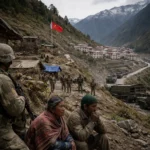

The history of the insurgency in Northeast India is not merely the history of guns, militancy, or state repressions but rather a very complex, multiple-layered story of identity, neglect, geography and political negotiation. This area had been among the most unstable conflict areas in the whole of South Asia. However, it is also today one of the biggest shifts towards negotiated peace by means of armed struggle in modern India. Yet, this change is not complete and even.
Historical Cores of Insurgency
The Northeast Indian insurgency started soon after Indian independence in 1947 and the earliest organized movement in the region was the Naga movement. Armed resistance took shape already in 1956 as a result of the need to establish sovereignty and secure ethnic identity.
This wave of resistance spread across the region in the long run. In Assam, the United Liberation Front of Asom (ULFA), in Nagaland, the stronghold of the National Socialist Council of Nagaland (NSCN) and in Manipur, various groups of insurgents based in the valleys appeared. Other states such as Mizoram, Tripura and Meghalaya had their days of militancy.
The region was at one point almost full of active insurgent groups each aiming at varying goals, such as the total independence, to demands to be autonomous or have ethnic recognition.
Why Did Insurgency Emerge?
The causes of insurgency in Northeast India are multifaceted; however, they can be simplified into the four factors: Ethnicity and Cultural Statement. The ethnic groups living in the region exceed 200 in number and most of them were afraid of being assimilated and lose identity. Geographical Isolation Bound to the mainland India via the narrow Siliguri Corridor, the region was both geographically and psychologically remote to the center.
Economic Neglect The region was poor in terms of infrastructure, employment and industrial development, despite its strategic significance. Political Marginalization Numerous communities felt they were not being included in the decision making processes which made them bitter against the central government. These provided good grounds on which insurgency thrived, transforming local dissatisfactions into armed resistance.
The Era of Armed Struggle
Between the 1970s and the early 2000s, there was stiff insurgency in Northeast India. Attacks were conducted by armies of people on security forces, government facilities and civilians. Extortion, kidnappings, and parallel shadow governments became everyday in a number of places. The state of India retaliated through high militarization.
In 1958, the military was given broad powers in the introduction of the Armed Forces Special Powers Act (AFSPA) in disturbed areas. Although meant to bring sanity, the AFSPA was so controversial because of the claims of the violation of human rights.
This was an important time of violence. Whole territories were consumed in the patterns of revenge amongst insurgents and the security agencies, and overwhelmingly impacted on the lives and economic performance of the civilians.
Cross-Border Dimensions
The international aspect of insurgency has been one of the characteristics of insurgent activities in Northeast India. It borders neighboring countries of China, Myanmar, Bangladesh, and Bhutan hence it is geopolitically sensitive. Insurgent groups tended to nest in other nations especially in Myanmar through porous borders to avoid the eyes of the Indian security force. These transnational connections enhanced insurgencies and extended violence. Reports continue to indicate that even in recent years there are actions performed by groups such as ULFA and they actually have maintained camps on the Myanmar border, proving the impending intricacy of the conflict.
Transform Shift of Peace: The Turning Point.
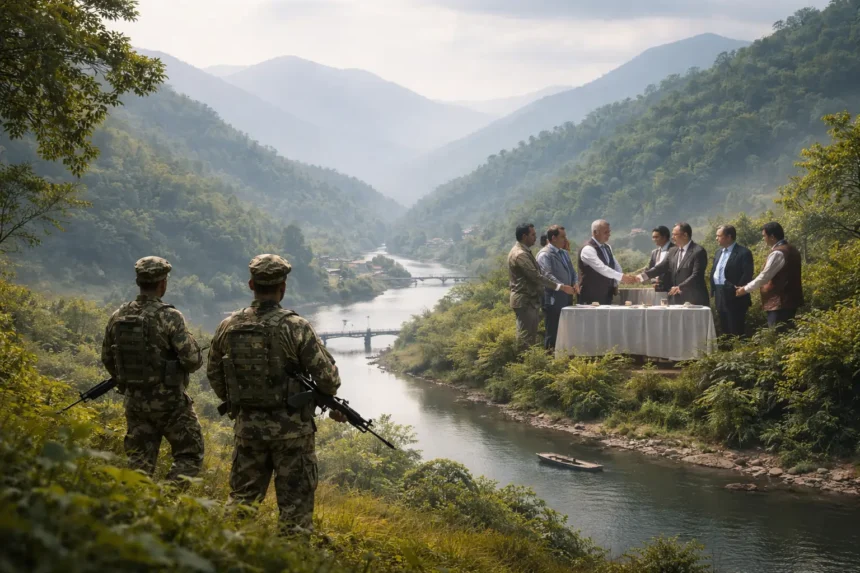
The beginning of the 21 st century was the period of the gradual replacement of the armed confrontation with the dialogue. The Indian government started dealing with the insurgent groups via cease-fires, negotiations and peace accords.
Among the earliest achievements, the Mizoram Peace Accord (1986), which is also used as a good example, succeeded. It changed Mizoram into a peaceful state among the most conflicted states in India.
This was followed by a number of great accords:
1997 Ceasefire with Naga groups 2015
Naga Framework Agreement 2020
Bodo Peace Accord Karbi Anglong Accord (2021)
The deal with NSCN in 2015 was a historic move towards the solution to one of the oldest insurgencies in the history of India.
Violence Decadence:
Facts and Figures. The effects of such peace efforts have been enormous: By the year 2022, the number of incidents concerning insurgency decreased by approximately 80 percent in 2014-2022. The number of deaths of civilians decreased by up to 99 percent within the same time. The total violence in the area was reduced by approximately 80 percent compared to the middle of 2010s. Over 8,000 rebels capitulated during 2014- 2025, becoming members of the mainstream society. Such figures indicate the radical change in the security situation in the region.
The transformation of Militarization to Rehabilitation.
One major change in the process of peace has been the transition where only military solutions are being substituted with rehabilitation and integration. Programs that were introduced by governments offered:
Vocational training
Financial assistance
Education opportunities
These programs were meant to help the ex-militants resume their normal lives, and chances of returning to violence were minimized. At the same time, the government started eliminating AFSPA in some regions, which is indicative of better stability. The law has been totally eliminated in such states as Tripura or Meghalaya.
Challenges and Limitations
The peace process is also weak although much has been done. Incomplete Agreements Some of the most influential groups such as ULFA (Independent faction) and NSCN (IM) have unresolvable requirements such as sovereignty and distinct constitutions. Ethnic Tensions Since peace accords are made with a group of people, this insecurity may be caused to another group and may be resultant to another conflict. Resurgence of Violence Ethnic conflict in Manipur (since 2023) demonstrates that there are still certain tensions at the background level.
Cross-Border Safe Havens
The existence of militant camps out of India remains a problem in the long-term peace. Actually, even though, some states such as Tripura and Meghalaya have peace in most parts, but some, such as Manipur remain unsustainable- what observers are terming as a dual reality a state of peace and violence operating simultaneously.
A Region in Transition
The Northeast Indian region is today on the verge. This has seen the region making great strides to leave behind it the insurgency that was rampant in the area to the state of better governance, development of infrastructure, and political participation. The fact that voting is a high of about 80 percent in general elections of 2014 also displays increasing confidence in democratic processes.Nevertheless, the peace in the region is not only a lack of the violence. It demands some more profound issues of identity, representation, and economic inclusion.
Conclusions
The process of Northeast Indian transitioning out of insurgency and making peace agreements is impressive and imperfect. It demonstrates that identity-based and marginalization-driven armed conflicts cannot be solved with the help of force only.
It requires dialogue, accommodation and political will. Although the region has seen an unchallenged reduction of violence along with a remarkable remerge of thousands of former militants, the existence of ethnic and unfulfilled political needs is a wake up call peace is a process, not an event.
The harder task to come is not simply peacekeeping, but peace with a purpose- that is, justice, development, and dignity to all the people in Northeast India.