
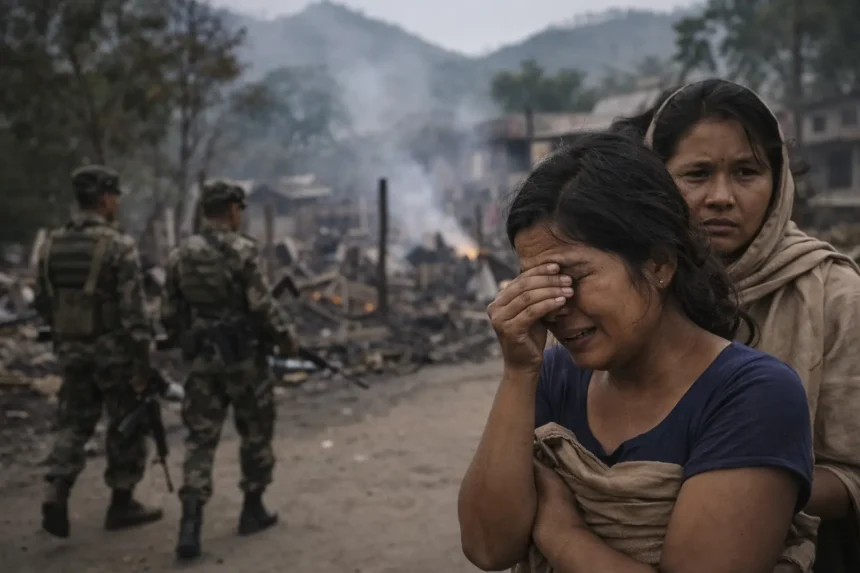
For a long time, the Northeast has been suffering from the worst human rights crisis. Today, not only children but also women in the Indian Northeast have been living in unfortunate conditions, including conflicts, militarization, and political neglect. The region Northeast has been known for its insecure environment, insurgency, ethnic tensions, and government backing against the dominant communities, neglecting the minor communities, who are mainly Christians. The support is not only a voiced one. It’s a systematic approach taken by governments for a long time. There is a need to analyze the situation in depth and how far this situation has worsened during the years of the BJP rule.
The Equation of Exclusion
For the past ten years, the Northern states have recorded a consistent increase in the number of crimes committed against women in the region. For the past ten years, the Northern states have recorded a consistent increase in the number of crimes committed against women in the region. In 2022, Assam had over thirty thousand crime incidents against women. All over India, the National Crime Records Bureau labelled Assam as the state that witnessed the highest level of crimes against women in India.
Since September 2023, 200 lives have been lost in the Indian Northeast due to the negligence of the government. Ethnic violence has a disproportionately adverse effect on women and children, and often occurs without a secure environment or enough resources.
Ethnic violence has a disproportionately adverse effect on women and children, and often occurs without a secure environment or enough resources.
An Issue Neglected by the Indian Government
The most important issue for India’s Northeast is what women are facing, and it is overlooked by everyone in power. The systematic support towards harassment, which is a human rights violation, is not only specific to Manipur. Across other states such as Nagaland, Assam, and parts of Arunachal Pradesh, women have commonly become the most vulnerable victims of prolonged violence and instability.
Moreover, from displacement during ethnic clashes to harassment in militarized zones, the vulnerable lives of women in the region is bearing loss, fear and a long ongoing sense of uncertainty. These political and social challenges are further compounded during elections, as the governance and security failures affect electoral fairness and representation in Northeast India. A detailed analysis of this problem can be found in Elections Under Fire in North East States: How Central Policies Suppress Opposition
Alarming Situation in Saikul
Currently, a recent situation has taken place in Manipur where, once again, a troubling pattern has repeated itself, which highlights the incident where unarmed Kuki-Zo women farmers were attacked while they were working in some agricultural fields in the area of Saikul subdivision of Kangpokpi district. The routine farming necessary for their livelihood has been threatened more severely due to this happening.
Many of the human rights groups have condemned this incident, as it is a grave violation of the principles of humanity. The recurrence of these conflicts in India’s Northeast is a point of concern for not only India but the international actors, as well, because the world is witnessing all of these incidents with regular intervals.
The Culture of Reoccurrence
Women, and their humiliation, have been used as tools of psychological warfare throughout history, and the conflict zones of North East India are no different. Attacks on women are intended to terrorize communities, undermine their means of survival, and increase ethnic fragmentation. Also, during insurgency attacks, communal violence, or military crackdowns, women suffer the greatest social and psychological burden of conflict. Usually, government involvement has been found for major crackdowns and attacks.
The Failure in the Northeast: The Real Culprits
Biren Singh, the former CM of Manipur, has resigned due to his involvements and planning of the bombing of minorities in the Northeast. Moreover, in the Northeast majority of the cases go unreported, or sometimes they are underinvestigated. The culture of impunity has been strengthened by such ignorance towards victims. Northeast violence’s economic impact is just as troubling. Many women farm or engage in small-scale agriculture, serving as the main income contributors in the households.
Such incidents not only block access to fields but also endanger the survival of the families and the entire community as well. In combination with the aforementioned elements, the most insulting is the complete disregard for the citizens of the Northeast, the most scorned concern being directed toward women. While justice remains absent, the feeling of fear and vulnerability will exist endlessly, and the presence of such phenomena, unfortunately, is the consequence of the prevalent violence in the Indian Northeast.