
The northeast of India has always been equated with the intricate insurgencies based on ethnicity, historical disputes as well as unequal development. However, the country New Delhi is officializing in 2026 an exciting and uncomfortable chapter in its constant security struggle: the implication of foreign nationals into militancy related activity on the Indo Myanmar border.
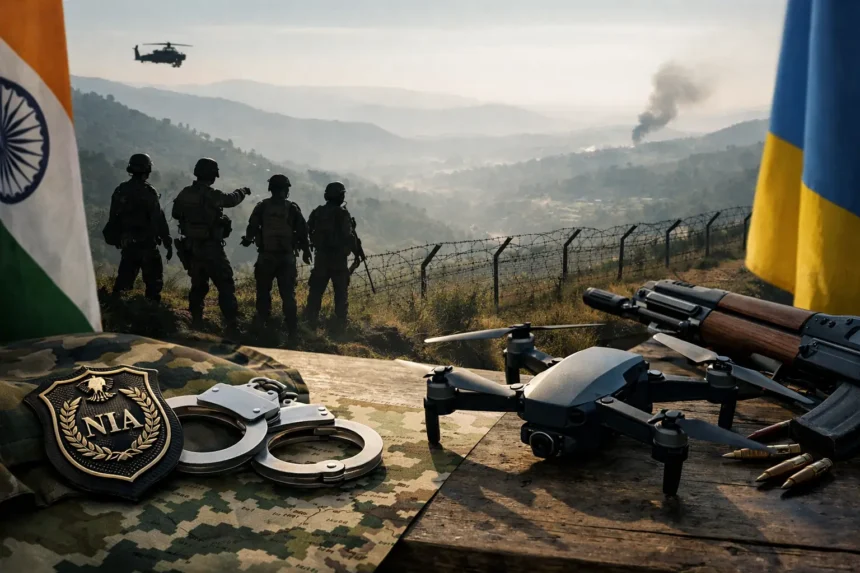
This trend has injected new weaknesses and created a coating of fears about the stability of the region and has stricterly called up strategic realignment. Recently, the National Investigation Agency (NIA), the top counter terrorism agency of India, has apprehended seven foreign citizens including a U.S citizen and six citizens of Ukraine on allegations of plotting to fund militant groups operating in the Northeast. Official filings indicate that these people flew into restricted strip areas without appropriate permits, flew into neighbouring Myanmar, and was involved in training ethnic armed groups and importing drones and other associated technology to Europe.
The event is a major step forward in insurgent trends in the area. In the past, militants in Northeast India (mostly the United Liberation Front of Assam (ULFA), the National Socialist Council of Nagaland (NSCN) and other of several Meitei and Kuki) have been mainly indigenous in nature, locally related to their goal of autonomy or self determination, and motivated by long term resentment of the Indian state. However, the supposed role of Western nationals who have access to enhanced drone technology and tactical networks brings on board a new aspect to these wars.
The northeastern states in India, such as Manipur, Mizoram, Nagaland and Arunachal Pradesh, border the porous 1,624 kilometres border with Myanmar, where various armed ethnic groups have long been present. These often take advantage of the challenging terrain to transfer resources, people and weaponry across boundaries making Indian security reaction challenging. The arrests of these by the NIA are indicating that this could be foreign forces that are taking advantage of the same to manipulate or even train militant groups and also modernised their own strength beyond ordinary guerilla manoeuvres. These developments have resulted in diplomatic overtures.
The Embassy of Ukraine in New Delhi has protested against the arrest of its citizens, requesting consular access as well as questioning the procedure involved in the arrests. In the meantime, the Indian authorities insist that they acted within the legal provisions due to strong laws on national security that encompasss the Unlawful Activities (Prevention) Act (UAPA).
Depending on how the legal and diplomatic implications of this episode resonate in the short term, the long-term effects are immense:
Eroding Trust in Border Management
The Northeast of India has long been hard to control, both in terms of its geography and ethnic composition. The mountainous geography, thick forests, and the inadequate infrastructure can easily act as described as natural havens of the militating groups and a huge challenge to monitor.
Insurrectionists and smugglers alike have extensively used the open borders with Myanmar which so far are only partially fenced and in the early stages of formalised control. Today, the hypothetical foreign intervention brings out the view of how these weaknesses are not mere logistical problems but also geostrategic weaknesses.
Militant Modernisation and Tactical Shifts
The fact that drones have been imported and there is training in operating the drones is an indicator that there is a disturbing tendency of the insurgent formations moving beyond the small arms skirmishes to the greater warfare capabilities. Drones will be deployed to carry out reconnaissance missions, logistics, surveillance, and in bad hands, armed attacks. Such technological breakthrough makes insurgent actions more deadly and less predictable and decreases the usefulness of the conventional counter insurgency methods.
Regional Security and Foreign Influence
Although the Indian government discounted the fake social media news about faux pas thousands of Ukrainians training soldiers fighting against Russia, the confirmed arrests do mark the fact that foreign influence whether direct or indirect is no longer a secondary story. It poses troubling answers to whether the global players in the geopolitical arena regard the Northeast of India as a venue of proxy wars, owing to the internal strife of Myanmar and other foreign powers in the southeastern region having an interest therein.
The Path Ahead
The holistic approach is very important in dealing with this multi layered security challenge. Enhancing the infrastructure and surveillance technology on their side of the border is merely half of the problem, New Delhi also has to strengthen the intelligence ties with the other states in the region, improve socio economic development in the Northeast and start selective diplomatic intervention to make sure that external forces do not use internal problems as a pretext to intervene.a Above all, policy maker should understand that security crisis in the Northeast of India has ceased being a localized problem of insurgency and has taken on a transnational and technological fashion. Implementation of current strategic posture can make India vulnerable to the external forces worsening the fault line existing in the country, consequently jeopardizing national unity and peace in the region.