
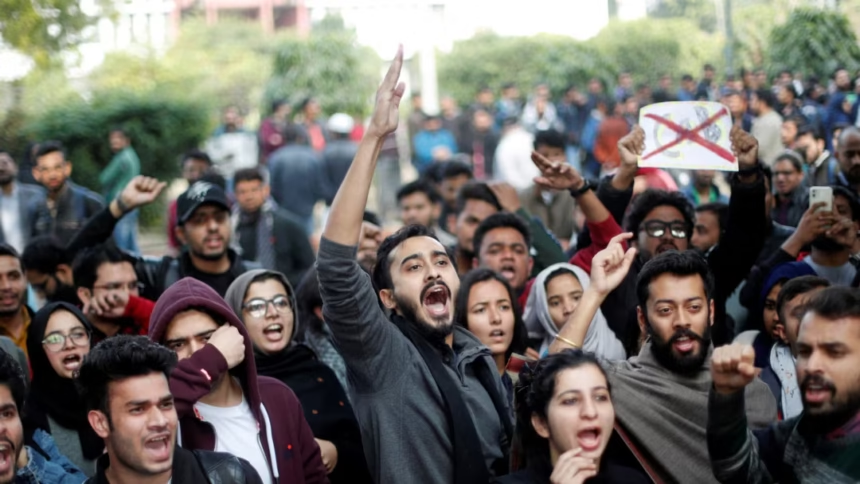
Students protesting on the highways of Manipur, Assamese youths protesting on the streets in protesting the citizenship bill and tribal associations protesting the extractive development projects in Meghalaya are all natural objects of the law-and-order approach of the institutional reaction. The frame of analysis is not analytically adequate.
Youth-led protest in Northeast India can be seen as an informal but organized process of policy feedback, a form of democracy communication that occurs when formal channels of communication are not working. Street politics is not a failure of democracy in areas of weak legislative bodies, where bureaucratic institutions have colonial and post-colonial histories of distance, and where identities and sovereignty have been constitutionally contested. It’s democracy on steroids. It’s democracy on steroids’ constraining.
It looks at the way youth movements in the Northeast India create a chain of reaction which reveal weaknesses in governance, challenge policy making and sometimes force a reaction from the state. The main thesis is that governance in the region will remain structurally unresponsive and persistently reactive unless the policy makers learn to take the meaning in protest.
The Northeast States are home to a dozen ethnic groups, more than 200 ethnic groups, a dozen languages, and a political landscape that is largely shaped by its structural distance from New Delhi. Less than four percent of its boundary is shared with the Indian mainland (that is the ‘Chicken’s Neck’ corridor) and since independence, it has been administered under a multi-layered system of special provisions, scheduled tribe status, peace pacts and counterinsurgency measures.
This tension around the center-periphery is not something that just happened. The sixth schedule of Constitution, Inner Line Permit (ILP) system and Article 371 provisions have been introduced to cater to the diversity of the region, but they have not been consistently followed and, sometimes, politicized. The development indices of majority of the Northeastern states are still lower than the country in infrastructure, institutional capacity and employment creation. For decades, a highly asymmetric and disempowering security relationship between the state and its citizens has been enabled by the Armed Forces (Special Powers) Act, AFSPA, which has been in place in large parts of the region.
This is in the context of formal accommodation and substantive exclusion in which youth protest must be seen.
Young people of NE India are not mere beneficiaries of ethnic challenges. They are active political agents in the context of growing levels of education, migration to cities and urban lifestyles, unemployment, and unprecedented digital connectivity. The Assamese student community (All Assam Students’ Union (AASU), Naga Student’s Federation, Mizo Zirlai Pawl) and other student unions have been historically one of the most politically significant groups in the region and sometimes acting as proxies for the wider community’s assertion.
The dynamics of mobilization have changed greatly due to social media. Grievances can be expressed quickly, visually captured, and disseminated across the region, even beyond, via platforms like X (Twitter), Facebook, and Instagram. The incident was starkly illustrated during the anti-Citizenship Amendment Act (CAA) protest in Assam in 2019, which spiraled into a nationwide movement in just days, generating a response from the central government which had not achieved so during any parliamentary opposition that was registered.
Importantly, digital amplification also calls for more precision in articulating demands, requiring movements to be more exact in their demands. In this disciplinary process, youth movements tend to migrate towards more coherent language in their policies, making their protests more legible as feedback even if the state does not respond.
The young people’s protests in the Northeast are diverse. They have their own issue-bundles which once carefully mapped out, expose the shapes of governance failures.
The CAA protests and the demands for ILP are about identity and demographic anxiety, especially when states such as Manipur had been agitating for ILP protection in 2019. The message behind it is that the communities are not feeling secure with the state’s policy on ethnic security concerns, there’s a sense of not being protected.
In Nagaland, people protest over the stalled peace process, in Manipur they protest over hill-valley ethnic conflict, and in Meghalaya they protest about land rights, all this driven by ethnic autonomy and territorial claims. The protests are a message that the current administrative structures are not satisfactory for addressing multifaceted issues of sovereignty.
Development gaps and extractive governance are drivers of opposition to industrial projects, infrastructure corridors, and resource extraction, when communities see it as being for external groups. This is structural feedback: development policy is made without consultation or benefit sharing with the communities.
The issues of security and impunity continue to be a constant concern. The security architecture is still not in sync with the rights-based governance as protest signals continue to be generated by extrajudicial killings and custodial deaths and the operational freedom enjoyed under AFSPA.
These protest types all have different policy implications. If they are dealt with in the same way, they lose the information they hold because of being dealt with as ‘unrest’.
Reactions of the Indian state to youth protest in the Northeast have varied and sometimes been contradictory. There are three general trends that can be seen.
Firstly, the extension of ILP to Manipur after protests, the suspension of land amendments in Meghalaya due to tribal demand, and the renegotiation of certain accords suggest that protests can and do lead to policy change albeit only when mobilization reaches a level at which the political costs of doing nothing become high.
Second, procedural absorption: Commissions, dialogues and consultative committees are often called because of protests. They may be actual but are more frequently used to stall momentum and not to make real changes. The long-standing Naga peace process is a clear example of the above: decades of peaceful processes which treat protest but fail to address its root causes.
Third, coercive containment: internet shutdowns, Section 144 orders and in extreme cases, the deployment of paramilitary forces, all are examples of the state’s refusal to consider protest as feedback. This response is expensive to the analysis, and it blocks the signal, not solves the source.
To Sum up, the youth-led movements of Northeast India are not irrational and incomprehensible. They are political communications which are generally well-argued and explicitly directed at specific policy failures. The analytical and political failure is that the state does not want to decode them as such.
The evidence drawn from a handful of democracies with diverse institutional arrangements, such as South Korea, Chile, and South Africa, indicates that having mechanisms in place that enable government leaders to heed and incorporate street-level feedback into policy iteration is more likely to result in lasting governance outcomes than relying on a strategy of coercion and ad hoc concession.
The situation is critical for Northeast India. Diversity, in the region, is not a governance burden, it’s a democratic asset but the State must build the capacity to listen. Protest is the region’s youth speaking for the state that it cannot see from New Delhi. Whether or not these signals are present is not the question. But does the state have the maturity for democracy to read them?