
The recent deployment of the SF-10 commandos in the village of Lapangap in Meghalaya has again brought to the fore the entrenched political and administrative malfunctions between Assam and Meghalaya relating to the Assam-Mon State conflict. So, issues which should have been solved through continuous dialogue, constitutional processes and community-based conflict management have increasingly become a security challenge.
When the farmers’ land is being threatened by the military forces which are composed of ordinary villagers, it is not a sign of strength but of the failure of the government to find a lasting solution politically. Lapangap, an area in the West Jaintia Hills district of Meghalaya, close to Assam border, has continued to be one of the most volatile flashpoints in the disputed region of the north-eastern states of Assam and Meghalaya. However, the situation worsened once again in May 2026, when villagers reported further encroachments, crop destruction, and abuse by groups from the Karbi Anglong district in Assam. Meghalaya government, then, sent in the SF-10 commandos and other police battalions to the state. The crisis is symptomatic of a structural issue.
However, some border areas continue to be disputed over more than 50 years after the creation of Meghalaya, from Assam in 1972. Of the 12 major disputed areas between Assam and Meghalaya, only six were settled during the first phase of this negotiation signed in March 2022. However, six other sectors, involving sensitive sections which are linked with the West Jaintia Hills, remain to experience recurring tensions, distrust and periodic violence. The disagreement has a long history as it dates to the Assam Reorganization Act, 1971. Meghalaya is bitterly protesting the transfer of several areas into Assam’s administration following the colonial administration, which historically belonged to Khasi, Jaintia and Garo tribes.
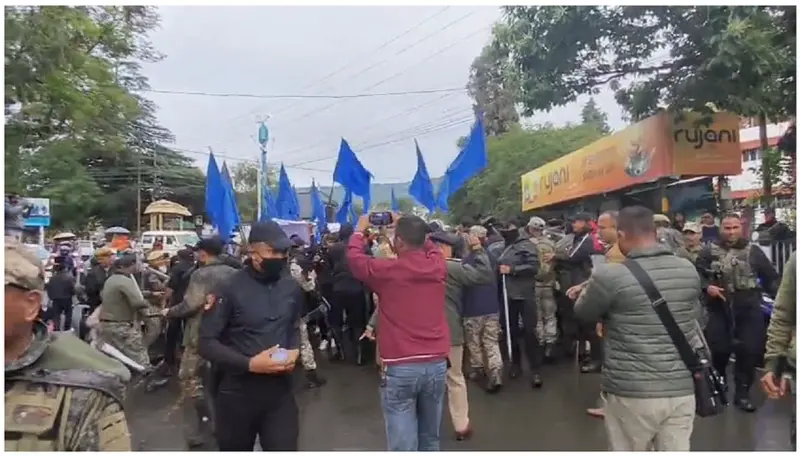
Therefore, Assam has its own constitutional and administrative rights with respect to many of these territories. The successive governments in both states have pledged dialogue and peace, but local communities are still paying the price for political indecision. The current Lapangap dispute occurred when farmers tried to farm the contested lands during the farming season. Villagers reported that the paddy field was damaged overnight and reported to be obstructed several times by people from the Karbi side. Hundreds of people took to the streets of Shillong, the capital of Meghalaya, to protest for security measures and intervention by the government. In response, the government of Meghalaya sent more Police officers and SF-10 commandos, an elite armed force unit, to the area. Meghalaya Director General of Police Idashisha Nongrang said that a platoon of SF-10 commandos was sent to Lapangap to stop further decline of law and order. But the deployment brings serious questions regarding the government’s priorities in the Northeast. What are the reasons for the rise in farming conflicts being resolved by armed policing as opposed to conflict resolution? The heavy security response is an illustration of the reliance on force rather than democratic consensus for border governance in the Northeast.
This trend is nothing unique and has been around for a while. Governments generally step in only after tensions have erupted in the open in border conflicts throughout the Northeast. There were violent incidents between the Assam and Mizoram communities in 2022 involving police and civilians resulting in fatalities. Similar tensions have often arisen between Nagaland and Assam and between Arunachal and Assam. The conflicts illustrate the lack of a broad regional plan for resolving interstate boundaries in the Northeast.
Political aspects of Lapangap’s conflict are not insignificant as well. Border tensions have remained unresolved even after several assurances of peace and cooperation by the BJP-led Northeast Democratic Alliance (NEDA) in the Northeast. The Northeast is often described by the central government as the most stable and developed region in the country, but the unresolved disputes create insecurity for the people.
The government led by Prime Minister Narendra Modi has stressed on connectivity initiatives, development of infrastructure and “Act East” policy in the northeastern region. Alongside highways, railways, and trade corridors, there has been a rise in the number of order and safety cases, but many local communities say that key political and ethnic concerns have not been addressed. Economic development cannot be a substitute for institutional trust and justice. The need for armed commandos to plow farmers’ fields demonstrates the lack of political control.
The deployment also comes as a reminder of the precarious state of relations between communities in disputed zones. Economic and cultural similarities between border communities of Assam and Meghalaya may give rise to suspicions and hostilities due to political differences. These conflicts may escalate ethnic tensions between the Khasi-Jaintia and Karbi communities in the future. If conflicts are not resolved, there is a greater likelihood that tensions could grow into larger identity conflicts. Another huge worry is the “normalization” of military presence in civilian public areas in the Northeast.
The use of security deployments as a temporary solution is often presented as such, but the repeated use of armed forces alters the relationship between citizens and state. Communities are increasingly facing the state in armed police camps, checkpoints and through the armed men of the state rather than as a mediator or welfare provider. It is reported that Meghalaya police are even setting up a permanent security camp as in Assam in the disputed border area. Such developments can lead to a vicious circle of competition over militarization, rather than speeding up political talks. It also reveals flaws in the Federal system in India.
Cooperation and negotiation are constitutionally expected to be the normal way to resolve interstate conflicts, and sometimes interstate disputes do require the help of the Union government. But the Centre has been more reactive than proactive in addressing the disputes in the North-East. There have been temporary agreements through meetings, committees, and regional panels, but they have not been implemented completely or quickly.
Importantly, local voices are frequently not heard at high level negotiations. Farmers, village councils, tribal groups and grassroots disgruntled individuals and groups who are impacted by these conflicts seldom have any real influence on decision making. Consequently, declarations made by politicians often are superficial and don’t reflect the ground truth. Lapangap is thus not just a spat on the local level. Represents the unresolved political issues of the Northeast.
Militarization can only put an end to violence for a while, but not peace. To reach sustainable resolution, negotiations must be transparent, the constitution needs to be clear, land rights must be protected and affected communities need to be included in the process. We must move away from crisis management to governance in the Northeast. However, sending commandos can only make a few weeks of “cooling down,” and cannot resolve the underlying structural issues of repeated conflict. Villages such as Lapang continue to be stuck in the cycle of uncertainty, fear and unaddressed history, without governments showing political courage to break it.