

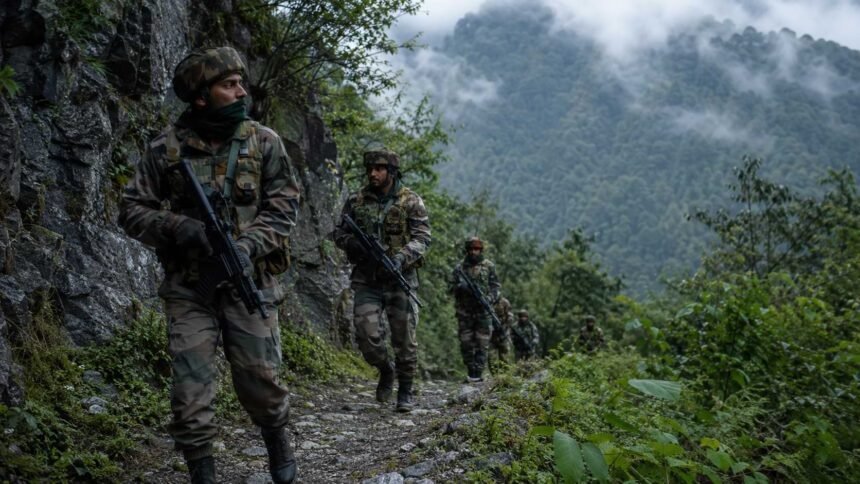
Arunachal Pradesh is again at the heart of the India’s counter-insurgency efforts as dense forests loom in the background. The Assam Rifles have stepped up its operations in the eastern districts of Assam as militant groups try to resurrect the extortion racket and the cross-border movement along the India–Myanmar border. In the North East, however, recent security skirmishes in the areas of Changlang, Longding and Tirap suggest a new face and flavour of insurgency in the region, as the old groups try to adjust to the new geopolitical realities, and Indian security forces are learning to be wiser, more vigilant and quicker to act on their tactical decisions.
The fatal shoot-out this week in Changlang district was one of the largest anti-insurgency operations seen in 2026 to date. Assam Rifles personnel killed two suspected NSCN militants one evening in the near vicinity of the Myanmar border, in the Miao sector. Security forces found arms and ammunition at the site, suggesting that the militants were well armed and had been planning for a longer campaign in the area.
This operation was not a one-off affair. It is a part of the security escalation that is taking place all over the Northeast India. In the recent times, intelligence agencies have been raising the alarm against the potential of a fresh militant regrouping in the border belt of Arunachal Pradesh, Nagaland, Assam and Myanmar at least for the past few months. Internally, Myanmar is experiencing instability following long-running conflicts, which has enabled insurgent groups to travel across alluring jungle borders, re-establish camps and resume extortion against civilian and contractor populations.
For Assam Rifles, which are the oldest paramilitary force in the country with strength of over 65,000 in active service, the struggle is no more confined to the traditional insurgency. In today’s operations, the fight against weapon smuggling, narco-trafficking, illegal taxation, infiltration across borders and new militant alliances is underway.
The recent security assessments indicate that in the past two years, there have been several incidents in Arunachal Pradesh linked to various groups of the NSCN-K, ULFA-I and NSCN-IM. In coordinated operations some militants have been arrested, neutralized or forced to surrender. At least nine militants from various insurgent groups laid down their arms in front of the security forces in Tirap and Changlang districts in 2026. The Home Department of the Arunachal Pradesh Government also told the Assembly that almost 165 underground operatives had surrendered in the belt of Tirap, Changlang and Longding in the last five years.
But despite all this good news, the danger remains.
The extortion system is firmly rooted in the region’s black world market. Militancy groups still ask contractors, road schemes and traders for “taxes”, and even government bodies. Intelligence reports indicate some groups are using the rough terrain and poor communication in the eastern part of Arunachal to establish temporary operational bases close to the Myanmar border. Intelligence reports indicate some groups have found rough terrain and poor communications close to the Myanmar border to establish temporary operational bases near the Myanmar border. Fear of militants and reliance on security forces often make villagers in remote areas caught between a rock and a hard place.
The recent Changlang event is an example of this changing threat. There were reports that residents were being extortion by militants in the area, leading security forces to step up their surveillance and combing operations.
The escalation of the insurgent tactics is what’s making the current situation so alarming. Security analysts say there are several groups of people turning against the big attacks for smaller missions, such as intelligence gathering, targeted ambushes and economic disruption, which have become more decentralized. In an earlier incident, the Assam Rifles camp at Changlang was reportedly attacked by the NSCN-K-YA militants in the vicinity of the India-Myanmar border earlier this year. The killing did not cause any reported fatalities, but it did show the enduring ability of insurgent groups to continue operating despite the pressure of counter-insurgency efforts over the past few years.
Meanwhile, the Assam Rifles’ tactical deployment has greatly increased. Suspicion and the use of drones to monitor movements has increased, along with joint operations with Arunachal Police and intelligence-led raids. In other States such as Manipur and Mizoram, the force has also intercepted arms consignments, rescued abducted civilians and destroyed militant hideout.
The strategic situation in New Delhi is broad-based. The state of Arunachal Pradesh is an extremely sensitive geopolitical state having borders with Myanmar and China. Instability in the region has global consequences if it becomes protracted. History has seen a tight relationship between Northeast India militancy with foreign sanctuaries, illegal arms networks and regional geopolitical competition. Development projects in the Northeast are becoming potential targets for insurgent groups to disrupt or exploit for extortion as India continues to expand infrastructure in the region such as military roads, highways and border infrastructure connectivity.
This is the reason for the changing government’s security doctrine in the Northeast. Military repression is no longer the only tactic they are using. Rather, the approach is a combination of forceful counterinsurgency and surrender policies, infrastructure development and intelligence-led policing. The aim is to separate “militant networks” from the local people and to boost economic integration in the historically marginal border areas, security experts say.
The Assam Rifles have become the mainstay of this approach. The force is known as the “Sentinels of the Northeast” and they are the most operationally experienced in the area’s terrain and tribal dynamics. For decades it has been used in regions where insurgency has been the issue, making it adept at establishing intelligence networks that are difficult to keep up with conventional forces.
But counterinsurgency in the Northeast has always entailed political and humanitarian challenges. Military operations in the area in the past led to allegations of excesses and distrust of civilians. Security experts caution that armed force is not enough for security success. Political dialogue, economic opportunities, and restoring public trust in the institutions of government are essential for long-term peace.
This is especially pertinent for Arunachal Pradesh today. The issues of weak infrastructure, low employment and poor connectivity remain a challenge in the eastern districts. Vulnerable youth are taken advantage of by militants who provide them with cash, influence or protection. Security wins will be short-lived without economic change.
But things seem to be going Indian security forces’ way for now. The number of militant surrenders has continued to rise, intelligence coordination has risen and so has the number of rapid response operations against the insurgent groups, which is a sign of increasing pressure against them. Once strong factions are now beset by leadership problems, dwindling recruitment, and operating divisions.
But the insurgency saga in the Northeast has always been clear that militant groups do not die out entirely. They change their face, divide, regroup and adjust to various political situations. Monitoring of the forests in Arunachal Pradesh is still challenging and the uncertainty on the Myanmar border gives respite to the networks operating under the ground.
The Assam Rifles for the time being is giving a clear indication that the Indian state won’t allow any resurgence of militancy in Arunachal Pradesh. The recent operations have not been just tactical successes; they are a part of the Indian Government’s attempt to protect one of the most strategically important borders.
Now the battle for the Northeast is not just about guns in the jungle. It’s about who’s going to own the future of a region during security, identity, development and geopolitics. And in that on-going battle, Arunachal Pradesh is again at the frontline.