
The conflict between India and China on the border has entered a new and even more insidious stage when not only military formations but also the infrastructure of civilian life and the population density are the objects of competition. This change is evident in Arunachal Pradesh, which is a region that China has asserted to be South Tibet. India is responding to this move by China by its Vibrant Villages Programme (VVP). This shifting rivalry is representative of a larger shift in contemporary geopolitics, whereby dominance of the land is strengthened not only through the use of force, but through settlement, development, and key human habitation.
Strategic Significance of Arunachal Pradesh.
The state of Arunachal Pradesh has a great geopolitical importance, as it lies within the eastern part of the contentious boundary between India and China. It borders on China, Myanmar and Bhutan, thus forming a strategic buffer of utmost importance to India. The long term ambitions of China are highlighted by the consistent claims that it has on the region, the intermittent renaming of places and diplomatic assertions. Here, any kind of development, civilian or military is given a strategic sense, making villages the tools of national policy.
The Strategy of Border Village in China.
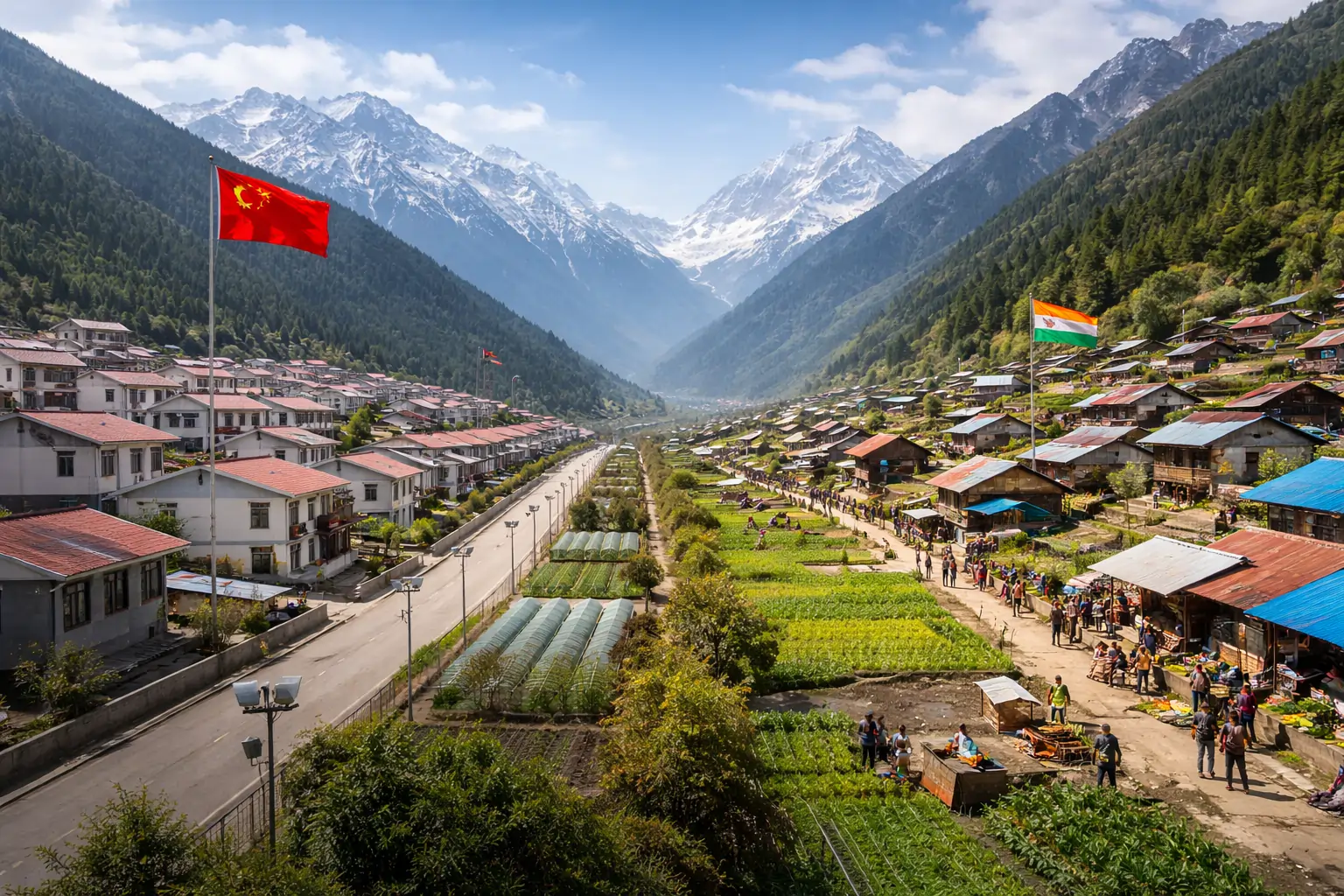
China has methodically developed hundreds of strategically located villages along its border areas in Tibet over the past decade, some of which are near the Line of Actual Control. Such villages are not just any rural settlement but are fitted with the facilities of modern houses, roads, electricity, internet and occasionally even the dual-purpose infrastructure that can accommodate military logistics. The aim is evident, which is to have a permanent civilian force that will reinforce the territorial claims and improve the level of surveillance and quick mobilization forces.
This approach has been linked to the principle of salami slicing in which small, progressive changes can modify the status quo without creating a conflictual situation. China is in effect strengthening its hold on disputed regions by filling in the isolated regions and making them part of its administrative system. This is a critical challenge in the context of Arunachal Pradesh, especially in the border areas with a small population of the country where in the past there has been little presence of India.
Vibrant Villages Programme (VVP) in India.
India then responded with the Vibrant Villages Programme in 2023, a holistic program to make the border villages successful communities. The programme was first able to identify 662 villages on the northern border, where much attention was given to Arunachal Pradesh where 455 villages were targeted. The government has launched thousands of projects to enhance the connectivity, infrastructure and livelihoods with a budget allocation of more than 3,400 crore.
VVP has a core aim to reverse the migration process within the border regions as well as to make sure that these regions are not left unoccupied and economically inactive. The programme works towards making border-villages desirable places to reside instead of isolated post-packets by offering them better roads, telecommunications, healthcare, education and employment opportunities. At the very least, it shows that it is working somewhat, with reports of reverse migration as individuals start coming back to better villages.
Development as a Strategic Instrument.
The method of India is contrasted to that of China in its humanistic focus of development. Whereas the villages in China are perceived as state-owned strategic posts, Vibrant Villages in India are established as sustainable communities blended with the local culture and involvement. It is centered on building independent economies by tourism, agriculture and small scale industries, as well as enhancing digital connectivity and access to vital services.
This approach is indicative of a larger concept that long-term border security is not only based on military prowess but also the well-being and stability of local communities. Greater economic activity and population density in a border area is an inherent deterrent and will decrease the susceptibility of unoccupied or abandoned districts.
Challenges Facing India
Although India has ambitious vision, there are various challenges involved in ensuring the successful implementation of Vibrant Villages Programme. The rugged nature of the Arunachal Pradesh surrounded by mountains, thick forests and extreme weather conditions makes the development of infrastructure costly and time-consuming. There are still a lot of villages where the road connectivity is not reliable and the time of completing the project is often postponed because of logistic problems.
Furthermore, the regulation by bureaucrats and coordination problem between central and state officials may make the development slow. Unlike the centralized system in China, India has to achieve a balance between development, and environmental laws, local government and democracy. Although these factors guarantee accountability, they do influence the pace of implementation.
The Transforming Character of Border Competition.
The events in Arunachal Pradesh point to a paradigm shift in the border conflicts nature. It is no longer military but more civilian in nature. Communication networks, villages and roads have become strategic instruments. This is indicative of a kind of hybrid competition, in which the states employ an amalgamation of development, demography, and infrastructure to bolster their territorial claims.
The strategies of China are more about speed and scale, whereas the approach of India is more about sustainability and inclusiveness. The two strategies are similar in that they are both geared towards the same goal of consolidating control over contested spaces. But the approaches vary greatly, which influences the end results of this competition.
The Way Forward
To successfully compete with China in Arunachal Pradesh, India needs to speed up its development efforts and at the same time not compromise on quality and sustainability. To make sure that people do not leave the border areas but flourish there, it will be necessary to enhance connectivity, foster tourism, and generate economic opportunities. It is also possible to increase the level of integration of civilian and military planning to improve overall border management.
Simultaneously, geographical issues can be addressed by using technology, including satellite surveillance, electronic governance, and clean energy. Enhancing local engagement and community empowerment will increase India even more in these strategically sensitive areas.
Conclusion
The border village race between the growing border villages in China and the Vibrant Villages Programme in India is a new form of geopolitical rivalry. It is a competition not only over territory, but also over authority, presence and legitimacy. Although China is currently at a comparative advantage with regard to speed and scale, the development-oriented strategy of India is a more sustainable one as long as it is executed well.
Ultimately, however, the future of Arunachal Pradesh will not be determined by how strong its military is, but by how strong and vibrant its border communities are. With the changing face of the conflict, it is evident that the village, which was considered as a peripheral space, has taken center stage in the fight to control the strategic power.