
The current fighting in Manipur has revealed a disturbing fact that, after extensive militarisation the security of civilians is still frail and insecure. What started out as ethnic violence in May 2023 has transformed into a long term humanitarian and security crisis. The reaction of the state, focusing on using force, surveillance, and emergency laws is a crucial question: Will militarisation be able to protect civilians, or will it further weaken them?
This article suggests that militarisation is not effective in providing long term security to the civilian population in Manipur despite being effective in providing short term control. Rather, it has fuelled fear, displacement and distrust and ordinary people have had to pay the real price of the war.
Background of the Conflict
The conflict between the Meitei and Kuki-Zo groups in land rights, political representation and identity is the primary source of violence in Manipur. What began as demonstrations soon turned into rampant street fights, burning and assassinations. This quickly escalated when the communities started to mobilise in their own defence making local differences an all out war.
The location of the region is strategic close to the India Myanmar Border thus has been always sensitive to insurgency and cross-border movement. But the present crisis is a much more severe and extended disintegration of law and order, where internal and external forces contribute to instability.
Measure of Violence and Human Cost.
The war has caused a very harsh human price with an increase still in progress. Over 260 people have been killed, and over 60,000 displaced since 2023. It has seen thousands of people injured, whole neighbourhoods destroyed, thousands of houses burnt and religious buildings destroyed.
The movement has caused severe social disintegration, with communities being divided racially into ethnically segregated areas. There is a great number of families which are residing in relief camps in poor conditions not knowing when and whether they will come home. The continuation of violence up to 2026 with the latest deaths of civilians illustrates that the crisis is still not resolved, even though time and security forces have passed.
The First Response, which is Militarisation.
The Indian state has been overly dependent on militarisation in reaction to the rising violence. Military, paramilitary and police forces have been used in sensitive regions, curfew and internet blockages have become the order of the day as means of control. The workaround of extraordinary laws and the introduction of direct central rule in the form of President’s Rule is an indication that it is a transition between civilian rule and a security-based rule.
To the common people it has changed life on the day to day basis. People cannot move freely, are under constant observation, and communication with armed people is inevitable. Although these actions are meant to bring sanity, they have also led to a sense of fear and insecurity, in which the distinction between security and repression is progressively becoming thin.
Question of Accountability and AFSPA.
The use of the Armed Forces Special Powers Act up to date is one of the most disputable features in governmental response. The law gives broad powers to the security forces such as the right to make arrest without warrant and the right to use lethal force under specific conditions.
Advocates believe that this is necessary in areas hit by insurgency where traditional policing might not be effective. This discussion is not abstract in Manipur, but it determines the reality of the life of civilians who have to live in a highly militarised environment with few legal avenues.
Between the Militants and the State, there are civilians.
Among the most perilous effects of the war is the status of civilians between armed groups and government troops. On the one hand, there are militant organisations and ethnic militias, and on the other hand, there are security forces whose role is to ensure the order.
This dynamic has been enhanced by the looting of thousands of weapons out of police armouries in the early days of the conflict, which has facilitated the emergence of armed civilian groups. This has led to the effect that many villages have basically become defensive areas, with life being based on either conforming to one group or the other.
Displacement and Humanitarian Crisis
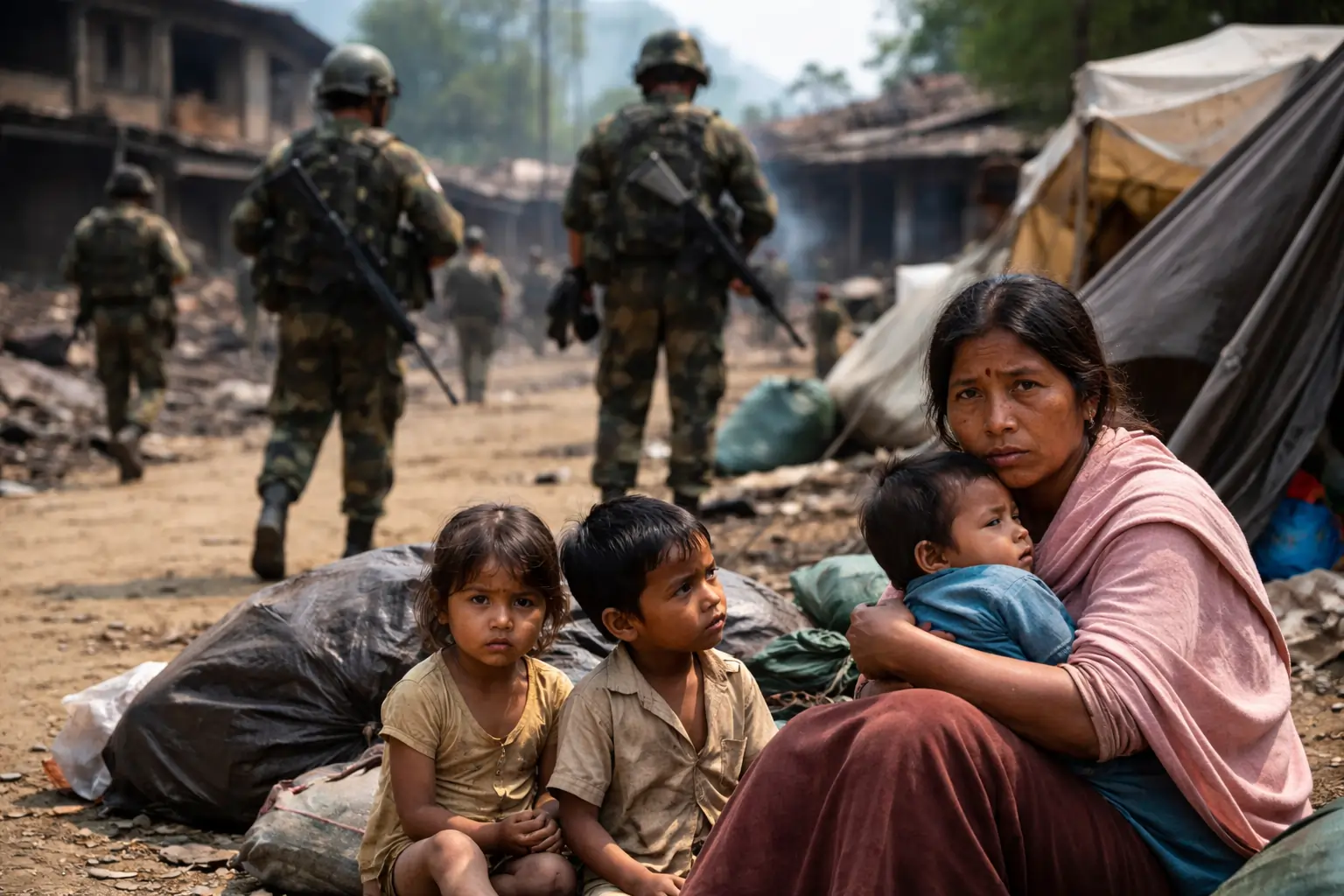
The Manipur displacement crisis is one of the largest humanitarian crises in the recent Indian history. There are tens of thousands of refugees in relief camps where they have limited access to basic needs, including healthcare, sanitation, and education.
The camps are characterized by uncertainty and suffering. Families are torn apart, livelihoods have been destroyed and education of children has been greatly affected. Though financial assistance has been declared, there is still a long-term rehabilitation and many displaced people are left in a state of limbo.
Gendered Effect of the War.
The crisis has been more disproportionately experienced by women and children. The loss of social control and the existence of armed forces have heightened the risk of gender-based violence and exploitation. Several women have lost relatives and livelihoods and ended up in precarious conditions in already hostile camp conditions.
The psychological effect is also not less important, because the trauma, fear and insecurity are involved into the normal life. Under these circumstances, militarisation does not contribute much to the particular needs and vulnerabilities of women and children, which further emphasizes its weaknesses as a holistic solution.
Dynamics and Complexity on the Border.
The fact that Manipar borders Myanmar is another complexity to the conflict. The porous border enables passage of insurgent groups, illegal weapons as well as narcotics, and also allows refugees to pass through during a time of instability.
Act East policy in India is to enhance connectivity and economic integration within the region. Nevertheless, unless there is internal stability, such efforts can be sabotaged. The fact that the local ethnic tensions intersect with the larger geopolitical processes complicates the situation in Manipur significantly, which is why any approach based on military means is unlikely to help resolve the problem.
Has Militarisation Made them safe?
The indications are that militarisation has not brought about sustainable security despite the large presence of security personnel. Violence still prevails, ethnic divisions have grown and displacement is still unresolved. The continued existence of armed groups and undermining of the trust of the people means that the strategy has been only partially successful.
Instead of solving the conflict militarisation seems to have made it steady at a certain level of tension where instead of preventing eruption of violence, it is contained. This casts grave doubt on the efficiency of a security-first strategy to respond to complicated social and political tensions.
The Way Forward
The only sustainable solution to the Manipur crisis will be a change in the paradigm of an entirely militarised strategy to a more balanced one that meets the root causes of the grievances. There is need to engage in political dialogue amongst communities, have more accountability, and create a measure to restore trust in institutions.
No less significant is the disarmament and rehabilitation required. Consolidation of efforts to recover looted weapons, break down militias and the safe re-location of displaced people should be a priority. The border management policies are also to be streamlined to respond to the security issues without offending the locals.
Conclusion
The case of Manipur reveals a key paradox: the increased number of security forces has not led to the increased safety of civilians. Rather militarisation has been accompanied by violence, displacement and fear.
In the end, the civilians are the one who suffer the most. In the middle of armed conflict and state control, they still have to reap the benefits of a crisis that does not have a definite end. Peace in Manipur will not be achieved without a change towards justice, accountability, and inclusive governance.