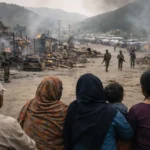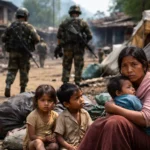

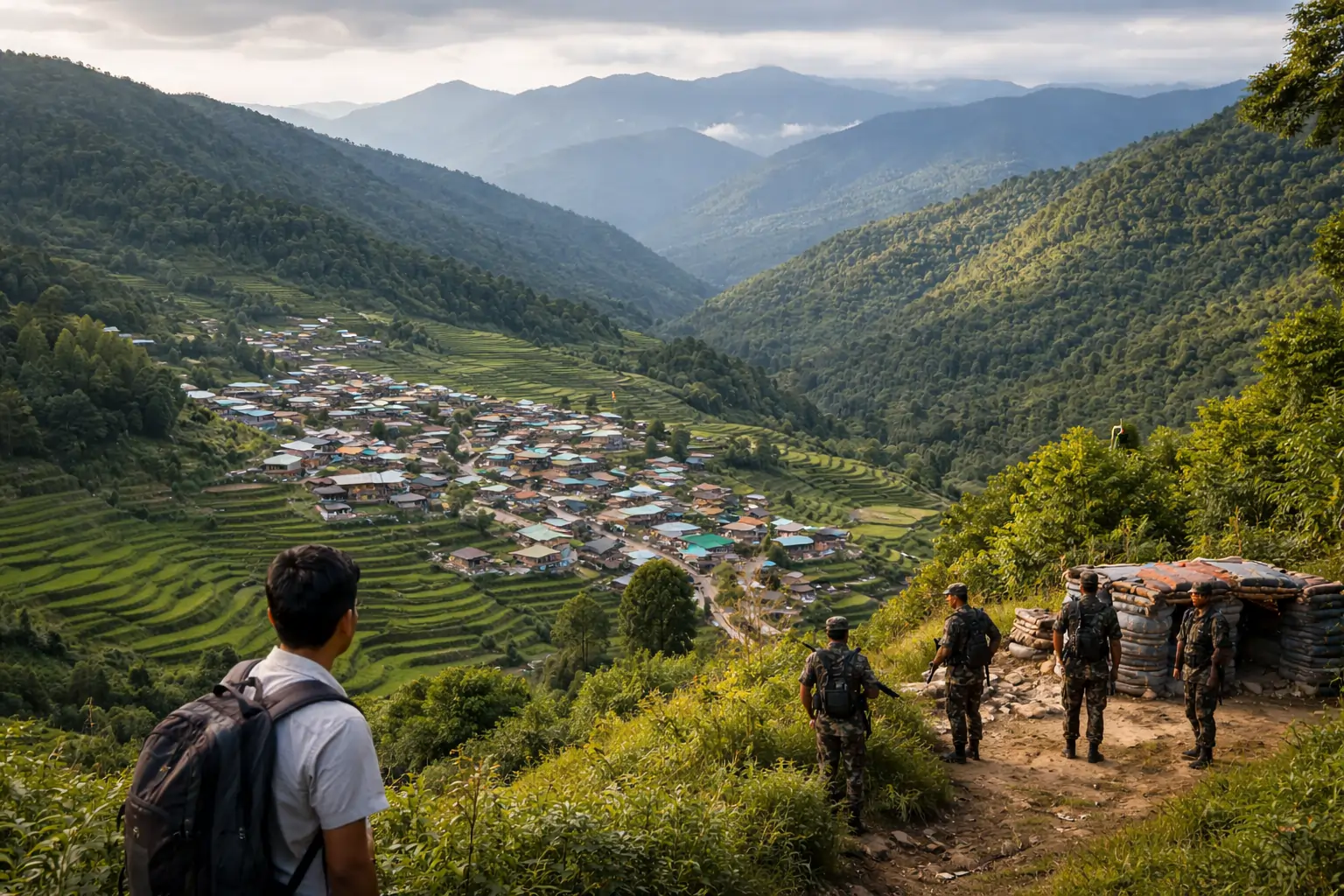
The Northeast of India, consisting of eight states such as Assam, Manipur and Nagaland, continues to be one of the most strategically significant, yet politically thorny regions of India. With decades of policy focus, financial packages, and interventions, the region still does not get out of the insurgency, underdevelopment, and governance issues.
This presents an unending and uneasy query: who should be blamed with the further instability of the Northeast- the central government or the state governments? The answer is not simple. This crisis has its roots in a blend of centralised control, the weak state capacity and structural neglect which has been decades long.
The Strategic Importance and Structural Isolation
The Northeast is strategically located in a geopolitical position with five countries as neighbors and to mainland India by the narrow Siliguri Corridor. The region has been historically, both physically and politically isolated, despite its strategic worth.
The Northeast, with a population of more than 45 million, and a land area of approximately 4 percent of the total Indian landmass, has a huge economic and cultural potential. But challenging landscape, poor connectivity, and decades of warfare have impeded the integration with the rest of the nation.
This seclusion has influenced the nature of governance, with the Centre frequently prevailing in decision making, leaving states with little freedom in dealing with local matters.
Economic Development: Growth with Disparities.
There has been some economic improvement in the Northeast, but there is still a high level of disparity. To take an example, the Gross State Domestic Product (GSDP) of Assam has been estimated at about 7.4 lakh crore with much smaller economies in smaller states such as Mizoram and Nagaland.
The income per capita is also diverse. States such as Sikkim are doing quite well with relatively high per capita income, whereas other states are underdeveloped, thus uneven development in the region.
Meanwhile, more than 70 percent of the population relies on agriculture, which is usually subsistence-based, curbing the industrial growth and the number of jobs. Although the Centre has declared significant investments, e.g. ₹80,000 crore investments announced at the 2025 Northeast Investors Summit, there are questions regarding the efficiency in implementation, and whether the investments are being translated to real benefits to local populations.
The Security and Insurgency: A Common Failure.
One of the most critical issues in the Northeast is security. Government statistics indicate that the insurgency-related violence has reduced dramatically since 2014, with the number of incidents possibly decreasing by up to 80 percent and a considerable decrease in civilian deaths by 2022.
This story of progress, however, is not complete. The recent re-emergence of violence in Manipur since 2023 underscores the precariousness of peace. In 2025, alone, 46 instances of insurgency against civilians were reported, including deaths, injuries, and kidnappings.
Security policy is controlled by the Centre by use of legislation such as AFSPA and armed forces deployment whereas the local enforcement of laws is done by states. This two-tier system tends to create coordination, response and accountability confusion.The end effect is a vicious circle wherein the Centre accuses state inefficiency and the states accuse the central control and inflexibility.
Governance and Political Accountability.
The unbalanced power relations between the states and the Centre is one of the fundamental problems of the Northeast. Major policy decisions, finances, and security are controlled by the central government via the ministry of Development of North Eastern Region (MDoNER).
Although this centralised strategy provides uniformity, it does not always take into consideration local realities. The policies being formulated in New Delhi might not completely consider the ethnic diversity, cultural sensitivities and ground level challenges.
Contrastingly, state governments have often been blamed as poor administrators, corrupt and ineffective in administration. The allocation of funds towards development is frequently not used effectively or efficiently, thus restricting its effectiveness. This results in a governance vacuum in which neither of these two levels of government has provided fully and citizens are left to be poorly served and lacking in stability.
Infrastructure and Networking Problems.
One of the greatest bottlenecks in the Northeast is infrastructure. Even though there has been an improvement in past years like the growth of the number of airports to 17 in 2025 (as opposed to 9 in 2013) and the extension of national highways, the connections gaps still exist.
Lack of proper road network, rail connectivity, and insufficient digital infrastructure has curtailed economic growth and access to vital services.Whereas, implementation and maintenance of large infrastructure projects are carried out by state governments, the Centre funds them. Incomplete or ineffective projects are common due to delays, cost overruns and coordination problems. This once again is a collective failure as opposed to the shortcoming of one party.
Human Development: Mixed Picture.
The Northeast is a paradox in the development of humans. On the one hand, such states as Mizoram have one of the highest literacy levels in India (more than 90%).
Conversely, the area grapples with inadequate access to health care, joblessness, and absence of industrial prospects.
The imbalance between high literacy and low employment is an indicator of the lack of a robust economic system that can absorb skilled young people. This has led to migration, frustration and in some instances, insurgent groups have been recruited.
The Identity and Ethnic Politics.
The Northeast has a strength and a challenge in ethnic diversity. The conflicts over land, identity and political representation have been ongoing due to competing claims.
State governments have found it difficult to strike a balance between these conflicting interests and the central policies have not always managed to deal with the factors behind such tensions.
The recent establishment of regional platforms such as One North East can be seen as a response to increasing frustration with state and central leadership as local leaders desire more autonomy and a single voice.
The Case of Centre vs. State, Who is responsible?
The evidence indicates that, the difficulties of the Northeast cannot be blamed on either the Centre or the states. Rather, they are as a result of a systemic failure of both.The Centre has been very active in focusing on security rather than long term development, heavily depending on military solutions and centralised policies. Although this can bring some short-term stability, it fails to deal with underlying socio-economic and political problems.
Meanwhile, state governments have faced inefficiency in governance, corruption, and lack of administrative capacity. They have also not been effective in their resource utilisation and localised policies in most instances.This overlap failure has resulted into a cycle of underdevelopment and instability which is still experienced in the region.
The Way Forward
It is necessary to change the way governance is done in order to break this cycle. The Centre should cease having a strictly top-down approach and give more autonomy and flexibility to state governments. The policies must be more participatory, inclusive and sensitive to the localities.
Simultaneously, the state governments have to enhance their administrative capacity, enhance transparency, and implement development programs effectively.
There is a need to have increased coordination between the Centre and states and especially in security, infrastructure and economic planning. In the absence of this, even well-financed initiatives may not work.
Conclusion
The problems of Northeast India are complex and multifaceted. Although the Centre and state governments have tried to deal with these concerns, they have not done so in a comprehensive and adequate manner.
Finally, it is not a question of who is failing the Northeast, but whether governance can be reimagined in a way that would do better in the region. Until there is real cooperation, responsibility and a sense of long-term improvement, the Northeast will be stuck between competing priorities- paying the price of failures on both levels of power.