

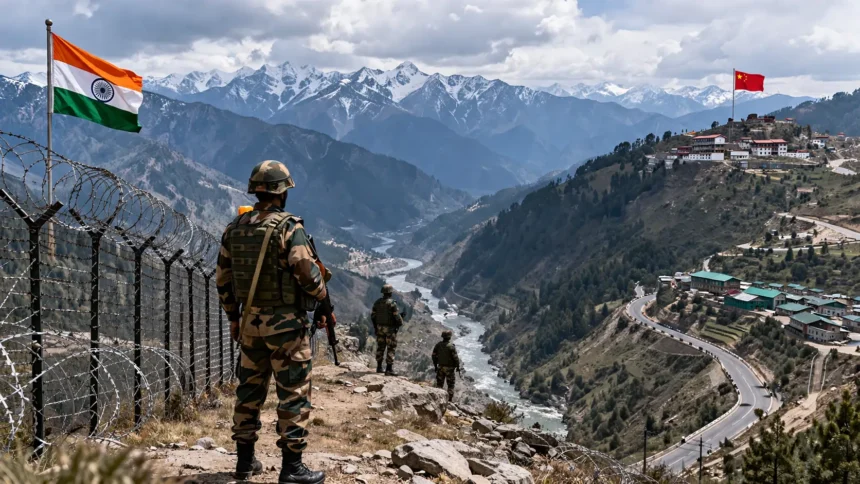
Situated in the eastern part of the India-China border, Arunachal Pradesh has, in fact, through its circumstances and events, revealed itself to be the focus of one of the most volatile geopolitical flashpoints in entire Asia. The region has been contested for long, but the recent incidents – from China’s territorial claims to construction of infrastructure – basically refer to an escalation of strategic anxiety. But underneath this changing security problem, there’s a fundamental question: has the BJP government dealt with this borderland effectively or have they, under the mask of robust nationalism, let the matters get worse?
A Disputed Frontier with Deep Historical Roots
The dispute over Arunachal Pradesh traces back to colonial times and the Simla Convention, which established the McMahon Line as the border between British India and Tibet. However, China has consistently denied the validity of this agreement and continues to regard Arunachal Pradesh as “South Tibet” or “Zangnan.” (Al Jazeera)
One of the avenues through which Beijing has demonstrated its sovereignty in a more symbolic manner is renaming places. Considering the timeframe 2017-2024, China has, in several rounds, officially changed the names of over 60 locations in Arunachal Pradesh; this is generally regarded as a type of map-based aggression. . (Indian Council of World Affairs) The constant repetition of such actions is indicative of a long-term strategy to internationally normalize its claims.
Military Imbalance and Infrastructure Gap
India’s strategic concern originates from a deep military imbalance. China’s defense budget, which is believed to be more than $240 billion, is great than India’s, giving China the capability to quickly modernize and gain logistical dominance along the border. (Taylor & Francis Online)
In Arunachal Pradesh, this imbalance is quite apparent on the ground. China has built dual-use infrastructures on a large scaleroads, airstrips, and “Xiaokang” border villages which are capable of supporting both civilian settlements and military operations. What is worst, an overwhelming majority, 72%, of the villages of these along the Line of Actual Control (LAC) are in disputed positions and almost 90% are located right opposite to Arunachal Pradesh. (The Indian Express)
However, these moves are not only defensive of China;s interests but they also reveal a salami slicing strategy where little-by-little expansion is changing situations at ground level and without initiating big wars, states an international study published in The RUSI Journal which points out that even if China does not win a limited war, its fast military upgrade would put India under great pressure at the eastern frontier. (Taylor & Francis Online)
Recurring Flashpoints and Escalation Risks
China and India have had many flashpoints, the most recent one being the 2022 Tawang incident when armed forces clashed face to face. (Forbes India) But what worries the most is China’s ongoing process of mind games and diplomatic warfare. For instance, in 2026 Beijing once more changed the names of some places in Arunachal Pradesh to which India responded by calling these name changes “mischievous, ” yet they go on to show China’s unyielding claims. Besides that, Reuters reported that almost 3,800 km of the India-China border is still unmarked, so these types of conflicts really have become a part of the situation by their very nature rather than being just the result of some particular events. (Reuters)
BJP’s Narrative vs Ground Reality
The BJP government has consistently portrayed itself as a staunch nationalist, advocating for the nation’s territorial integrity and a ready military at all times. What however is unfolding on the ground is a very different story. A loud talk notwithstanding, China’s aggressive attitude has escalated in fact since 2014. The ongoing renaming of places, the enlargement of border villages, and further border trespasses indicate that India’s deterrence measures have not been effective enough.
Concentrating on superficial things only, like orchestrating big visiting programs or unveiling infrastructures in a very theatrical way, has resulted in ignoring the government deep-rooted problems such as delays in logistics, lack of proper border connectivity, and sluggish military modernization. Besides, diplomatic effort has yielded very little results. Contrary to the times when confidence building measures had a positive effect on stabilizing the border, at present the level of trust between the two countries is very low with border skirmishes occurring quite frequently. Also, not having the border properly demarcated adds to the worsening of the situation.
Strategic Vulnerabilities Beyond the Battlefield
Arunachal Pradesh is not just a military border; it is also a major geopolitical landmark. Because of its proximity to China, Myanmar, and Bhutan, it is very crucial to India’s Act East policy and regional connectivity. (Indian Council of World Affairs) However, the location of this area near the highly vulnerable Siliguri Corridor – the narrow “Chicken’s Neck” that connects the rest of India to the Northeast – brings an added risk factor. Any conflict in Arunachal Pradesh may lead to problems for the territorial integrity of India. Moreover, China’s parallel strategy of developing infrastructure in Tibet, such as dams and transport networks, further exacerbates the situation by causing environmental and hydrological hazards to the downstream areas.
Conclusion: A Gathering Storm
Arunachal Pradesh epitomizes the shifting dynamics of Asian geopolitics at large, where territorial disputes are increasingly shaped by the factors of infrastructure, population, and the battle of perceptions. China is methodically and meticulously combining military buildup with the use of symbolic parallels, with the result that the aegis of India’s eastern border is constantly being weakened. For India under the BJP administration, the main headache is how to effectively convert their talk into actual strategic successes. Apart from gearing up for war, they will also need to have mastered diplomacy, made friends in the neighborhood, and rapidly develop their infrastructure. If they do not take such an all-round path, the story of power could turn out to be just a facade while the actual situation on the ground will be changing slowly but surely to China’s advantage. Ultimately, Arunachal Pradesh is not only near to China but it represents the frontline of India’s strategic standing.