
In the northeastern Indian state of Assam, an increasing number of Muslim people say that the police forcibly bring them to the border of Bangladesh in order to crack down on the allegation of “foreign nationals”. Most complain that they were treated as outsiders in the very country where they have lived for several generations. Continuing along this line is Ufa Ali 67 a bicycle mechanic by profession, recently comes back to his place of origin after being stuck for several days on the other side of the border. He vehemently denies ever seeing Bangladesh prior to this incident. His story unfolds when the police arrested him from his village in Morigaon district while conducting a verification drive of persons suspected of being without proper documents.
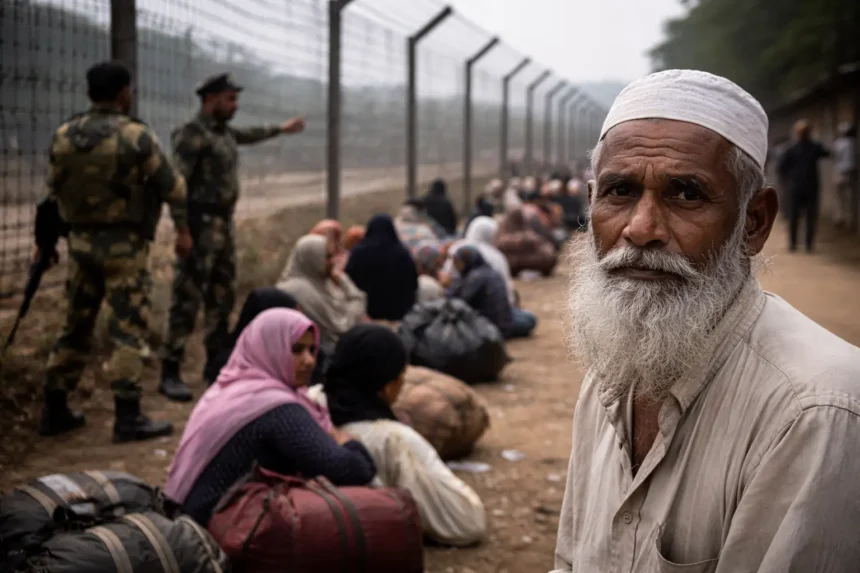
After being held in detention, Ali was brought to a big detention center in Goalpara district. A few days later, he and the other individuals among them women were taken by border forces to the India-Bangladesh border and allegedly forced to cross over. Without any security for living and food these people were denied by Bangladesh labelling them as Indians.
Many said that they were threatened and even shot with rubber bullets when they opposed the crossing over. A number of them said that the ordeal was a nightmare as they were stuck in a no-man’s land where neither country was willing to accept them. While a few were eventually allowed to return after the intervention of the Bangladeshi officials, some of them came back on their own.
The Role of Indian Government
According to Chief Minister of Assam, Himanta Biswa Sarma, “pushing back” people into Bangladesh may probably continue for some more time as a process. He claimed that several hundred people have already been forcibly returned. The government launched the action after a violent incident causing 45 deaths in Kashmir in 2025.
The attack was followed by imposition of anti-Muslim sentiments in some areas of India.
Opponents say the officials are using security as an excuse to carry out a systematic targeting of Muslim communities, especially Bengali-speaking ones who even if legally recognized as citizens, are always treated as migrants.
Assam- A region with a history of citizenship disputes.
The people of Assam especially those belonging to Bengali origin have been facing psychological as well as physical torture for a long time. The citizenship disputes is as old as their birth which has been worsen by the formulation of special foreigners tribunals by Indian government
But these tribunals have come under heavy criticisms for their discrepancies and alleged prejudices. Even those who are recorded in official documents such as the National Register of Citizens (NRC) are said to have been declared foreigners for very small discrepancies in the paperwork. Some of those held in custody reveal that they do not have the money to challenge this kind of decision before the higher courts.
Lives Of The Affected
Several affected people who insist that they are Indian citizens. Some have the law on their side, while others have official proof of their citizenship. In spite of these, they claim that they were or removed or pushed to the border with no legal way. In many cases, a family found out about what happened to their members only after watching the circulated videos of their relatives stuck at the border. Some, on the other hand, have no idea where their relatives are as they are still missing. The psychological impact has been great. This gives a sense of belonging to no place in the world. Many of them felt like they have been treated less than what we call a basic human values.
Deportation Drives Spreading Like Wildfire Beyond Assam:
There are many reports indicating that such type of actions are now going on in other BJP-ruled states as well. For example, in Gujarat and Maharashtra, the police have arrested people who were suspected of being illegal immigrants and, at times, they have been sent towards the Bangladesh border. But, on the other hand, intervention of the authorities in some areas has revealed that some of the people arrested were actually Indian citizens. According to the critics, the authorities’ action is just a segment of the huge attempt of racial profiling where the deciding factors are language, religion or ethnicity.
Law and Human Rights Issues
According to lawyers, what the authorities are doing now is against the law not only in our country but also internationally. They explain that expelling or deporting a person from the country is the last resort after all other procedures and criteria have been exhausted including proper verification of the nationality of the person and the commitment of the receiving country which, in several cases, seems to have been ignored. Furthermore, human right organizations have also pounced on the government against these measures saying that the crack down on the Muslims is heavy handed. Moreover, they argue that a law like Citizenship Amendment Act which gives citizenship to non-Muslims migrants is also exclusionary to the Muslims which makes the whole thing questionable regarding fairness and equality.
A Deepening Sense of Insecurity
This issue has, for many Muslims in Assam, produced not only fear but a whole climate of insecurity and doubt. It is a fact that police rounds and arrests have become the order of the day and even more so in the parts where hostility toward migrants is very strong. Parents are afraid of their children’s abduction, and people generally live in fear of being judged foreigners even if they have been in India for generations. Several people also point out that “foreigners” is now synonym to Bengali-speaking Muslims.
Between Identity and Exclusion The developments that are happening in Assam illustrate the difficult and multifaceted relationship that exists among identity, migration, and politics. The government, on the one hand, stays that its measures are in no way against those who are legally residing in the country; on the other hand its actions are being heavily criticized as a lack of transparency and fairness. To many, the matter is a very sensitive one. These people have been completely marginalized. They have no rights to belong to a place. They have been rejected by those from where they originally belong.