
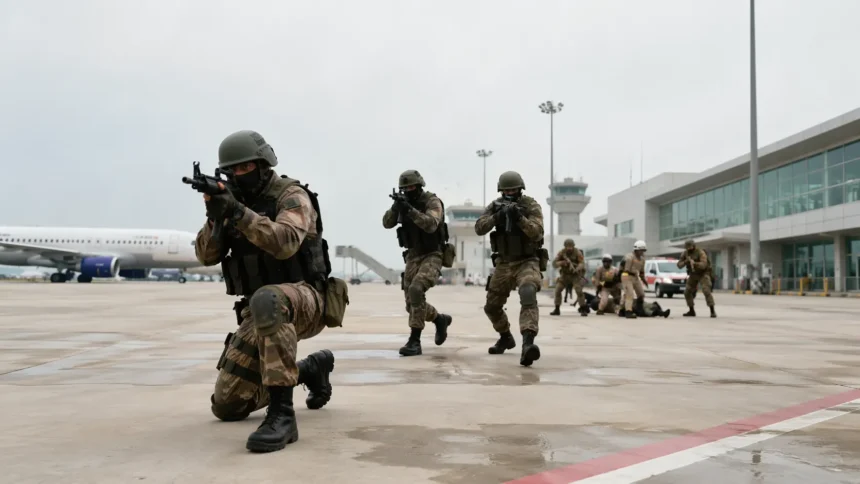
Involving various agencies the Assam Rifles spearheaded security drill at Maharaja Bir Bikram Airport, Agartala. The drill was a joint effort with the Central Industrial Security Force (CISF) and was presented as a major move towards increasing the preparedness and inter-agency coordination of the participating departments. That said, while these drills are mostly shown as the mainstay of the nation’s security, a close examination of such events may show that their real effectiveness, intentions, and openness are quite doubtful.
Security Theatre vs Real Preparedness
At first, the drill looked like it was about coordination, response systems, and readiness for the occurrence of threats. But, in reality, these are the kind of drills that critics claim to be “security theatre” – very public performances aimed more at making the audience feel safe than to actually improving the security they have. India conducts a lot of such exercises every year at airports and other critical infrastructures. However, hardly any data has been made open to the public that presents how these exercises actually result in benefits like lessened response time or better crisis management performance.
The lack of transparency and measurable outcomes
One of the main issues is the lack of transparency. On paper, they claim that coordination and operational readiness. Aviation security standards at the global level require detailed evaluations post-exercises and independent assessments. Lack of such facilities leads to questions whether the exercises are being critically evaluated or simply seen as rituals.
Institutional Overlap and Operational Redundancy
That the Assam Rifles was used together with the Central Industrial Security Force is another sign that the problem is structural. Security of airports in India is mainly the function of the CISF, which is also helped by the local police and intelligence agencies. Use of a force whose main function is counterinsurgency like the Assam Rifles may actually be a sign of institutional overlap rather than working more efficiently. On the contrary, such plans may end up not only confusing the command without lead but also lose communication in emergency, which are critical times for clarity and speed.
Changing Security Realities in Northeast India
This change should be understood in light of the overall security situation of the Northeast of India. For a long time, Tripura and some other regions have been branded as the areas with a heavy security presence because of the insurgency. However, the crime figures given by the Ministry of Home Affairs of India show that incidents of violence related to insurgency in the Northeast have gone down by more than 70 percent during the last decade. Deaths of civilians have also been drastically reduced which indicates an overall improvement in the security situation. Against this backdrop, the ongoing focus on military exercises in the civilian locales like airports seems to be out of proportion with the actual threat scenario.
Militarization of Civilian Spaces
Pointing to another very significant issue, the steady acceptance and promotion of militarization of civilian environments is kind of a problem. Airports are facilities for the public meant to enable them to move around and to be a part of the economic activities. The problem is that the increasing presence of paramilitary forces and their conducting drills of high-intensity can change the atmosphere from one of reassurance to a kind of fear. The best security in fact should be based on intelligence and should be executed in a manner that is both inconspicuous and the least intrusive. Too much of an emphasis on the visual shows of force may, in fact, end up being one of the reasons that cause the public to lose their faith rather than that of regain it.
Neglect of Civilian-Centric Preparedness
What is equally worrisome is the lack of a civilian-centric angle in these kinds of drills. Eventually, there hardly any signs that the passengers or airport employees were deeply considered or included in the context of evacuation drills or emergency awareness sessions. The new security policies have a bigger focus on human intervention steps, conceptually covering communication networks and mass movement management approaches. If the focus is only on the coordination of different departments, it is the civiliansthe most important element of any disasterthat will be forgotten.
Political Optics and Strategic Timing
Also, the very time when the military exercise was held is causing mistrust. Since it was done against the backdrop of regional political developments, such as the holding of local elections in the area, these kinds of security exhibitions may carry a message or a symbolism besides simply showing readiness for operations. In areas where politics is highly sensitive, the security personnel and their equipment that are on display to the general public become a medium through which the government conveys its capability and power instead of addressing the threats that are present.
Preparedness or Performance?
To sum up, the drill done by the Assam Rifles and the Central Industrial Security Force might be an operationally useful point but it is very hard to justify the granting of a wider importance to it. Without open doors for public scrutiny, criteria for judging the success of the drill, and adoption of up-to-date, intelligence-led security methods, the probability of such exercises simply turning into theatrical actions rather than genuine preparedness is very high. Actual security is not proven by how often the exercises are held but by how effectively the forces operate during real incidents.