
New Delhi has been celebrating loudly. The Red Corridor, that long stretch of Maoist extremism in central and eastern parts of India, which has existed since 1967, is now officially declared over. Home Minister Amit Shah gave a public deadline of March 31, 2026, and the government’s propaganda has been going full speed since then. The statistics roll out liberally: Naxal-hit districts reduced drastically from 126 in 2014 to only 11 in 2025, violent incidents shot down by 53%, and just in 2025, more than 317 Naxals being neutralized, 800 arrested, and almost 2,000 surrendering. On paper, a victory indeed. In fact, it’s more like a narrative where the state put out a fire by setting the whole house on fire.
Fifty-Seven Years of State Failure Rebranded as Victory
We need to be blunt about a matter that India’s praising writers are purposefully ignoring: the Red Corridor did not just pop up. The Maoist uprising in essence was a peasant-lord conflict in tribal areas in the late 1960s. The lack of tribal control over land and natural resources is considered the main cause of the uprising. Naxalite groups appeared in those areas without state presence where poverty was highest, no electricity, no running water, or bad healthcare. It was Indian State which controlled everything through 7 decades of deliberate neglect, it now seeks applause for cleaning up the mess it made itself.
According to South Asia Terrorism Portal, more than 12,102 people, including 4,134 civilians 2722 security force personnel, and 4,994 Naxalites, were killed in the conflict from 2000 to 2025 only. Between 1980 and 2011, Al Jazeera valued the total rise of deaths to about 10,000. What the figures depict is not merely statistics; rather, they are the total costs of a state which, for half a century, has been choosing to send paramilitary waves instead of teachers to its most deprived regions.
The Adivasi Question Nobody in Delhi Wants to Answer
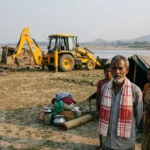
Getting rid of that victorious cry reveals an unwelcome truth: the principal victims of both the rebellion and the governmental repression were the very same people, the Adivasi tribal Lakhs of Chhattisgarh, Jharkhand, and Odisha. The Adivasis make up about 8 percent of the population in India, while they represent more than 50 percent of the 20 million people who have been displaced by mining and industrial projects since the country gained independence. It is in these very forests, where India now plants its flag of victory, that the communities have been systematically losing their land.
Though laws formally recognized the rights of Adivasi communities over their land and forests, their reality was quite different. In Chhattisgarh, the indigenous peoples continued to be subjected to land grabbing, large-scale displacement, and environmental harm on a massive scale. The pace of state-backed land grabbing by companies, which had already been going on since 2014, got a new lease of life from the enactment of a series of pro-corporate legislations that not only trampled on constitutional guarantees of self-government and tenure rights of indigenous people but further alienated them. The involvement of the government in promoting mining corporations is evident from the fact that it has signed 272 Memoranda of Understanding with mining companies in the period 2003-2018, amounting to a total investment of around $16. 5 billion. However, the government keeps maintaining that it is working for the welfare of the same Adivasis whose land is being sold out right under their noses.
A “Development” Doctrine Built on Displacement
India’s narrative presents roads, mobile towers, and bank branches in former Naxal zones as evidence of a humanitarian missionThey stress on the construction of 12,000 kilometres of roads in LWE areas, opening of 48 Industrial Training Institutes, and the deployment of nearly 38,000 banking correspondents. What the official story does not mention is the reason that the roads were being blocked, and who stands to benefit from them at present. Roads in mineral-rich tribal forests are not just for schoolchildren; they are also facilitating the passage of trucks, mining machinery and corporate capital.
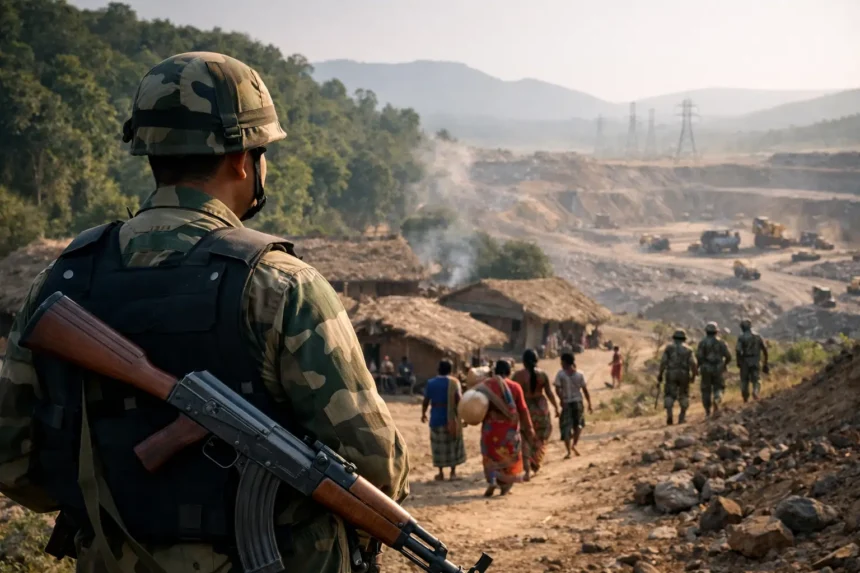
However, the most shocking and hotly debated is the proposal for a huge land grab of more than 54,000 hectares of the Abujhmad forest for the Indian Army to establish a training range. This would displace over 10,000 Adivasis. Besides endangering the tribals’ means of living and their culture, the chain of environment activists argue that this project will be the cause of a major ecological zone’s destruction. This is not development. This is dispossession marketed as nation-building.
Human Rights: The Collateral Damage India Refuses to Count
A collective statement issued by more than 50 organizations that 450 individuals have lost their lives till date of May 2024 and most of them are indigenous Adivasis. According to the activists, these killings are largely extrajudicial ones and authorities describe them as ‘encounters’ but local communities and human rights groups are of the opinion that most of the victims were unarmed civilian ones.
The government has been ordered to set up 28 security camps with 100,000 security forces in Chhattisgarh making it one of the most militarized zones in India. The National Human Rights Commission has condemned the violence by the military. As a matter of fact, a massive military operation involving more than 20,000 personnel has been launched in the Karregutta hills in 2025 which, according to media, is also one of the largest anti-Naxalite operations in Indian history. But issues of civilian deaths and damage of the forest have not been responded to by the government yet.
Structural Poverty: The Underlying Issue Which Has Not Been addressed
The states, which are the main constituents of Red Corridor namely Chhattisgarh, Jharkhand, and Odisha, have a low Human Development Index and a high percentage of poor people. These areas suffer from overpopulation and depend solely on primary sector activities such as agriculture where majority of the people do not own land.
Suppressing the Maoists militarily without fundamentally transforming land ownership patterns, caste-based discrimination, and corporate extraction means the social fuel that fed the insurgency for 57 years has not been removed, it has merely been compressed beneath a lid of security force deployments.
What Victory Actually Looks Like
India’s political establishment wants to claim a decisive win in 2026. The March 31 deadline holds significance beyond symbolism, as authorities emphasised, Naxalism was not just about violence, it was about obstructing governance. That is partially true. But governance that continues to displace indigenous communities, suppress human rights defenders, and hand mineral-rich forests to corporations is not the governance that 12 crore tribal citizens were owed.
A genuine victory would look different. It would feature land titles returned to Adivasi communities. It would feature gram sabha consent actually enforced before a single mining lease is signed. It would feature prosecutions, not just of Naxal commanders, but of security personnel credibly accused of extrajudicial killings and sexual violence in the same forests.
Until that reckoning arrives, India’s celebration of the Red Corridor’s end is, at its core, a powerful state congratulating itself for subduing the people it failed most and calling it justice.