
The Special Intensive Revision of voter lists in West Bengal is being sold as housekeeping. What it looks like, up close, is a surgical strike on democratic participation.
Electoral politics has an old saying: if you are unable to win the vote, then change the unit of vote being counted. West Bengal, which is going to have one of the most important legislative assembly elections in a generation, is actually implementing that saying. It is the voter list itself.
The Special Intensive Revision, SIR, in the clinical acronym favored by bureaucrats, was introduced by the Election Commission of India ostensibly to cleanse the rolls of ghost voters, infiltrators, and irregular entries The whole state is the fighting arena, not just one or a few constituencies. Changing the voters’ list is a regular democratic exercise. It helps clean the electoral rolls and also removes bogus and duplicate entries. However, when we look into the details of SIR, see who is being marked, and consider who benefits from the confusion that follows, it hardly resembles the exercise of good governance. Instead, it looks like very deliberate political mathematics.
1.5 Cr
Names initially flagged
60 Lac
Under active adjudication
90 Lac
Estimated deletions
The legal grey zone at the heart of SIR
Begin with the law. The Representation of the People Act does permit intensive revision of electoral rolls. What it does not do, and this is crucial, is explicitly authorize SIR in its current form. Legal scholars and opposition parties have pointed this out. The Election Commission has not provided a satisfactory explanation. When the main legal ground for a mass revision of voter list involving millions of people is still being challenged, a constitutional body should rightly stop, clarify, and hold a consultation before proceeding. Instead, the Commission pressed forward at speed.
“When voter verification becomes a de facto citizenship test, it is no longer an administrative exercise. It becomes an instrument of exclusion.”
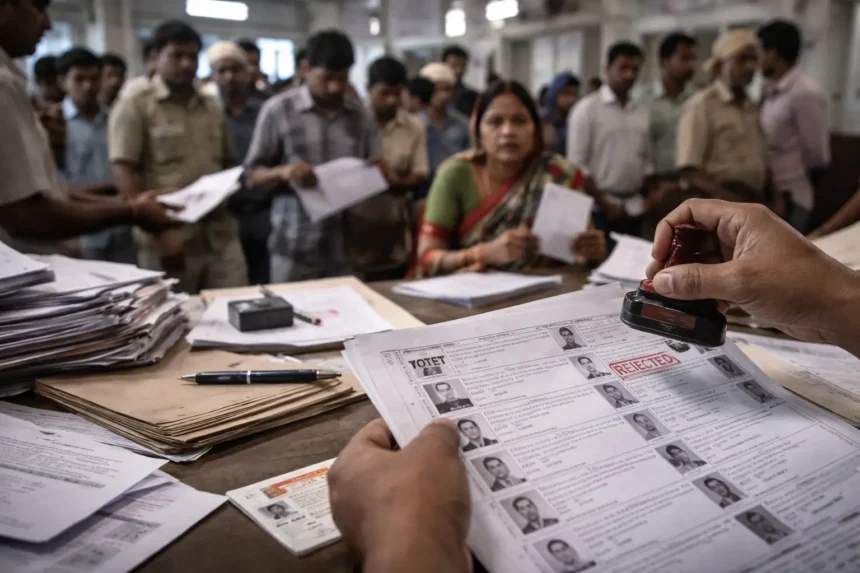
Flagging “logical discrepancies” sounds broad, like it could mean just about anything. In reality, it seems to compare current voter lists with old ones and flags those who don’t match exactly year to year. People who moved, changed names after marriage, or had inconsistent records from different offices get penalized – even if they’re real citizens. There’s no proof that the records are wrong that changes the outcome. It is a system that treats normal administrative imperfection as evidence of fraud.
When the names deleted are not anonymous
The arbitrariness of SIR became hardest to dismiss when high-profile names began appearing on the deletion lists. A former judge of the Calcutta High Court found his name struck off the rolls and was subjected to a revalidation process that would be humiliating for any citizen, let alone a retired officer of the judiciary. Nobel laureate Amartya Sen reportedly received notices. These are not obscure individuals who slipped through a database error. These are people whose credentials and citizenship are beyond question.
Their inclusion on flagged lists does one of two things: either it exposes the process as mechanically incompetent, or it reveals a net cast so wide that it must inevitably catch enormous numbers of legitimate voters along with any supposed irregularities. Neither possibility reflects well on the Commission. Both possibilities should alarm anyone who cares about electoral integrity.
The infiltrator justification that no data supports
The stated rationale for SIR is the detection and removal of illegal migrants, specifically Bangladeshi nationals and Rohingya refugees allegedly enrolled as voters. This claim, if true, would demand real action. But neither the central government nor the election Commission has released data that shows this at scale. The kind of data needed to justify changing registrations for 90 lakh names hasn’t been shared publicly. More or less, there’s no solid foundation to back the assertion.
Rhetoric has substituted for evidence. Political speeches have treated the allegation as established fact. But assertion is not proof, and a revision of this magnitude demands proof. Without it, the infiltrator narrative functions primarily as a justification for targeting Muslim voters and other communities whose demographic profile is politically inconvenient for the BJP. When voter verification becomes a de facto citizenship test, it is no longer an administrative exercise. It becomes an instrument of exclusion.
Bulk forms and the other side of the ledger
The SIR controversy has a mirror image that deserves equal scrutiny. Even as lakhs of existing voters face deletion, reports have emerged of systematic bulk submissions of Form 6, the form used to add new voters to the rolls. Tens of thousands of forms, allegedly coordinated, have been submitted in clusters across constituencies including Bhatpara, Barrackpore, and Noapara.
The rules governing Form 6 submissions exist precisely to prevent coordinated manipulation. An individual can only submit a limited number of applications. One person reportedly had 30,000 forms, a number that suggests rules were bent or broken. The Trinamool Congress asked for CCTV from the chief Electoral Officer’s office to prove what happened. That footage hasn’t come out yet.
Obviously now: a system that might erase thousands of legitimate voters is also being used to add many new ones, probably with official help or oversight failures.The direction of each operation, taken together, points toward a coherent political objective rather than neutral electoral administration.
An Election Commission that has lost its constitutional bearing
The most damaging consequence of this episode may not be what it does to the voter rolls. It may be what it does to the institution overseeing them. The Election Commission of India was designed as a buffer between the democratic process and the party in power. Its authority rests entirely on the perception of independence. That perception is now severely compromised.
The Supreme Court, when petitioned to halt the SIR rollout, declined to do so and instead directed petitioners to the Calcutta High Court. The Court acknowledged a “trust deficit” between the state government and the Commission, a phrase that is, in its own way, a significant institutional indictment. A trust deficit with the body responsible for running free and fair elections is not a minor procedural complaint. It is a statement about the health of the democratic machinery itself.
The transfer of more than 250 state officials, including the Chief Secretary, DGP, and Home Secretary, has added to the confusion. Even if each transfer might have been justifiable individually, the fact that they were so many and done at the same time, right in the middle of the election season, clearly shows who is seen as the boss of the state administration. Moreover, the news that officials from BJP-ruled states are being recruited to replace them has only increased the doubts.
What is really at stake?
Taking a broad view besides the nitty-gritty, one’s mind goes straight to the main issues. West Bengal has about 75 million registered voters. To the extent that the estimated figure of 9 million deletions is correct, then more than one out of every eight voters may be barred from voting – not because they are not eligible – but because they did not manage to figure out and complete a complicated, non-transparent, and fast-moving revalidation exercise on time.
The most affected groups – Muslims Matuas Namashudras, Rajbanshis, and Bengali Hindus from lower-income strata – are the very ones who have the least means to mobilize bureaucratic resistance on very short notice. A democracy does not demand flawless voters’ lists. What it does require is that the procedure of maintaining those lists be open to the public, clearly established by the law, uniformly executed, and protected from any sort of partisan interference.
By each of these criteria, the SIR procedure in West Bengal has not only failed but also The remaining question, which the Election Commission, the courts, and civil society must answer before the election, is whether the shortfall is due to failure of the institution or its capture.